

24.6 Gallic Acid
In Gahn’s notes from 1770, he wrote that Scheele had isolated an acid from fermented
oak apples or oak galls, outgrows on oaks formed by the larvae of gall wasps. This
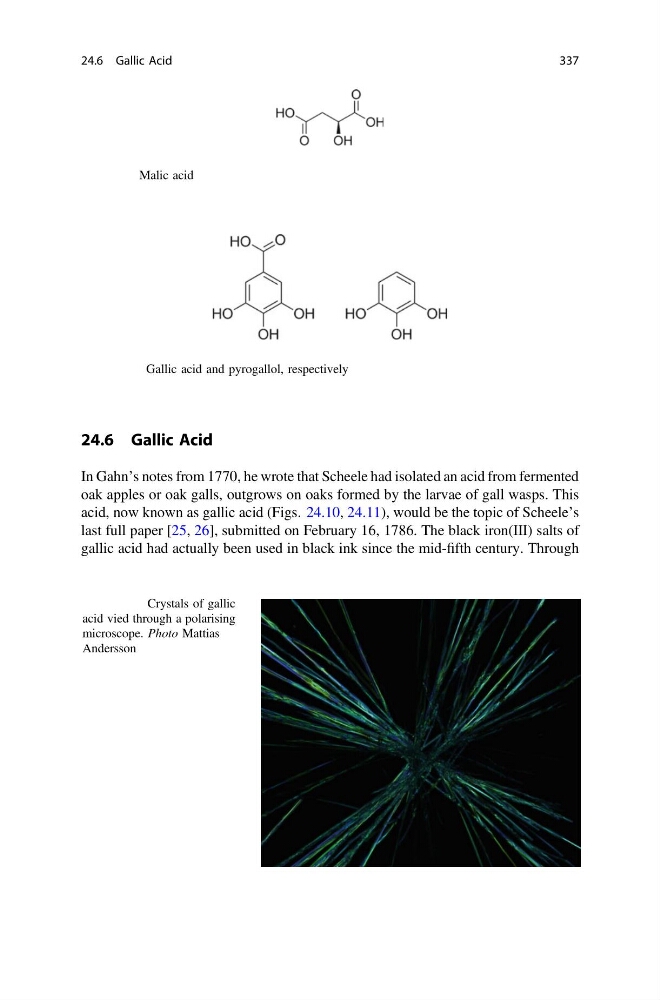
acid, now known as gallic acid (Figs. 24.10, 24.11), would be the topic of Scheele’s
last full paper [25, 26], submitted on February 16, 1786. The black iron(III) salts of
gallic acid had actually been used in black ink since the mid-fifth century. Through
Fig. 24.9 Malic acid
Fig. 24.10 Gallic acid and pyrogallol, respectively
Fig. 24.11 Crystals of gallic
acid vied through a polarising
microscope. Photo Mattias
Andersson
24.6 Gallic Acid
337
In Gahn’s notes from 1770, he wrote that Scheele had isolated an acid from fermented
oak apples or oak galls, outgrows on oaks formed by the larvae of gall wasps. This
acid, now known as gallic acid (Figs. 24.10, 24.11), would be the topic of Scheele’s
last full paper [25, 26], submitted on February 16, 1786. The black iron(III) salts of
gallic acid had actually been used in black ink since the mid-fifth century. Through
Fig. 24.9 Malic acid
Fig. 24.10 Gallic acid and pyrogallol, respectively
Fig. 24.11 Crystals of gallic
acid vied through a polarising
microscope. Photo Mattias
Andersson
24.6 Gallic Acid
337