

not write how he determined the correct amount of sulphuric acid but wrote that
146 g (11 lod) of sulphuric acid should be used for every 133 g (10 lod) of calcium
carbonate. The correct value is 130 g of pure sulphuric acid, but Scheele’s acid was
not water-free and a slightly larger amount is expected. The precipitated calcium
sulphate was filtered off, and the solution concentrated and crystallised.
24.5 Malic Acid
Scheele then studied a large number of unripe fruits and berries, and when he
analysed the juice of unripe gooseberries, he found that the juice remained acidic
after precipitating calcium citrate and concluded that gooseberries contained an
unknown acid forming a water-soluble calcium salt
3 [23]. This acid could be
precipitated as a lead salt and liberated with sulphuric acid in the same manner as
oxalic acid [24]. Scheele soon found that unripe apples contained no citric acid or
gum, and thus was a more convenient source of the new acid, which he consequently called acid of apples (now known as malic acid from Latin malum, apple;
Fig. 24.9).
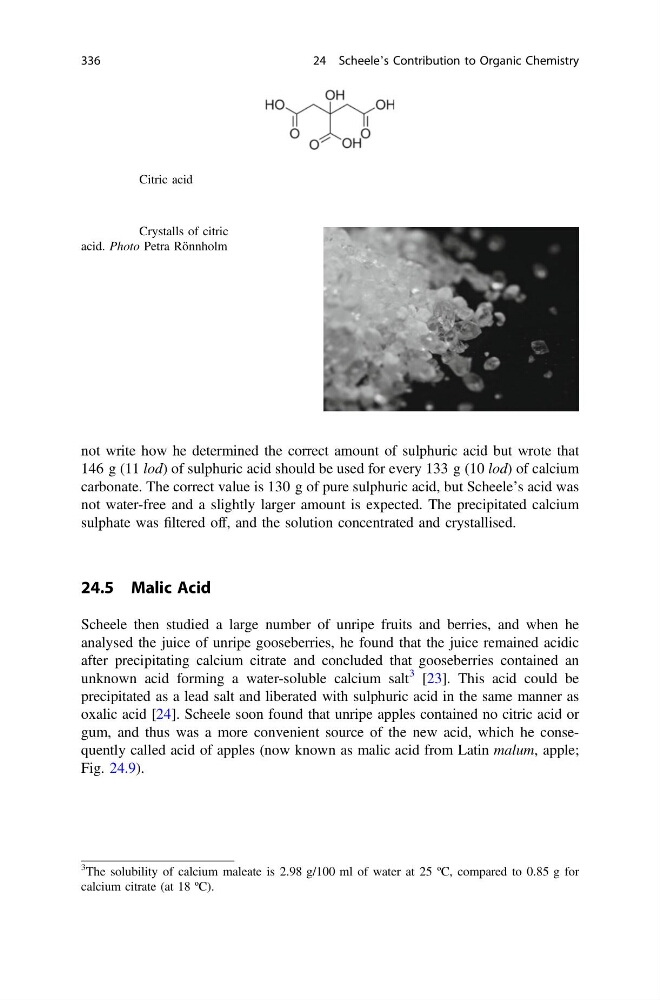
Fig. 24.7 Citric acid
Fig. 24.8 Crystalls of citric
acid. Photo Petra Rönnholm
3
The solubility of calcium maleate is 2.98 g/100 ml of water at 25 ºC, compared to 0.85 g for
calcium citrate (at 18 ºC).
336
24 Scheele’s Contribution to Organic Chemistry
146 g (11 lod) of sulphuric acid should be used for every 133 g (10 lod) of calcium
carbonate. The correct value is 130 g of pure sulphuric acid, but Scheele’s acid was
not water-free and a slightly larger amount is expected. The precipitated calcium
sulphate was filtered off, and the solution concentrated and crystallised.
24.5 Malic Acid
Scheele then studied a large number of unripe fruits and berries, and when he
analysed the juice of unripe gooseberries, he found that the juice remained acidic
after precipitating calcium citrate and concluded that gooseberries contained an
unknown acid forming a water-soluble calcium salt
3 [23]. This acid could be
precipitated as a lead salt and liberated with sulphuric acid in the same manner as
oxalic acid [24]. Scheele soon found that unripe apples contained no citric acid or
gum, and thus was a more convenient source of the new acid, which he consequently called acid of apples (now known as malic acid from Latin malum, apple;
Fig. 24.9).
Fig. 24.7 Citric acid
Fig. 24.8 Crystalls of citric
acid. Photo Petra Rönnholm
3
The solubility of calcium maleate is 2.98 g/100 ml of water at 25 ºC, compared to 0.85 g for
calcium citrate (at 18 ºC).
336
24 Scheele’s Contribution to Organic Chemistry