

muscles is optically active, while the acid in milk is racemic), and in the hands of
German chemist Johannes Wislicenus (1835–1902) lactic acid played an important
role in the investigation of the three-dimensional structure of molecules [17].
While working with milk, Scheele studied lactose and investigated whether
lactose, like common sugar, would yield oxalic acid (acid of sugar) on treatment
with nitric acid [18]. Rather than obtaining oxalic acid, Scheele obtained yet
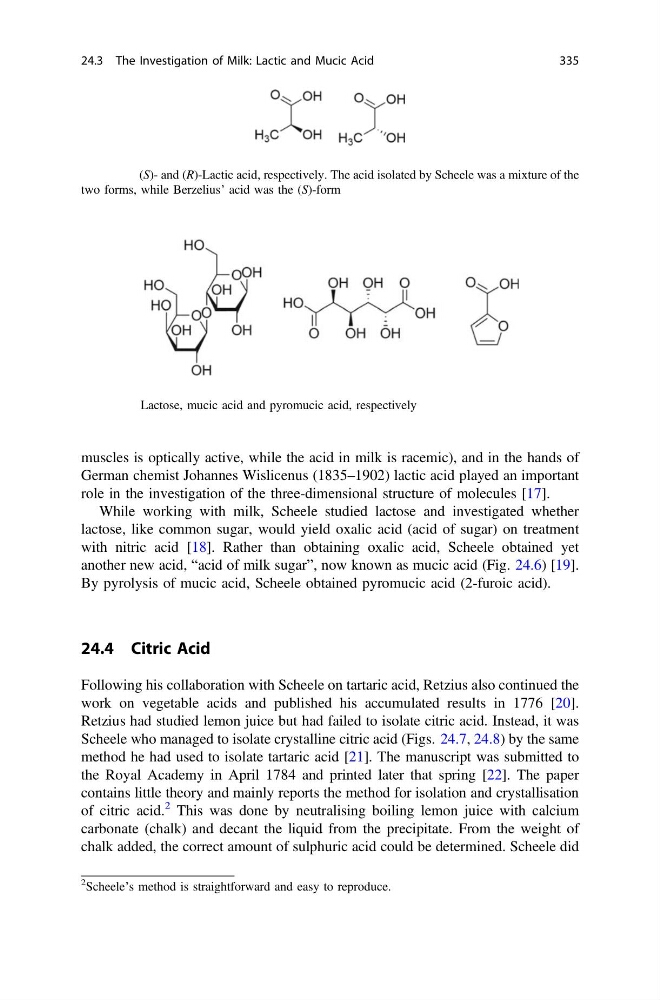
another new acid, “acid of milk sugar”, now known as mucic acid (Fig. 24.6) [19].
By pyrolysis of mucic acid, Scheele obtained pyromucic acid (2-furoic acid).
24.4 Citric Acid
Following his collaboration with Scheele on tartaric acid, Retzius also continued the
work on vegetable acids and published his accumulated results in 1776 [20].
Retzius had studied lemon juice but had failed to isolate citric acid. Instead, it was
Scheele who managed to isolate crystalline citric acid (Figs. 24.7, 24.8) by the same
method he had used to isolate tartaric acid [21]. The manuscript was submitted to
the Royal Academy in April 1784 and printed later that spring [22]. The paper
contains little theory and mainly reports the method for isolation and crystallisation
of citric acid.
2 This was done by neutralising boiling lemon juice with calcium
carbonate (chalk) and decant the liquid from the precipitate. From the weight of
chalk added, the correct amount of sulphuric acid could be determined. Scheele did
Fig. 24.5 (S)- and (R)-Lactic acid, respectively. The acid isolated by Scheele was a mixture of the
two forms, while Berzelius’ acid was the (S)-form
Fig. 24.6 Lactose, mucic acid and pyromucic acid, respectively
2
Scheele’s method is straightforward and easy to reproduce.
24.3 The Investigation of Milk: Lactic and Mucic Acid
335
German chemist Johannes Wislicenus (1835–1902) lactic acid played an important
role in the investigation of the three-dimensional structure of molecules [17].
While working with milk, Scheele studied lactose and investigated whether
lactose, like common sugar, would yield oxalic acid (acid of sugar) on treatment
with nitric acid [18]. Rather than obtaining oxalic acid, Scheele obtained yet
another new acid, “acid of milk sugar”, now known as mucic acid (Fig. 24.6) [19].
By pyrolysis of mucic acid, Scheele obtained pyromucic acid (2-furoic acid).
24.4 Citric Acid
Following his collaboration with Scheele on tartaric acid, Retzius also continued the
work on vegetable acids and published his accumulated results in 1776 [20].
Retzius had studied lemon juice but had failed to isolate citric acid. Instead, it was
Scheele who managed to isolate crystalline citric acid (Figs. 24.7, 24.8) by the same
method he had used to isolate tartaric acid [21]. The manuscript was submitted to
the Royal Academy in April 1784 and printed later that spring [22]. The paper
contains little theory and mainly reports the method for isolation and crystallisation
of citric acid.
2 This was done by neutralising boiling lemon juice with calcium
carbonate (chalk) and decant the liquid from the precipitate. From the weight of
chalk added, the correct amount of sulphuric acid could be determined. Scheele did
Fig. 24.5 (S)- and (R)-Lactic acid, respectively. The acid isolated by Scheele was a mixture of the
two forms, while Berzelius’ acid was the (S)-form
Fig. 24.6 Lactose, mucic acid and pyromucic acid, respectively
2
Scheele’s method is straightforward and easy to reproduce.
24.3 The Investigation of Milk: Lactic and Mucic Acid
335