

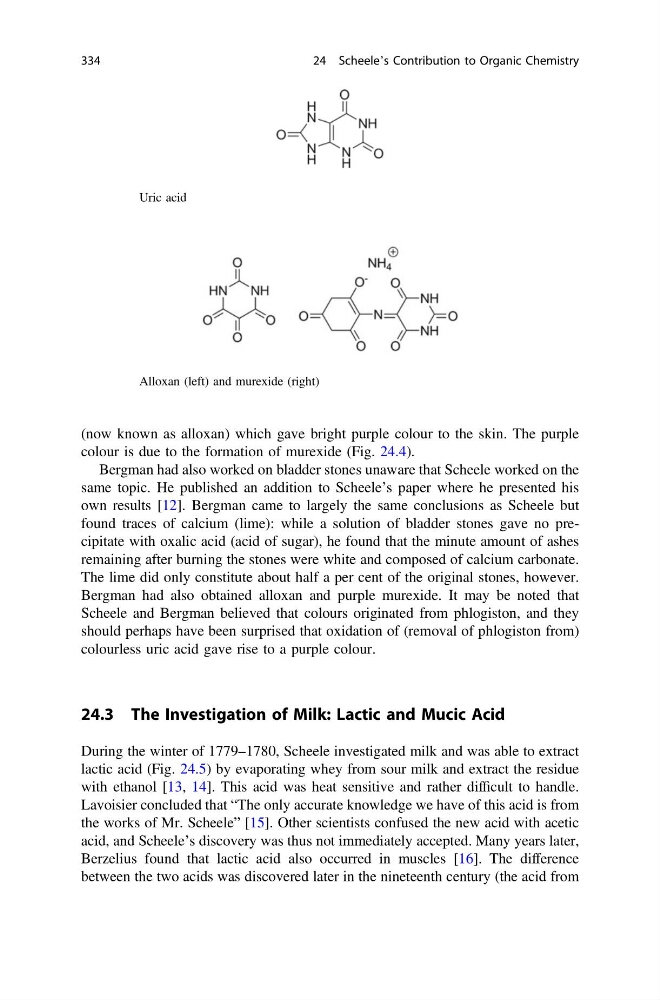
(now known as alloxan) which gave bright purple colour to the skin. The purple
colour is due to the formation of murexide (Fig. 24.4).
Bergman had also worked on bladder stones unaware that Scheele worked on the
same topic. He published an addition to Scheele’s paper where he presented his
own results [12]. Bergman came to largely the same conclusions as Scheele but
found traces of calcium (lime): while a solution of bladder stones gave no precipitate with oxalic acid (acid of sugar), he found that the minute amount of ashes
remaining after burning the stones were white and composed of calcium carbonate.
The lime did only constitute about half a per cent of the original stones, however.
Bergman had also obtained alloxan and purple murexide. It may be noted that
Scheele and Bergman believed that colours originated from phlogiston, and they
should perhaps have been surprised that oxidation of (removal of phlogiston from)
colourless uric acid gave rise to a purple colour.
24.3 The Investigation of Milk: Lactic and Mucic Acid
During the winter of 1779–1780, Scheele investigated milk and was able to extract
lactic acid (Fig. 24.5) by evaporating whey from sour milk and extract the residue
with ethanol [13, 14]. This acid was heat sensitive and rather difficult to handle.
Lavoisier concluded that “The only accurate knowledge we have of this acid is from
the works of Mr. Scheele” [15]. Other scientists confused the new acid with acetic
acid, and Scheele’s discovery was thus not immediately accepted. Many years later,
Berzelius found that lactic acid also occurred in muscles [16]. The difference
between the two acids was discovered later in the nineteenth century (the acid from
Fig. 24.3 Uric acid
Fig. 24.4 Alloxan (left) and murexide (right)
334
24 Scheele’s Contribution to Organic Chemistry
colour is due to the formation of murexide (Fig. 24.4).
Bergman had also worked on bladder stones unaware that Scheele worked on the
same topic. He published an addition to Scheele’s paper where he presented his
own results [12]. Bergman came to largely the same conclusions as Scheele but
found traces of calcium (lime): while a solution of bladder stones gave no precipitate with oxalic acid (acid of sugar), he found that the minute amount of ashes
remaining after burning the stones were white and composed of calcium carbonate.
The lime did only constitute about half a per cent of the original stones, however.
Bergman had also obtained alloxan and purple murexide. It may be noted that
Scheele and Bergman believed that colours originated from phlogiston, and they
should perhaps have been surprised that oxidation of (removal of phlogiston from)
colourless uric acid gave rise to a purple colour.
24.3 The Investigation of Milk: Lactic and Mucic Acid
During the winter of 1779–1780, Scheele investigated milk and was able to extract
lactic acid (Fig. 24.5) by evaporating whey from sour milk and extract the residue
with ethanol [13, 14]. This acid was heat sensitive and rather difficult to handle.
Lavoisier concluded that “The only accurate knowledge we have of this acid is from
the works of Mr. Scheele” [15]. Other scientists confused the new acid with acetic
acid, and Scheele’s discovery was thus not immediately accepted. Many years later,
Berzelius found that lactic acid also occurred in muscles [16]. The difference
between the two acids was discovered later in the nineteenth century (the acid from
Fig. 24.3 Uric acid
Fig. 24.4 Alloxan (left) and murexide (right)
334
24 Scheele’s Contribution to Organic Chemistry