

24.8 Esterification and Catalysis
To a modern organic chemist, an ether is a substance where two hydrocarbon groups
are connected by a single oxygen atom. In the eighteenth century, however, the word
ether referred to any flammable liquid insoluble in water. In September 1781, Scheele
attempted to reproduce Count Lauraguais’
4 synthesis of “ether” (actually the ester
ethyl acetate; Fig. 24.13) from acetic acid and ethanol, but failed. When he asked
Bergman for advice, Bergman wrote back that he had failed as well. Scheele then
repeated the experiment with the addition of mineral acid (hydrochloric or sulphuric
acid), and by doing so, he obtained ethyl acetate [31]. Scheele had discovered
acid-catalysed esterification: the reaction between ethanol and acetic acid is very
slow, unless the acetic acid is activated by a strong mineral acid. This reaction is
commonly known as Fischer-esterification, based on a paper by Nobel laureate Emil
Fischer (1852–1919) and Arthur Speir from 1895 [32], but it would be more
appropriate to call it Scheele esterification. Scheele realised the general nature of this
reaction, and was also able to prepare ethyl benzoate from ethanol and benzoic acid.
In a letter to Bergman, dated October 3, 1781, Scheele clearly stated that the
reaction between acetic acid and ethanol only takes place in the presence of mineral
acid, and he appears to be the first to clearly describe the phenomenon of catalysis,
a discovery of fundamental importance. The word catalysis was later coined by
Berzelius [33], following the discovery of heterogeneous catalysis by Davy and
Wollaston.
Scheele’s paper on different kinds of ethers [34] is of great importance in the
history of chemistry. He discussed not only the well-known diethyl ether but he also
studied chloroethane, obtained from ethanol (Spiritus vini) with hydrochloric acid
and zinc chloride (“Zinc calx dissolved in hydrochloric acid”), or ethanol and tin
(IV)- or antimony(III) chloride (Spiritus fumans Libavii and Butyrum antimonii,
respectively). This was the first compound in the important class of organic halides.
Scheele found that chloroethane gave no precipitate with silver nitrate solution, but
that a precipitate of silver chloride was obtained by igniting the mixture. Thus, the
hydrochloric acid was a component in the “ether”. From ethanol, sulphuric acid and
manganese(IV) oxide Scheele isolated the first aldehyde, acetaldehyde (CH 3 CHO).
When distilling ethanol, manganese(IV) oxide, sodium chloride and sulphuric acid,
or ethanol, manganese(IV) oxide and hydrochloric acid, he obtained both ether
(chloroethane) and an oil. This oil was 2,2,2-trichloro-1-ethoxyethanol (chloral
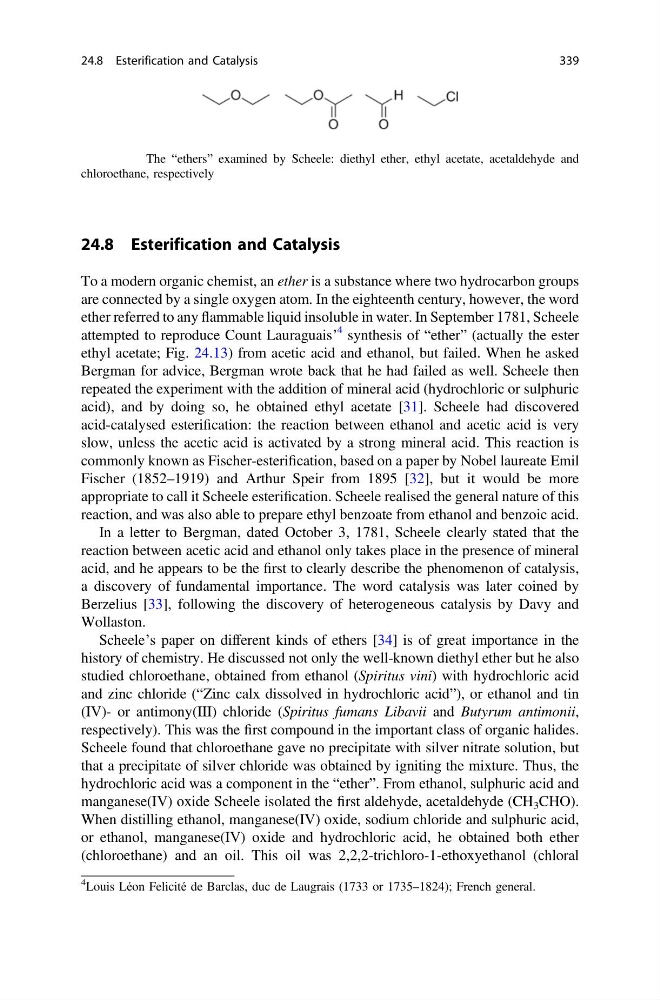
Fig. 24.13 The “ethers” examined by Scheele: diethyl ether, ethyl acetate, acetaldehyde and
chloroethane, respectively
4
Louis Léon Felicité de Barclas, duc de Laugrais (1733 or 1735–1824); French general.
24.8 Esterification and Catalysis
339
To a modern organic chemist, an ether is a substance where two hydrocarbon groups
are connected by a single oxygen atom. In the eighteenth century, however, the word
ether referred to any flammable liquid insoluble in water. In September 1781, Scheele
attempted to reproduce Count Lauraguais’
4 synthesis of “ether” (actually the ester
ethyl acetate; Fig. 24.13) from acetic acid and ethanol, but failed. When he asked
Bergman for advice, Bergman wrote back that he had failed as well. Scheele then
repeated the experiment with the addition of mineral acid (hydrochloric or sulphuric
acid), and by doing so, he obtained ethyl acetate [31]. Scheele had discovered
acid-catalysed esterification: the reaction between ethanol and acetic acid is very
slow, unless the acetic acid is activated by a strong mineral acid. This reaction is
commonly known as Fischer-esterification, based on a paper by Nobel laureate Emil
Fischer (1852–1919) and Arthur Speir from 1895 [32], but it would be more
appropriate to call it Scheele esterification. Scheele realised the general nature of this
reaction, and was also able to prepare ethyl benzoate from ethanol and benzoic acid.
In a letter to Bergman, dated October 3, 1781, Scheele clearly stated that the
reaction between acetic acid and ethanol only takes place in the presence of mineral
acid, and he appears to be the first to clearly describe the phenomenon of catalysis,
a discovery of fundamental importance. The word catalysis was later coined by
Berzelius [33], following the discovery of heterogeneous catalysis by Davy and
Wollaston.
Scheele’s paper on different kinds of ethers [34] is of great importance in the
history of chemistry. He discussed not only the well-known diethyl ether but he also
studied chloroethane, obtained from ethanol (Spiritus vini) with hydrochloric acid
and zinc chloride (“Zinc calx dissolved in hydrochloric acid”), or ethanol and tin
(IV)- or antimony(III) chloride (Spiritus fumans Libavii and Butyrum antimonii,
respectively). This was the first compound in the important class of organic halides.
Scheele found that chloroethane gave no precipitate with silver nitrate solution, but
that a precipitate of silver chloride was obtained by igniting the mixture. Thus, the
hydrochloric acid was a component in the “ether”. From ethanol, sulphuric acid and
manganese(IV) oxide Scheele isolated the first aldehyde, acetaldehyde (CH 3 CHO).
When distilling ethanol, manganese(IV) oxide, sodium chloride and sulphuric acid,
or ethanol, manganese(IV) oxide and hydrochloric acid, he obtained both ether
(chloroethane) and an oil. This oil was 2,2,2-trichloro-1-ethoxyethanol (chloral
Fig. 24.13 The “ethers” examined by Scheele: diethyl ether, ethyl acetate, acetaldehyde and
chloroethane, respectively
4
Louis Léon Felicité de Barclas, duc de Laugrais (1733 or 1735–1824); French general.
24.8 Esterification and Catalysis
339