

15.4 The Discovery of Molybdenum
The Greek word lόkmbdo1 means lead, and the word molybdæna became synonymous with galena, a soft lead ore composed of lead(II) sulphide. Over time,
however, the word molybdæna started to be used for other soft, dark minerals that
were assumed to be lead ores. This included the mineral that is now called
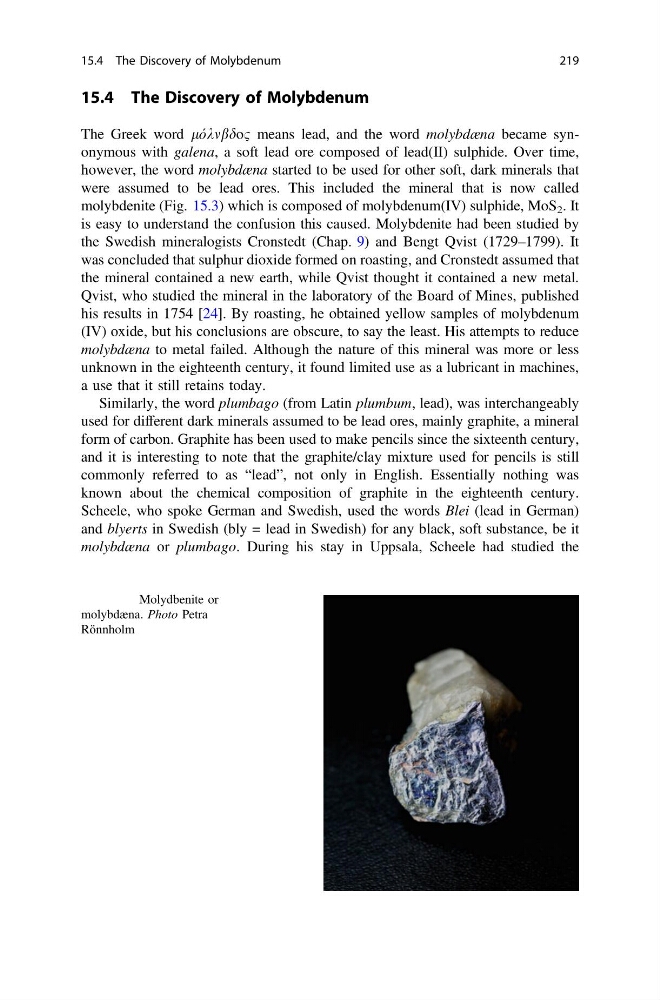
molybdenite (Fig. 15.3) which is composed of molybdenum(IV) sulphide, MoS 2 . It
is easy to understand the confusion this caused. Molybdenite had been studied by
the Swedish mineralogists Cronstedt (Chap. 9) and Bengt Qvist (1729–1799). It
was concluded that sulphur dioxide formed on roasting, and Cronstedt assumed that
the mineral contained a new earth, while Qvist thought it contained a new metal.
Qvist, who studied the mineral in the laboratory of the Board of Mines, published
his results in 1754 [24]. By roasting, he obtained yellow samples of molybdenum
(IV) oxide, but his conclusions are obscure, to say the least. His attempts to reduce
molybdæna to metal failed. Although the nature of this mineral was more or less
unknown in the eighteenth century, it found limited use as a lubricant in machines,
a use that it still retains today.
Similarly, the word plumbago (from Latin plumbum, lead), was interchangeably
used for different dark minerals assumed to be lead ores, mainly graphite, a mineral
form of carbon. Graphite has been used to make pencils since the sixteenth century,
and it is interesting to note that the graphite/clay mixture used for pencils is still
commonly referred to as “lead”, not only in English. Essentially nothing was
known about the chemical composition of graphite in the eighteenth century.
Scheele, who spoke German and Swedish, used the words Blei (lead in German)
and blyerts in Swedish (bly = lead in Swedish) for any black, soft substance, be it
molybdæna or plumbago. During his stay in Uppsala, Scheele had studied the
Fig. 15.3 Molydbenite or
molybdæna. Photo Petra
Rönnholm
15.4 The Discovery of Molybdenum
219
The Greek word lόkmbdo1 means lead, and the word molybdæna became synonymous with galena, a soft lead ore composed of lead(II) sulphide. Over time,
however, the word molybdæna started to be used for other soft, dark minerals that
were assumed to be lead ores. This included the mineral that is now called
molybdenite (Fig. 15.3) which is composed of molybdenum(IV) sulphide, MoS 2 . It
is easy to understand the confusion this caused. Molybdenite had been studied by
the Swedish mineralogists Cronstedt (Chap. 9) and Bengt Qvist (1729–1799). It
was concluded that sulphur dioxide formed on roasting, and Cronstedt assumed that
the mineral contained a new earth, while Qvist thought it contained a new metal.
Qvist, who studied the mineral in the laboratory of the Board of Mines, published
his results in 1754 [24]. By roasting, he obtained yellow samples of molybdenum
(IV) oxide, but his conclusions are obscure, to say the least. His attempts to reduce
molybdæna to metal failed. Although the nature of this mineral was more or less
unknown in the eighteenth century, it found limited use as a lubricant in machines,
a use that it still retains today.
Similarly, the word plumbago (from Latin plumbum, lead), was interchangeably
used for different dark minerals assumed to be lead ores, mainly graphite, a mineral
form of carbon. Graphite has been used to make pencils since the sixteenth century,
and it is interesting to note that the graphite/clay mixture used for pencils is still
commonly referred to as “lead”, not only in English. Essentially nothing was
known about the chemical composition of graphite in the eighteenth century.
Scheele, who spoke German and Swedish, used the words Blei (lead in German)
and blyerts in Swedish (bly = lead in Swedish) for any black, soft substance, be it
molybdæna or plumbago. During his stay in Uppsala, Scheele had studied the
Fig. 15.3 Molydbenite or
molybdæna. Photo Petra
Rönnholm
15.4 The Discovery of Molybdenum
219