

my part I have to admit, that several circumstances appear to speak strongly for its
metallic nature”, Bergman wrote [7]. Among the evidence was the fact that
manganese salts gave a precipitate with potassium hexacyanoferrate. Bergman
thought that Magnesia nigra could be either an oxide (calx) of a previously
unknown metal or, possibly, the oxide of platinum, as platinum oxide was
unknown. He wrote that experiments were on-going, and by the time the paper was
published in the summer of 1774, Gahn had already managed to reduce pyrolusite
with charcoal to metallic manganese (Fig. 15.2). Bergman later wrote that Gahn
worked unaware of his ideas [19]. Gahn told Scheele of the new metal in a letter
written in May, and Scheele could verify the results by investigating samples sent to
him by Gahn. He showed that manganese dissolve in sulphuric acid with evolution
of hydrogen, and thus was a base metal, and summarised his experiments in a letter
to Gahn dated June 27. Scheele lacked metallurgical training and working in a
pharmacy laboratory he did not have access to a furnace hot enough to perform the
reduction. Although MnO 2 is easily reduced to MnO, the last step, reduction to
manganese metal, requires at least 1,400 °C [20]. Bergman had a better equipped
laboratory and could confirm Gahn’s results in his own laboratory, and called the
new metal magnesium [19]. Gahn began writing up a paper for the Transactions of
the Royal Swedish Academy of Sciences, but when Bergman asked him in August
1775, Gahn replied that he had not had time to finish the paper, and that additional
experiments would have been required [21]. Thus, as usual, Gahn did not publish
his results, and the news of the metal were spread by Bergman [19]. Hjelm also
studied manganese, refined the reduction process and published a detailed account
in 1785 [22]. He also studied manganese alloys (which are extremely important in
modern metallurgy) and found traces of manganese in many iron ores [23].
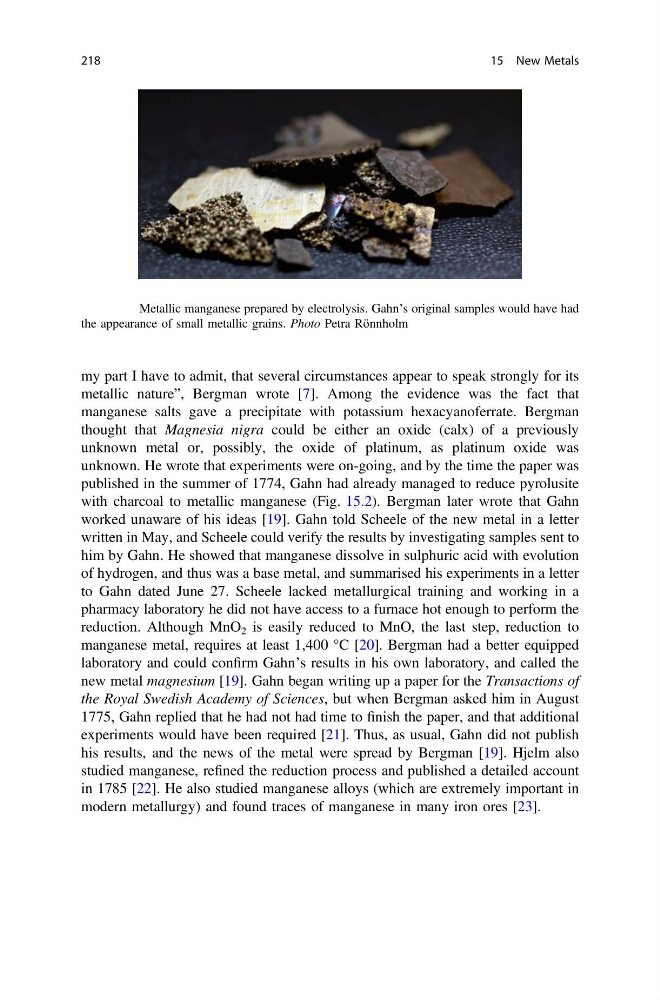
Fig. 15.2 Metallic manganese prepared by electrolysis. Gahn’s original samples would have had
the appearance of small metallic grains. Photo Petra Rönnholm
218
15 New Metals
metallic nature”, Bergman wrote [7]. Among the evidence was the fact that
manganese salts gave a precipitate with potassium hexacyanoferrate. Bergman
thought that Magnesia nigra could be either an oxide (calx) of a previously
unknown metal or, possibly, the oxide of platinum, as platinum oxide was
unknown. He wrote that experiments were on-going, and by the time the paper was
published in the summer of 1774, Gahn had already managed to reduce pyrolusite
with charcoal to metallic manganese (Fig. 15.2). Bergman later wrote that Gahn
worked unaware of his ideas [19]. Gahn told Scheele of the new metal in a letter
written in May, and Scheele could verify the results by investigating samples sent to
him by Gahn. He showed that manganese dissolve in sulphuric acid with evolution
of hydrogen, and thus was a base metal, and summarised his experiments in a letter
to Gahn dated June 27. Scheele lacked metallurgical training and working in a
pharmacy laboratory he did not have access to a furnace hot enough to perform the
reduction. Although MnO 2 is easily reduced to MnO, the last step, reduction to
manganese metal, requires at least 1,400 °C [20]. Bergman had a better equipped
laboratory and could confirm Gahn’s results in his own laboratory, and called the
new metal magnesium [19]. Gahn began writing up a paper for the Transactions of
the Royal Swedish Academy of Sciences, but when Bergman asked him in August
1775, Gahn replied that he had not had time to finish the paper, and that additional
experiments would have been required [21]. Thus, as usual, Gahn did not publish
his results, and the news of the metal were spread by Bergman [19]. Hjelm also
studied manganese, refined the reduction process and published a detailed account
in 1785 [22]. He also studied manganese alloys (which are extremely important in
modern metallurgy) and found traces of manganese in many iron ores [23].
Fig. 15.2 Metallic manganese prepared by electrolysis. Gahn’s original samples would have had
the appearance of small metallic grains. Photo Petra Rönnholm
218
15 New Metals