

blyerts he sold at the Arms of Upland pharmacy. This material was plumbago, i.e.
graphite. In 1776, after moving to Köping, he met with Andreas Hofgaard (1748–
1811; a Norwegian mineralogist, official at Kongsberg and an acquaintance of
Bergman) [25]. Hofgaard presented Scheele with a small sample of molybdæna.
This material was superficially similar to the plumbago he had studied, but
chemically it was very different. Unfortunately, he had an insufficient amount to
perform any thorough chemical investigation. In a letter to Gahn, dated February 9,
1777, Scheele asked his friend to send a sample of molybdæna, but as far as we
know he never got any sample from Gahn. Scheele then turned to Bergman,
Rinman and Hermelin, and by spring 1778 he finally had enough material for his
study [26].
Scheele found that molybdæna was scarcely soluble in acids, hot nitric acid and
hot arsenic acid being the exceptions [27]. Hot nitric acid gave a white powder,
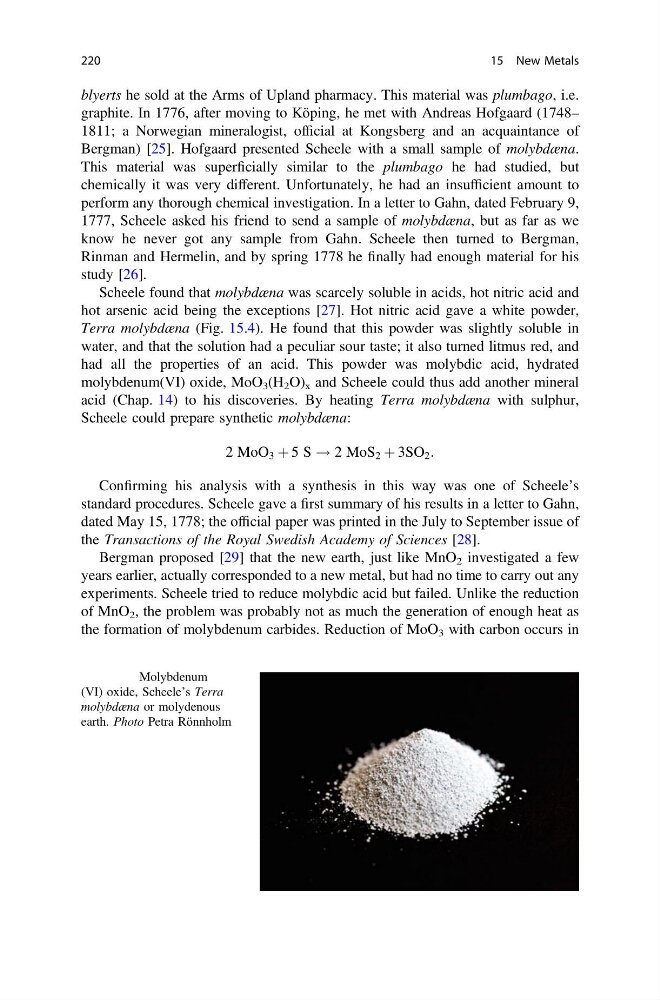
Terra molybdæna (Fig. 15.4). He found that this powder was slightly soluble in
water, and that the solution had a peculiar sour taste; it also turned litmus red, and
had all the properties of an acid. This powder was molybdic acid, hydrated
molybdenum(VI) oxide, MoO 3 (H 2 O) x and Scheele could thus add another mineral
acid (Chap. 14) to his discoveries. By heating Terra molybdæna with sulphur,
Scheele could prepare synthetic molybdæna:
2 MoO 3 þ 5 S ! 2 MoS 2 þ 3SO 2 :
Confirming his analysis with a synthesis in this way was one of Scheele’s
standard procedures. Scheele gave a first summary of his results in a letter to Gahn,
dated May 15, 1778; the official paper was printed in the July to September issue of
the Transactions of the Royal Swedish Academy of Sciences [28].
Bergman proposed [29] that the new earth, just like MnO 2 investigated a few
years earlier, actually corresponded to a new metal, but had no time to carry out any
experiments. Scheele tried to reduce molybdic acid but failed. Unlike the reduction
of MnO 2 , the problem was probably not as much the generation of enough heat as
the formation of molybdenum carbides. Reduction of MoO 3 with carbon occurs in
Fig. 15.4 Molybdenum
(VI) oxide, Scheele’s Terra
molybdæna or molydenous
earth. Photo Petra Rönnholm
220
15 New Metals
graphite. In 1776, after moving to Köping, he met with Andreas Hofgaard (1748–
1811; a Norwegian mineralogist, official at Kongsberg and an acquaintance of
Bergman) [25]. Hofgaard presented Scheele with a small sample of molybdæna.
This material was superficially similar to the plumbago he had studied, but
chemically it was very different. Unfortunately, he had an insufficient amount to
perform any thorough chemical investigation. In a letter to Gahn, dated February 9,
1777, Scheele asked his friend to send a sample of molybdæna, but as far as we
know he never got any sample from Gahn. Scheele then turned to Bergman,
Rinman and Hermelin, and by spring 1778 he finally had enough material for his
study [26].
Scheele found that molybdæna was scarcely soluble in acids, hot nitric acid and
hot arsenic acid being the exceptions [27]. Hot nitric acid gave a white powder,
Terra molybdæna (Fig. 15.4). He found that this powder was slightly soluble in
water, and that the solution had a peculiar sour taste; it also turned litmus red, and
had all the properties of an acid. This powder was molybdic acid, hydrated
molybdenum(VI) oxide, MoO 3 (H 2 O) x and Scheele could thus add another mineral
acid (Chap. 14) to his discoveries. By heating Terra molybdæna with sulphur,
Scheele could prepare synthetic molybdæna:
2 MoO 3 þ 5 S ! 2 MoS 2 þ 3SO 2 :
Confirming his analysis with a synthesis in this way was one of Scheele’s
standard procedures. Scheele gave a first summary of his results in a letter to Gahn,
dated May 15, 1778; the official paper was printed in the July to September issue of
the Transactions of the Royal Swedish Academy of Sciences [28].
Bergman proposed [29] that the new earth, just like MnO 2 investigated a few
years earlier, actually corresponded to a new metal, but had no time to carry out any
experiments. Scheele tried to reduce molybdic acid but failed. Unlike the reduction
of MnO 2 , the problem was probably not as much the generation of enough heat as
the formation of molybdenum carbides. Reduction of MoO 3 with carbon occurs in
Fig. 15.4 Molybdenum
(VI) oxide, Scheele’s Terra
molybdæna or molydenous
earth. Photo Petra Rönnholm
220
15 New Metals