

unique in that it, by modern terminology, introduced three new chemical elements in
a single paper.
Scheele showed that no alum could be obtained from pyrolusite, but that it
indeed contained a new earth [6]. He prepared and studied a number of manganese
compounds and was the first to systematically study the chemistry of manganese
and should share the credit of discovering manganese with Gahn and Bergman. He
found that manganese (IV) oxide (Magnesia nigra) was insoluble in acids (hydrochloric acid being the exception, see Sect. 15.2), unless phlogiston was present.
This is true in the sense that Mn(IV) has to be reduced to Mn(II) in order to form
soluble salts with acids; simple hydrated Mn
4+ ions are unknown. Phlogiston could
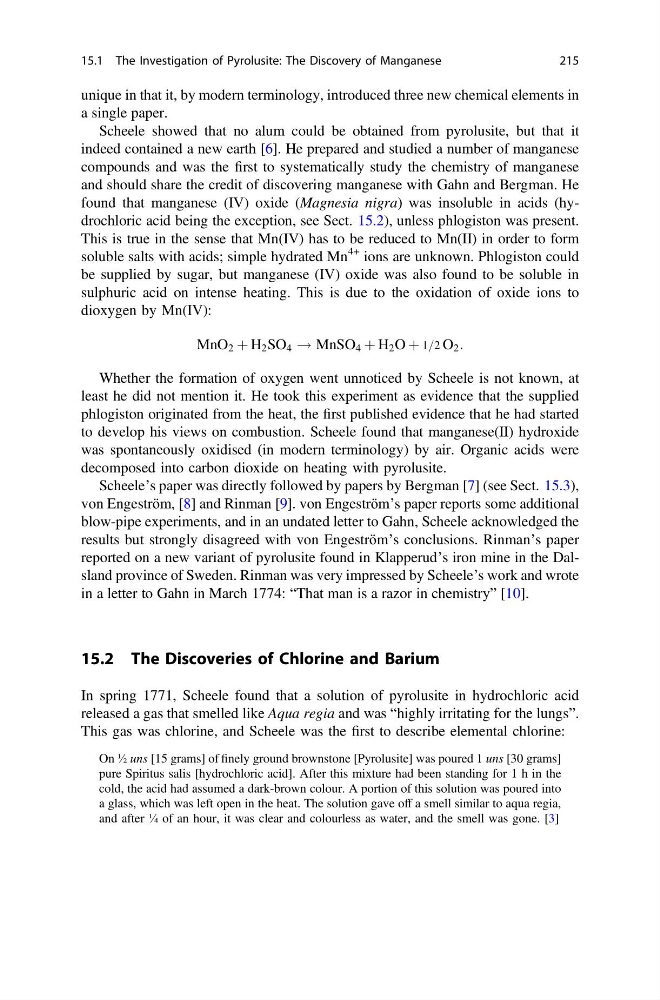
be supplied by sugar, but manganese (IV) oxide was also found to be soluble in
sulphuric acid on intense heating. This is due to the oxidation of oxide ions to
dioxygen by Mn(IV):
MnO 2 þ H 2 SO 4 ! MnSO 4 þ H 2 O þ 1=2 O 2 :
Whether the formation of oxygen went unnoticed by Scheele is not known, at
least he did not mention it. He took this experiment as evidence that the supplied
phlogiston originated from the heat, the first published evidence that he had started
to develop his views on combustion. Scheele found that manganese(II) hydroxide
was spontaneously oxidised (in modern terminology) by air. Organic acids were
decomposed into carbon dioxide on heating with pyrolusite.
Scheele’s paper was directly followed by papers by Bergman [7] (see Sect. 15.3),
von Engeström, [8] and Rinman [9]. von Engeström’s paper reports some additional
blow-pipe experiments, and in an undated letter to Gahn, Scheele acknowledged the
results but strongly disagreed with von Engeström’s conclusions. Rinman’s paper
reported on a new variant of pyrolusite found in Klapperud’s iron mine in the Dalsland province of Sweden. Rinman was very impressed by Scheele’s work and wrote
in a letter to Gahn in March 1774: “That man is a razor in chemistry” [10].
15.2 The Discoveries of Chlorine and Barium
In spring 1771, Scheele found that a solution of pyrolusite in hydrochloric acid
released a gas that smelled like Aqua regia and was “highly irritating for the lungs”.
This gas was chlorine, and Scheele was the first to describe elemental chlorine:
On ½ uns [15 grams] of finely ground brownstone [Pyrolusite] was poured 1 uns [30 grams]
pure Spiritus salis [hydrochloric acid]. After this mixture had been standing for 1 h in the
cold, the acid had assumed a dark-brown colour. A portion of this solution was poured into
a glass, which was left open in the heat. The solution gave off a smell similar to aqua regia,
and after ¼ of an hour, it was clear and colourless as water, and the smell was gone. [3]
15.1 The Investigation of Pyrolusite: The Discovery of Manganese
215
a single paper.
Scheele showed that no alum could be obtained from pyrolusite, but that it
indeed contained a new earth [6]. He prepared and studied a number of manganese
compounds and was the first to systematically study the chemistry of manganese
and should share the credit of discovering manganese with Gahn and Bergman. He
found that manganese (IV) oxide (Magnesia nigra) was insoluble in acids (hydrochloric acid being the exception, see Sect. 15.2), unless phlogiston was present.
This is true in the sense that Mn(IV) has to be reduced to Mn(II) in order to form
soluble salts with acids; simple hydrated Mn
4+ ions are unknown. Phlogiston could
be supplied by sugar, but manganese (IV) oxide was also found to be soluble in
sulphuric acid on intense heating. This is due to the oxidation of oxide ions to
dioxygen by Mn(IV):
MnO 2 þ H 2 SO 4 ! MnSO 4 þ H 2 O þ 1=2 O 2 :
Whether the formation of oxygen went unnoticed by Scheele is not known, at
least he did not mention it. He took this experiment as evidence that the supplied
phlogiston originated from the heat, the first published evidence that he had started
to develop his views on combustion. Scheele found that manganese(II) hydroxide
was spontaneously oxidised (in modern terminology) by air. Organic acids were
decomposed into carbon dioxide on heating with pyrolusite.
Scheele’s paper was directly followed by papers by Bergman [7] (see Sect. 15.3),
von Engeström, [8] and Rinman [9]. von Engeström’s paper reports some additional
blow-pipe experiments, and in an undated letter to Gahn, Scheele acknowledged the
results but strongly disagreed with von Engeström’s conclusions. Rinman’s paper
reported on a new variant of pyrolusite found in Klapperud’s iron mine in the Dalsland province of Sweden. Rinman was very impressed by Scheele’s work and wrote
in a letter to Gahn in March 1774: “That man is a razor in chemistry” [10].
15.2 The Discoveries of Chlorine and Barium
In spring 1771, Scheele found that a solution of pyrolusite in hydrochloric acid
released a gas that smelled like Aqua regia and was “highly irritating for the lungs”.
This gas was chlorine, and Scheele was the first to describe elemental chlorine:
On ½ uns [15 grams] of finely ground brownstone [Pyrolusite] was poured 1 uns [30 grams]
pure Spiritus salis [hydrochloric acid]. After this mixture had been standing for 1 h in the
cold, the acid had assumed a dark-brown colour. A portion of this solution was poured into
a glass, which was left open in the heat. The solution gave off a smell similar to aqua regia,
and after ¼ of an hour, it was clear and colourless as water, and the smell was gone. [3]
15.1 The Investigation of Pyrolusite: The Discovery of Manganese
215