

Scheele’s explanation was that Magnesia nigra first forms a loose compound
with hydrochloric acid (the brown solution). Magnesia nigra then attracts phlogiston from the acid to give a solution of dephlogisticated Magnesia bound to
hydrochloric acid (manganese(II) chloride in modern terminology) and phlogisticated hydrochloric acid (chlorine). The idea that chlorine was an oxidised form of
hydrochloric acid would still be defended by prominent chemists in the 1820s. The
elemental nature of chlorine was first proposed by Humphry Davy in 1810 [11].
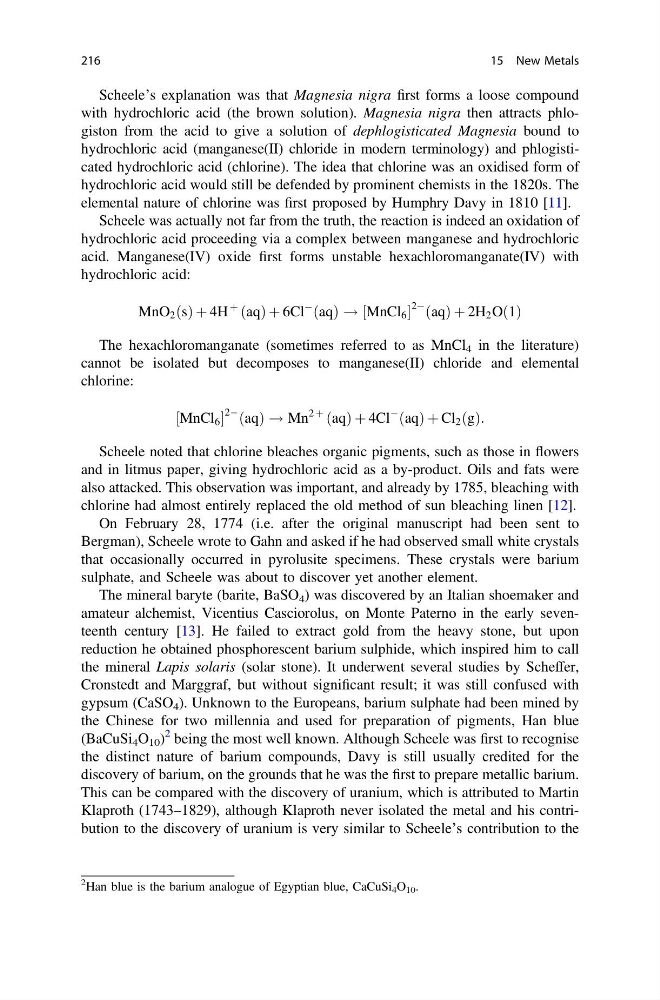
Scheele was actually not far from the truth, the reaction is indeed an oxidation of
hydrochloric acid proceeding via a complex between manganese and hydrochloric
acid. Manganese(IV) oxide first forms unstable hexachloromanganate(IV) with
hydrochloric acid:
MnO 2 ðsÞ þ 4H
þ
ðaqÞ þ 6Cl
À
ðaqÞ ! MnCl 6
½
2À ðaqÞ þ 2H 2 Oð1Þ
The hexachloromanganate (sometimes referred to as MnCl 4 in the literature)
cannot be isolated but decomposes to manganese(II) chloride and elemental
chlorine:
MnCl 6
½
2À ðaqÞ ! Mn
2 þ
ðaqÞ þ 4Cl
À
ðaqÞ þ Cl 2 ðgÞ:
Scheele noted that chlorine bleaches organic pigments, such as those in flowers
and in litmus paper, giving hydrochloric acid as a by-product. Oils and fats were
also attacked. This observation was important, and already by 1785, bleaching with
chlorine had almost entirely replaced the old method of sun bleaching linen [12].
On February 28, 1774 (i.e. after the original manuscript had been sent to
Bergman), Scheele wrote to Gahn and asked if he had observed small white crystals
that occasionally occurred in pyrolusite specimens. These crystals were barium
sulphate, and Scheele was about to discover yet another element.
The mineral baryte (barite, BaSO 4 ) was discovered by an Italian shoemaker and
amateur alchemist, Vicentius Casciorolus, on Monte Paterno in the early seventeenth century [13]. He failed to extract gold from the heavy stone, but upon
reduction he obtained phosphorescent barium sulphide, which inspired him to call
the mineral Lapis solaris (solar stone). It underwent several studies by Scheffer,
Cronstedt and Marggraf, but without significant result; it was still confused with
gypsum (CaSO 4 ). Unknown to the Europeans, barium sulphate had been mined by
the Chinese for two millennia and used for preparation of pigments, Han blue
(BaCuSi 4 O 10 )
2 being the most well known. Although Scheele was first to recognise
the distinct nature of barium compounds, Davy is still usually credited for the
discovery of barium, on the grounds that he was the first to prepare metallic barium.
This can be compared with the discovery of uranium, which is attributed to Martin
Klaproth (1743–1829), although Klaproth never isolated the metal and his contribution to the discovery of uranium is very similar to Scheele’s contribution to the
2
Han blue is the barium analogue of Egyptian blue, CaCuSi 4 O 10 .
216
15 New Metals
with hydrochloric acid (the brown solution). Magnesia nigra then attracts phlogiston from the acid to give a solution of dephlogisticated Magnesia bound to
hydrochloric acid (manganese(II) chloride in modern terminology) and phlogisticated hydrochloric acid (chlorine). The idea that chlorine was an oxidised form of
hydrochloric acid would still be defended by prominent chemists in the 1820s. The
elemental nature of chlorine was first proposed by Humphry Davy in 1810 [11].
Scheele was actually not far from the truth, the reaction is indeed an oxidation of
hydrochloric acid proceeding via a complex between manganese and hydrochloric
acid. Manganese(IV) oxide first forms unstable hexachloromanganate(IV) with
hydrochloric acid:
MnO 2 ðsÞ þ 4H
þ
ðaqÞ þ 6Cl
À
ðaqÞ ! MnCl 6
½
2À ðaqÞ þ 2H 2 Oð1Þ
The hexachloromanganate (sometimes referred to as MnCl 4 in the literature)
cannot be isolated but decomposes to manganese(II) chloride and elemental
chlorine:
MnCl 6
½
2À ðaqÞ ! Mn
2 þ
ðaqÞ þ 4Cl
À
ðaqÞ þ Cl 2 ðgÞ:
Scheele noted that chlorine bleaches organic pigments, such as those in flowers
and in litmus paper, giving hydrochloric acid as a by-product. Oils and fats were
also attacked. This observation was important, and already by 1785, bleaching with
chlorine had almost entirely replaced the old method of sun bleaching linen [12].
On February 28, 1774 (i.e. after the original manuscript had been sent to
Bergman), Scheele wrote to Gahn and asked if he had observed small white crystals
that occasionally occurred in pyrolusite specimens. These crystals were barium
sulphate, and Scheele was about to discover yet another element.
The mineral baryte (barite, BaSO 4 ) was discovered by an Italian shoemaker and
amateur alchemist, Vicentius Casciorolus, on Monte Paterno in the early seventeenth century [13]. He failed to extract gold from the heavy stone, but upon
reduction he obtained phosphorescent barium sulphide, which inspired him to call
the mineral Lapis solaris (solar stone). It underwent several studies by Scheffer,
Cronstedt and Marggraf, but without significant result; it was still confused with
gypsum (CaSO 4 ). Unknown to the Europeans, barium sulphate had been mined by
the Chinese for two millennia and used for preparation of pigments, Han blue
(BaCuSi 4 O 10 )
2 being the most well known. Although Scheele was first to recognise
the distinct nature of barium compounds, Davy is still usually credited for the
discovery of barium, on the grounds that he was the first to prepare metallic barium.
This can be compared with the discovery of uranium, which is attributed to Martin
Klaproth (1743–1829), although Klaproth never isolated the metal and his contribution to the discovery of uranium is very similar to Scheele’s contribution to the
2
Han blue is the barium analogue of Egyptian blue, CaCuSi 4 O 10 .
216
15 New Metals