

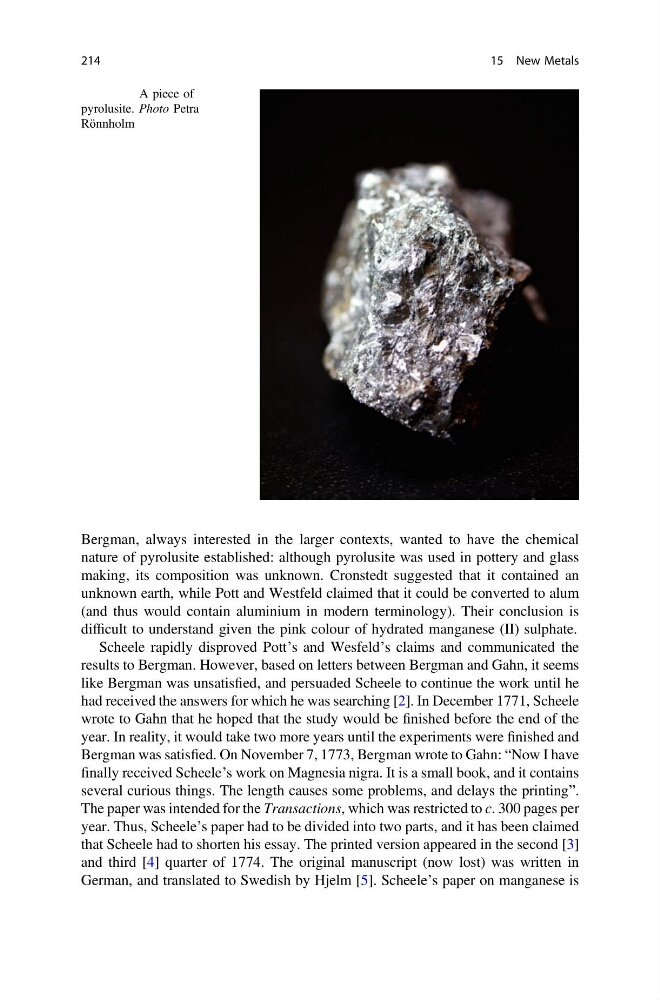
Bergman, always interested in the larger contexts, wanted to have the chemical
nature of pyrolusite established: although pyrolusite was used in pottery and glass
making, its composition was unknown. Cronstedt suggested that it contained an
unknown earth, while Pott and Westfeld claimed that it could be converted to alum
(and thus would contain aluminium in modern terminology). Their conclusion is
difficult to understand given the pink colour of hydrated manganese (II) sulphate.
Scheele rapidly disproved Pott’s and Wesfeld’s claims and communicated the
results to Bergman. However, based on letters between Bergman and Gahn, it seems
like Bergman was unsatisfied, and persuaded Scheele to continue the work until he
had received the answers for which he was searching [2]. In December 1771, Scheele
wrote to Gahn that he hoped that the study would be finished before the end of the
year. In reality, it would take two more years until the experiments were finished and
Bergman was satisfied. On November 7, 1773, Bergman wrote to Gahn: “Now I have
finally received Scheele’s work on Magnesia nigra. It is a small book, and it contains
several curious things. The length causes some problems, and delays the printing”.
The paper was intended for the Transactions, which was restricted to c. 300 pages per
year. Thus, Scheele’s paper had to be divided into two parts, and it has been claimed
that Scheele had to shorten his essay. The printed version appeared in the second [3]
and third [4] quarter of 1774. The original manuscript (now lost) was written in
German, and translated to Swedish by Hjelm [5]. Scheele’s paper on manganese is
Fig. 15.1 A piece of
pyrolusite. Photo Petra
Rönnholm
214
15 New Metals
nature of pyrolusite established: although pyrolusite was used in pottery and glass
making, its composition was unknown. Cronstedt suggested that it contained an
unknown earth, while Pott and Westfeld claimed that it could be converted to alum
(and thus would contain aluminium in modern terminology). Their conclusion is
difficult to understand given the pink colour of hydrated manganese (II) sulphate.
Scheele rapidly disproved Pott’s and Wesfeld’s claims and communicated the
results to Bergman. However, based on letters between Bergman and Gahn, it seems
like Bergman was unsatisfied, and persuaded Scheele to continue the work until he
had received the answers for which he was searching [2]. In December 1771, Scheele
wrote to Gahn that he hoped that the study would be finished before the end of the
year. In reality, it would take two more years until the experiments were finished and
Bergman was satisfied. On November 7, 1773, Bergman wrote to Gahn: “Now I have
finally received Scheele’s work on Magnesia nigra. It is a small book, and it contains
several curious things. The length causes some problems, and delays the printing”.
The paper was intended for the Transactions, which was restricted to c. 300 pages per
year. Thus, Scheele’s paper had to be divided into two parts, and it has been claimed
that Scheele had to shorten his essay. The printed version appeared in the second [3]
and third [4] quarter of 1774. The original manuscript (now lost) was written in
German, and translated to Swedish by Hjelm [5]. Scheele’s paper on manganese is
Fig. 15.1 A piece of
pyrolusite. Photo Petra
Rönnholm
214
15 New Metals