

lost. The much cheaper pigment Prussian blue was discovered in 1704 by a German
named Diesbach, who kept the preparation process secret. In 1724, John Woodward
(1665–1728) could reveal the secret. Scheffer gives the following method for
preparing Prussian blue: [28] sodium carbonate (soda), purified by dissolution in
hot water, filtration and crystallisation, is mixed with the same weight of dried
powdered ox blood. The mixture is heated, where upon the blood starts to burn and
a viscose melt is obtained. The residue is cooled, powdered and extracted with hot
water. This extract contained potassium cyanide and potassium hexacyanoferrates,
and was known as Lixivium sanguinis or phlogisticated alkali. Prussian blue was
finally precipitated by addition of a filtered solution of one part potassium aluminium sulphate (alum) and five parts iron(II) sulphate (iron vitriol). An early study
of the chemical properties of Prussian blue was reported by Marggraf in 1745.
Macquer isolated potassium hexacyanoferrate(II) from Lixivium sanguinis in 1752
(potassium hexacyanoferrate(III) was not isolated until 1822 [29]), otherwise little
was known about the commercially very important pigment.
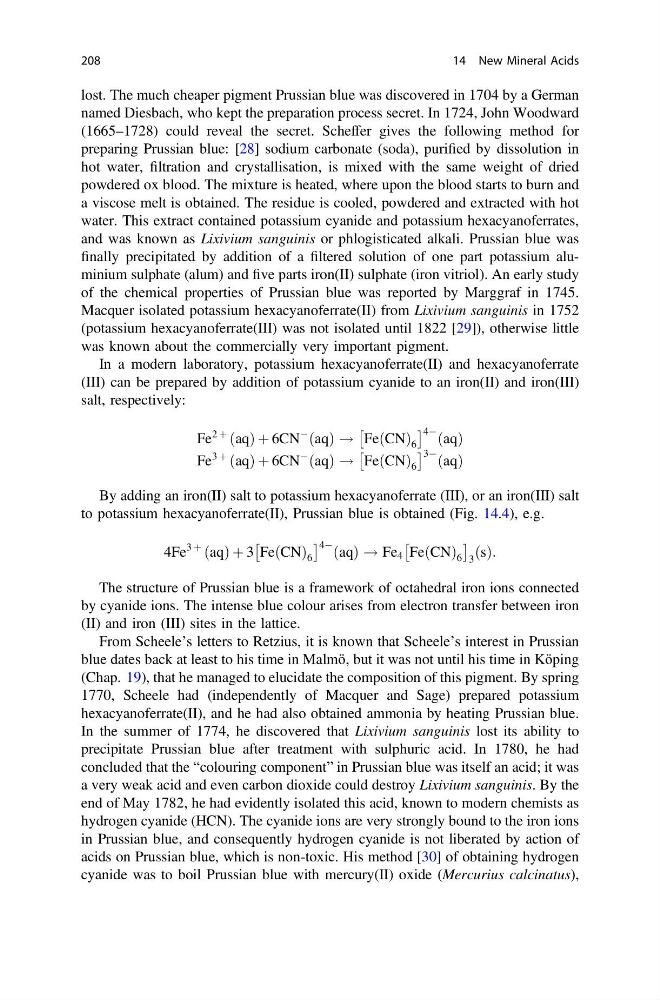
In a modern laboratory, potassium hexacyanoferrate(II) and hexacyanoferrate
(III) can be prepared by addition of potassium cyanide to an iron(II) and iron(III)
salt, respectively:
Fe
2 þ
ðaqÞ þ 6CN
À
ðaqÞ ! FeðCNÞ 6
Â
à 4À ðaqÞ
Fe
3 þ
ðaqÞ þ 6CN
À
ðaqÞ ! FeðCNÞ 6
Â
à 3À ðaqÞ
By adding an iron(II) salt to potassium hexacyanoferrate (III), or an iron(III) salt
to potassium hexacyanoferrate(II), Prussian blue is obtained (Fig. 14.4), e.g.
4Fe
3 þ
ðaqÞ þ 3 FeðCNÞ 6
Â
à 4À ðaqÞ ! Fe 4 FeðCNÞ 6
Â
Ã
3
ðsÞ:
The structure of Prussian blue is a framework of octahedral iron ions connected
by cyanide ions. The intense blue colour arises from electron transfer between iron
(II) and iron (III) sites in the lattice.
From Scheele’s letters to Retzius, it is known that Scheele’s interest in Prussian
blue dates back at least to his time in Malmö, but it was not until his time in Köping
(Chap. 19), that he managed to elucidate the composition of this pigment. By spring
1770, Scheele had (independently of Macquer and Sage) prepared potassium
hexacyanoferrate(II), and he had also obtained ammonia by heating Prussian blue.
In the summer of 1774, he discovered that Lixivium sanguinis lost its ability to
precipitate Prussian blue after treatment with sulphuric acid. In 1780, he had
concluded that the “colouring component” in Prussian blue was itself an acid; it was
a very weak acid and even carbon dioxide could destroy Lixivium sanguinis. By the
end of May 1782, he had evidently isolated this acid, known to modern chemists as
hydrogen cyanide (HCN). The cyanide ions are very strongly bound to the iron ions
in Prussian blue, and consequently hydrogen cyanide is not liberated by action of
acids on Prussian blue, which is non-toxic. His method [30] of obtaining hydrogen
cyanide was to boil Prussian blue with mercury(II) oxide (Mercurius calcinatus),
208
14 New Mineral Acids
named Diesbach, who kept the preparation process secret. In 1724, John Woodward
(1665–1728) could reveal the secret. Scheffer gives the following method for
preparing Prussian blue: [28] sodium carbonate (soda), purified by dissolution in
hot water, filtration and crystallisation, is mixed with the same weight of dried
powdered ox blood. The mixture is heated, where upon the blood starts to burn and
a viscose melt is obtained. The residue is cooled, powdered and extracted with hot
water. This extract contained potassium cyanide and potassium hexacyanoferrates,
and was known as Lixivium sanguinis or phlogisticated alkali. Prussian blue was
finally precipitated by addition of a filtered solution of one part potassium aluminium sulphate (alum) and five parts iron(II) sulphate (iron vitriol). An early study
of the chemical properties of Prussian blue was reported by Marggraf in 1745.
Macquer isolated potassium hexacyanoferrate(II) from Lixivium sanguinis in 1752
(potassium hexacyanoferrate(III) was not isolated until 1822 [29]), otherwise little
was known about the commercially very important pigment.
In a modern laboratory, potassium hexacyanoferrate(II) and hexacyanoferrate
(III) can be prepared by addition of potassium cyanide to an iron(II) and iron(III)
salt, respectively:
Fe
2 þ
ðaqÞ þ 6CN
À
ðaqÞ ! FeðCNÞ 6
Â
à 4À ðaqÞ
Fe
3 þ
ðaqÞ þ 6CN
À
ðaqÞ ! FeðCNÞ 6
Â
à 3À ðaqÞ
By adding an iron(II) salt to potassium hexacyanoferrate (III), or an iron(III) salt
to potassium hexacyanoferrate(II), Prussian blue is obtained (Fig. 14.4), e.g.
4Fe
3 þ
ðaqÞ þ 3 FeðCNÞ 6
Â
à 4À ðaqÞ ! Fe 4 FeðCNÞ 6
Â
Ã
3
ðsÞ:
The structure of Prussian blue is a framework of octahedral iron ions connected
by cyanide ions. The intense blue colour arises from electron transfer between iron
(II) and iron (III) sites in the lattice.
From Scheele’s letters to Retzius, it is known that Scheele’s interest in Prussian
blue dates back at least to his time in Malmö, but it was not until his time in Köping
(Chap. 19), that he managed to elucidate the composition of this pigment. By spring
1770, Scheele had (independently of Macquer and Sage) prepared potassium
hexacyanoferrate(II), and he had also obtained ammonia by heating Prussian blue.
In the summer of 1774, he discovered that Lixivium sanguinis lost its ability to
precipitate Prussian blue after treatment with sulphuric acid. In 1780, he had
concluded that the “colouring component” in Prussian blue was itself an acid; it was
a very weak acid and even carbon dioxide could destroy Lixivium sanguinis. By the
end of May 1782, he had evidently isolated this acid, known to modern chemists as
hydrogen cyanide (HCN). The cyanide ions are very strongly bound to the iron ions
in Prussian blue, and consequently hydrogen cyanide is not liberated by action of
acids on Prussian blue, which is non-toxic. His method [30] of obtaining hydrogen
cyanide was to boil Prussian blue with mercury(II) oxide (Mercurius calcinatus),
208
14 New Mineral Acids