

which resulted in a solution with a “strong mercurial taste”. This solution (containing mercury(II) cyanide) was treated with iron flings to give a solution of iron
cyanide and metallic mercury. Since cyanide is less strongly bound to iron than to
mercury, hydrogen cyanide could now be liberated by sulphuric acid and separated
as an aqueous solution by distillation. The method that Scheele arrived at is rather
complex and certainly impressive, and it is clear that Scheele must have put a lot of
effort on the project before arriving at the final procedure.
Scheele accidently discovered that hydrogen cyanide is combustible:
I met by accident with a very remarkable phenomenon: As I was one evening about to pour
the liquor of the first distillation of the colouring matter out of the receiver into a bottle […],
and a burning candle happened to be standing near the orifice, the air contained in the
receiver instantly took fire, without, however, any explosion” [31]. By combustion of
hydrogen cyanide, Scheele obtained carbon dioxide (aerial acid) and by heating metal
cyanides he obtained ammonia. From this he concluded that “the constituent parts of the
colouring matter were volatile alkali [ammonia] and an oily substance [i.e. carbon and
hydrogen]. [32]
When translated to modern terminology this is equivalent to saying that it was
composed of carbon, nitrogen and hydrogen. He failed to combine oils or fats with
ammonia, but when he added ammonium chloride to a red-hot mixture of potassium
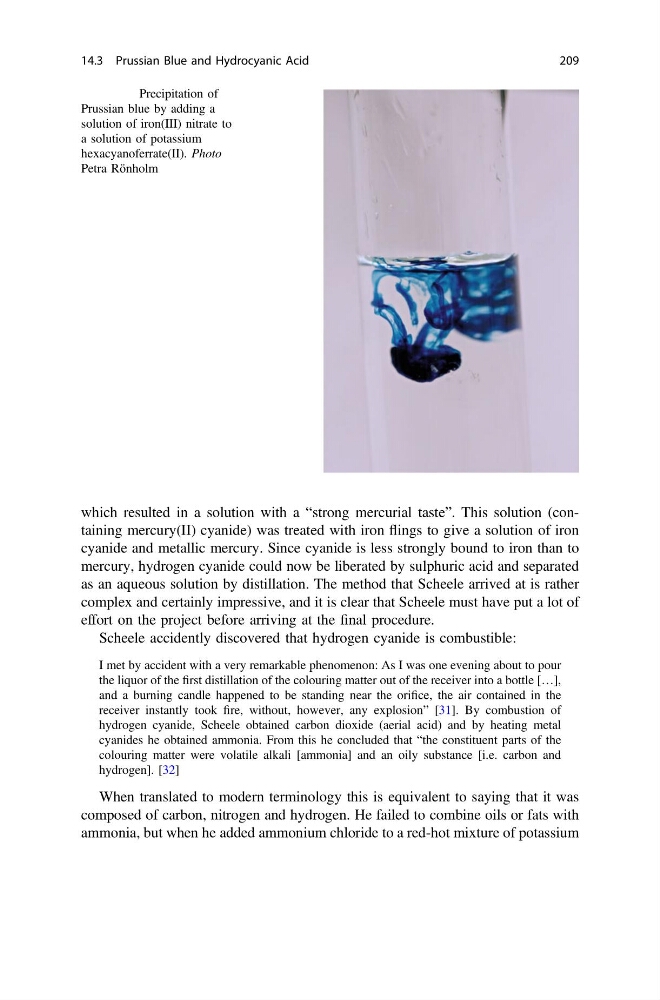
Fig. 14.4 Precipitation of
Prussian blue by adding a
solution of iron(III) nitrate to
a solution of potassium
hexacyanoferrate(II). Photo
Petra Rönholm
14.3 Prussian Blue and Hydrocyanic Acid
209
cyanide and metallic mercury. Since cyanide is less strongly bound to iron than to
mercury, hydrogen cyanide could now be liberated by sulphuric acid and separated
as an aqueous solution by distillation. The method that Scheele arrived at is rather
complex and certainly impressive, and it is clear that Scheele must have put a lot of
effort on the project before arriving at the final procedure.
Scheele accidently discovered that hydrogen cyanide is combustible:
I met by accident with a very remarkable phenomenon: As I was one evening about to pour
the liquor of the first distillation of the colouring matter out of the receiver into a bottle […],
and a burning candle happened to be standing near the orifice, the air contained in the
receiver instantly took fire, without, however, any explosion” [31]. By combustion of
hydrogen cyanide, Scheele obtained carbon dioxide (aerial acid) and by heating metal
cyanides he obtained ammonia. From this he concluded that “the constituent parts of the
colouring matter were volatile alkali [ammonia] and an oily substance [i.e. carbon and
hydrogen]. [32]
When translated to modern terminology this is equivalent to saying that it was
composed of carbon, nitrogen and hydrogen. He failed to combine oils or fats with
ammonia, but when he added ammonium chloride to a red-hot mixture of potassium
Fig. 14.4 Precipitation of
Prussian blue by adding a
solution of iron(III) nitrate to
a solution of potassium
hexacyanoferrate(II). Photo
Petra Rönholm
14.3 Prussian Blue and Hydrocyanic Acid
209