

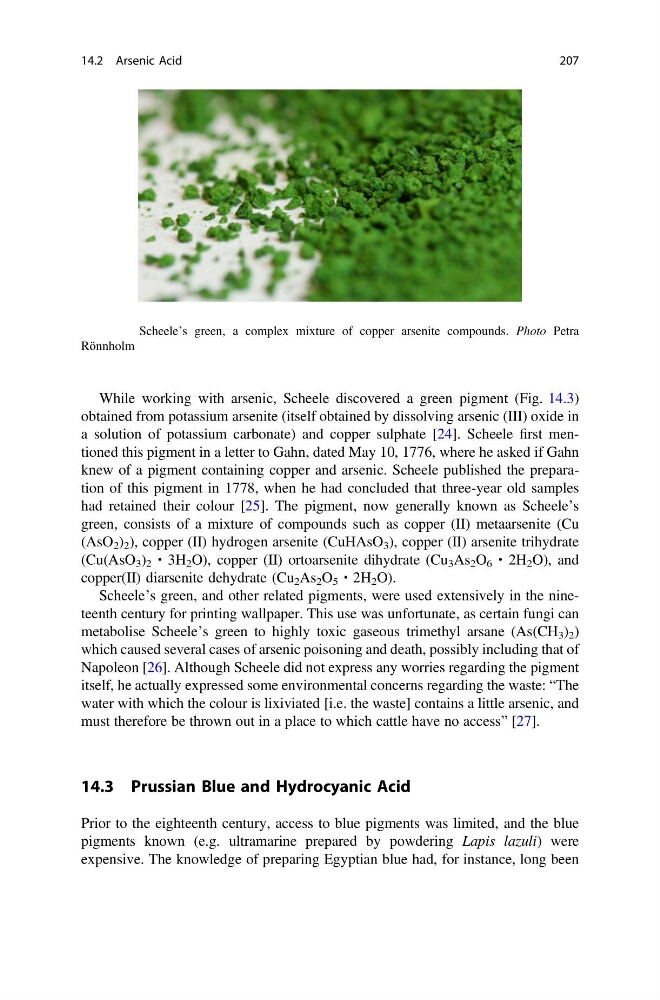
While working with arsenic, Scheele discovered a green pigment (Fig. 14.3)
obtained from potassium arsenite (itself obtained by dissolving arsenic (III) oxide in
a solution of potassium carbonate) and copper sulphate [24]. Scheele first mentioned this pigment in a letter to Gahn, dated May 10, 1776, where he asked if Gahn
knew of a pigment containing copper and arsenic. Scheele published the preparation of this pigment in 1778, when he had concluded that three-year old samples
had retained their colour [25]. The pigment, now generally known as Scheele’s
green, consists of a mixture of compounds such as copper (II) metaarsenite (Cu
(AsO 2 ) 2 ), copper (II) hydrogen arsenite (CuHAsO 3 ), copper (II) arsenite trihydrate
(Cu(AsO 3 ) 2 ∙ 3H 2 O), copper (II) ortoarsenite dihydrate (Cu 3 As 2 O 6 ∙ 2H 2 O), and
copper(II) diarsenite dehydrate (Cu 2 As 2 O 5 ∙ 2H 2 O).
Scheele’s green, and other related pigments, were used extensively in the nineteenth century for printing wallpaper. This use was unfortunate, as certain fungi can
metabolise Scheele’s green to highly toxic gaseous trimethyl arsane (As(CH 3 ) 2 )
which caused several cases of arsenic poisoning and death, possibly including that of
Napoleon [26]. Although Scheele did not express any worries regarding the pigment
itself, he actually expressed some environmental concerns regarding the waste: “The
water with which the colour is lixiviated [i.e. the waste] contains a little arsenic, and
must therefore be thrown out in a place to which cattle have no access” [27].
14.3 Prussian Blue and Hydrocyanic Acid
Prior to the eighteenth century, access to blue pigments was limited, and the blue
pigments known (e.g. ultramarine prepared by powdering Lapis lazuli) were
expensive. The knowledge of preparing Egyptian blue had, for instance, long been
Fig. 14.3 Scheele’s green, a complex mixture of copper arsenite compounds. Photo Petra
Rönnholm
14.2 Arsenic Acid
207
obtained from potassium arsenite (itself obtained by dissolving arsenic (III) oxide in
a solution of potassium carbonate) and copper sulphate [24]. Scheele first mentioned this pigment in a letter to Gahn, dated May 10, 1776, where he asked if Gahn
knew of a pigment containing copper and arsenic. Scheele published the preparation of this pigment in 1778, when he had concluded that three-year old samples
had retained their colour [25]. The pigment, now generally known as Scheele’s
green, consists of a mixture of compounds such as copper (II) metaarsenite (Cu
(AsO 2 ) 2 ), copper (II) hydrogen arsenite (CuHAsO 3 ), copper (II) arsenite trihydrate
(Cu(AsO 3 ) 2 ∙ 3H 2 O), copper (II) ortoarsenite dihydrate (Cu 3 As 2 O 6 ∙ 2H 2 O), and
copper(II) diarsenite dehydrate (Cu 2 As 2 O 5 ∙ 2H 2 O).
Scheele’s green, and other related pigments, were used extensively in the nineteenth century for printing wallpaper. This use was unfortunate, as certain fungi can
metabolise Scheele’s green to highly toxic gaseous trimethyl arsane (As(CH 3 ) 2 )
which caused several cases of arsenic poisoning and death, possibly including that of
Napoleon [26]. Although Scheele did not express any worries regarding the pigment
itself, he actually expressed some environmental concerns regarding the waste: “The
water with which the colour is lixiviated [i.e. the waste] contains a little arsenic, and
must therefore be thrown out in a place to which cattle have no access” [27].
14.3 Prussian Blue and Hydrocyanic Acid
Prior to the eighteenth century, access to blue pigments was limited, and the blue
pigments known (e.g. ultramarine prepared by powdering Lapis lazuli) were
expensive. The knowledge of preparing Egyptian blue had, for instance, long been
Fig. 14.3 Scheele’s green, a complex mixture of copper arsenite compounds. Photo Petra
Rönnholm
14.2 Arsenic Acid
207