

Leiden to study with the celebrated physician and chemist Herman Boerhaave
(1668−1738). It was in Leiden he published his Systema naturæ, and rapidly gained
a reputation. Boerhaave introduced Linnaeus to the wealthy banker George Clifford
(1685−1760), director of the Dutch East Indian Company, who hired Linnaeus to
catalogue his botanical garden and extensive natural history collections. Linnaeus
was also sent to England and France on Clifford’s expense. In 1738, Linnaeus
returned to Sweden, and with an improved economy and increasing reputation, he
was finally able to marry Sara Moræus, whom he had met during his travel in
Dalarna. His appointment as professor of medicine in Uppsala is discussed in
Chap. 9.1. After his ennoblement in 1761, he took the name von Linné, and in
Sweden is invariably known as Carl von Linné. He died in 1778 after a series of
strokes and years of declining health.
The second most important scientist in Sweden during the early eighteenth
century was probably Samuel Klingenstierna (Fig. 1.4). Klingenstierna [2] was
born in 1698 in Linköping and he enrolled at Uppsala University in 1717. Initially,
he studied law, but when he had to consult Euclid to find the answer to a problem,
he was struck by the beauty of mathematics. In 1720, he obtained a civil servant
position in Stockholm but used his spare time to study mathematics. After five
years, he was back in Uppsala, now giving private tutoring in mathematics and he
also published his first mathematical works in Acta Societatis Regiae Scientiarum
Upsaliensis. In 1727, he embarked on a journey through Europe: Germany,
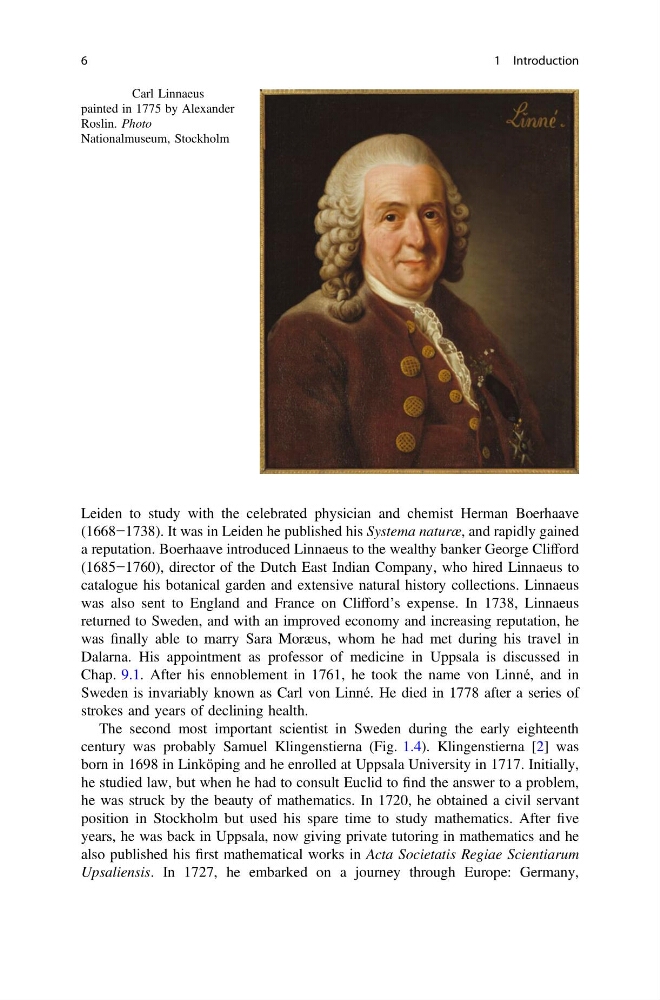
Fig. 1.3 Carl Linnaeus
painted in 1775 by Alexander
Roslin. Photo
Nationalmuseum, Stockholm
6
1 Introduction
(1668−1738). It was in Leiden he published his Systema naturæ, and rapidly gained
a reputation. Boerhaave introduced Linnaeus to the wealthy banker George Clifford
(1685−1760), director of the Dutch East Indian Company, who hired Linnaeus to
catalogue his botanical garden and extensive natural history collections. Linnaeus
was also sent to England and France on Clifford’s expense. In 1738, Linnaeus
returned to Sweden, and with an improved economy and increasing reputation, he
was finally able to marry Sara Moræus, whom he had met during his travel in
Dalarna. His appointment as professor of medicine in Uppsala is discussed in
Chap. 9.1. After his ennoblement in 1761, he took the name von Linné, and in
Sweden is invariably known as Carl von Linné. He died in 1778 after a series of
strokes and years of declining health.
The second most important scientist in Sweden during the early eighteenth
century was probably Samuel Klingenstierna (Fig. 1.4). Klingenstierna [2] was
born in 1698 in Linköping and he enrolled at Uppsala University in 1717. Initially,
he studied law, but when he had to consult Euclid to find the answer to a problem,
he was struck by the beauty of mathematics. In 1720, he obtained a civil servant
position in Stockholm but used his spare time to study mathematics. After five
years, he was back in Uppsala, now giving private tutoring in mathematics and he
also published his first mathematical works in Acta Societatis Regiae Scientiarum
Upsaliensis. In 1727, he embarked on a journey through Europe: Germany,
Fig. 1.3 Carl Linnaeus
painted in 1775 by Alexander
Roslin. Photo
Nationalmuseum, Stockholm
6
1 Introduction