

Switzerland, France, and England. On recommendation by mathematician Christian
von Wolff (1679–1754) in Marburg, he was appointed professor in mathematics in
Uppsala in 1728. He did not, however, return to Sweden and Uppsala until 1731.
His appearance in Uppsala would become very important for the development of
mathematics and physics at the university: with Klingenstierna, the theories of
Newton received a definite breakthrough in Uppsala on the expence of the old
Aristotelean system. From England, Klingenstierna bought physical instruments,
including a static electricity generator, a hydrostatic balance, and a pressure boiler,
and thereby introducing experimental physics in Uppsala. When, in 1750, a professorship in physics
5 was established, Klingenstierna was the obvious choice. Due
to poor health, he had to apply for a leave of absence after just two years and
devoted his time to research in ballistics for the army. In 1756, the royal couple,
Adolph Frederick and Lovisa Ulrika, attempted a coup d’état, which failed. In the
aftermaths of the coup, the Crown Prince Gustav’s teacher, Carl Gustaf Tessin
(1695–1770; Sect. 9.3), was fired. Count Carl Fredrik Scheffer took over Tessin’s
position and Klingenstierna became the Crown Prince’s teacher in geometry and
surveying [3]. He now finally resigned from his professorship in Uppsala. As the
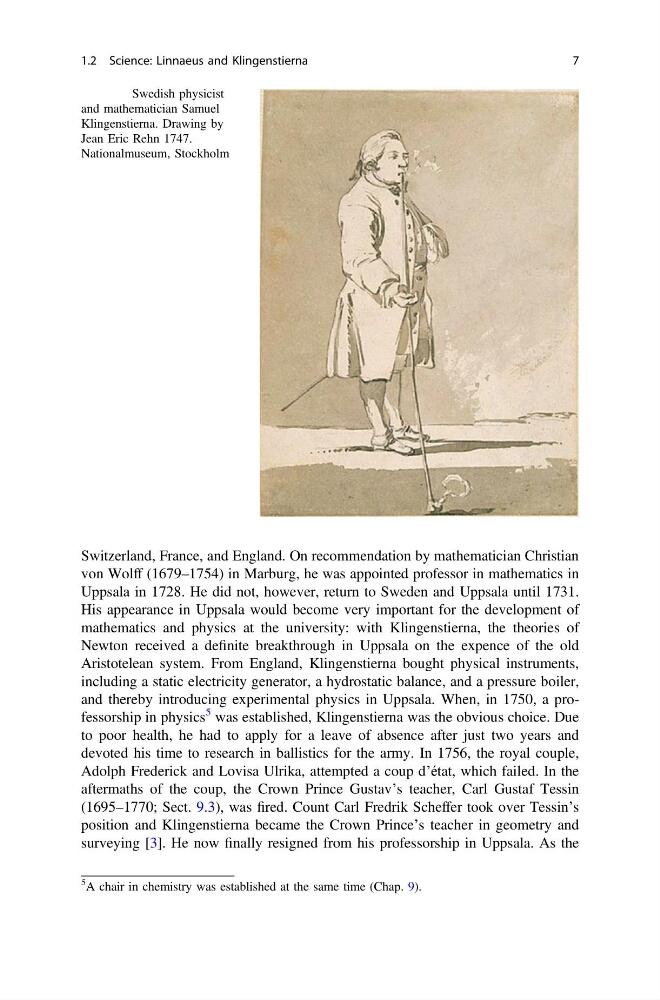
Fig. 1.4 Swedish physicist
and mathematician Samuel
Klingenstierna. Drawing by
Jean Eric Rehn 1747.
Nationalmuseum, Stockholm
5
A chair in chemistry was established at the same time (Chap. 9).
1.2 Science: Linnaeus and Klingenstierna
7
von Wolff (1679–1754) in Marburg, he was appointed professor in mathematics in
Uppsala in 1728. He did not, however, return to Sweden and Uppsala until 1731.
His appearance in Uppsala would become very important for the development of
mathematics and physics at the university: with Klingenstierna, the theories of
Newton received a definite breakthrough in Uppsala on the expence of the old
Aristotelean system. From England, Klingenstierna bought physical instruments,
including a static electricity generator, a hydrostatic balance, and a pressure boiler,
and thereby introducing experimental physics in Uppsala. When, in 1750, a professorship in physics
5 was established, Klingenstierna was the obvious choice. Due
to poor health, he had to apply for a leave of absence after just two years and
devoted his time to research in ballistics for the army. In 1756, the royal couple,
Adolph Frederick and Lovisa Ulrika, attempted a coup d’état, which failed. In the
aftermaths of the coup, the Crown Prince Gustav’s teacher, Carl Gustaf Tessin
(1695–1770; Sect. 9.3), was fired. Count Carl Fredrik Scheffer took over Tessin’s
position and Klingenstierna became the Crown Prince’s teacher in geometry and
surveying [3]. He now finally resigned from his professorship in Uppsala. As the
Fig. 1.4 Swedish physicist
and mathematician Samuel
Klingenstierna. Drawing by
Jean Eric Rehn 1747.
Nationalmuseum, Stockholm
5
A chair in chemistry was established at the same time (Chap. 9).
1.2 Science: Linnaeus and Klingenstierna
7