

58
4 Open and Closed Strings
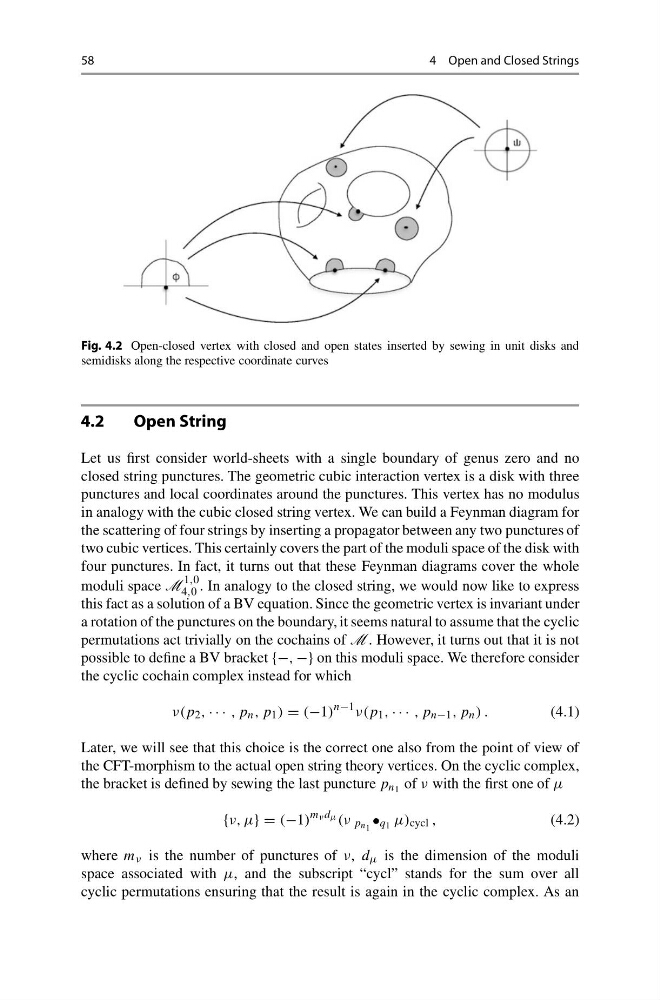
Fig. 4.2 Open-closed vertex with closed and open states inserted by sewing in unit disks and
semidisks along the respective coordinate curves
4.2
Open String
Let us first consider world-sheets with a single boundary of genus zero and no
closed string punctures. The geometric cubic interaction vertex is a disk with three
punctures and local coordinates around the punctures. This vertex has no modulus
in analogy with the cubic closed string vertex. We can build a Feynman diagram for
the scattering of four strings by inserting a propagator between any two punctures of
two cubic vertices. This certainly covers the part of the moduli space of the disk with
four punctures. In fact, it turns out that these Feynman diagrams cover the whole
moduli space M
1,0
4,0 . In analogy to the closed string, we would now like to express
this fact as a solution of a BV equation. Since the geometric vertex is invariant under
a rotation of the punctures on the boundary, it seems natural to assume that the cyclic
permutations act trivially on the cochains of M . However, it turns out that it is not
possible to define a BV bracket {−, −} on this moduli space. We therefore consider
the cyclic cochain complex instead for which
ν(p 2 , · · · , p n , p 1 ) = (−1)
n−1 ν(p 1 , · · · , p n−1 , p n ) .
(4.1)
Later, we will see that this choice is the correct one also from the point of view of
the CFT-morphism to the actual open string theory vertices. On the cyclic complex,
the bracket is defined by sewing the last puncture p n 1 of ν with the first one of μ
{ν, μ} = (−1)
m ν d μ (ν p n 1 • q 1 μ) cycl ,
(4.2)
where m ν is the number of punctures of ν, d μ is the dimension of the moduli
space associated with μ, and the subscript “cycl” stands for the sum over all
cyclic permutations ensuring that the result is again in the cyclic complex. As an
4 Open and Closed Strings
Fig. 4.2 Open-closed vertex with closed and open states inserted by sewing in unit disks and
semidisks along the respective coordinate curves
4.2
Open String
Let us first consider world-sheets with a single boundary of genus zero and no
closed string punctures. The geometric cubic interaction vertex is a disk with three
punctures and local coordinates around the punctures. This vertex has no modulus
in analogy with the cubic closed string vertex. We can build a Feynman diagram for
the scattering of four strings by inserting a propagator between any two punctures of
two cubic vertices. This certainly covers the part of the moduli space of the disk with
four punctures. In fact, it turns out that these Feynman diagrams cover the whole
moduli space M
1,0
4,0 . In analogy to the closed string, we would now like to express
this fact as a solution of a BV equation. Since the geometric vertex is invariant under
a rotation of the punctures on the boundary, it seems natural to assume that the cyclic
permutations act trivially on the cochains of M . However, it turns out that it is not
possible to define a BV bracket {−, −} on this moduli space. We therefore consider
the cyclic cochain complex instead for which
ν(p 2 , · · · , p n , p 1 ) = (−1)
n−1 ν(p 1 , · · · , p n−1 , p n ) .
(4.1)
Later, we will see that this choice is the correct one also from the point of view of
the CFT-morphism to the actual open string theory vertices. On the cyclic complex,
the bracket is defined by sewing the last puncture p n 1 of ν with the first one of μ
{ν, μ} = (−1)
m ν d μ (ν p n 1 • q 1 μ) cycl ,
(4.2)
where m ν is the number of punctures of ν, d μ is the dimension of the moduli
space associated with μ, and the subscript “cycl” stands for the sum over all
cyclic permutations ensuring that the result is again in the cyclic complex. As an