

4.1 World-Sheets with Boundaries
57
where I (z) = −1/z, . . . H is the correlator on the upper half plane and I ∗ O
denotes the conformal transformation of O with respect to I . Due to the PSL(2, R)invariance this correlator is non-vanishing only if it is saturated by three c-ghost
insertions and consequently, the BPZ inner product carries ghost number −3. The
BRST invariance of the open string is the same as for the closed string modulo the
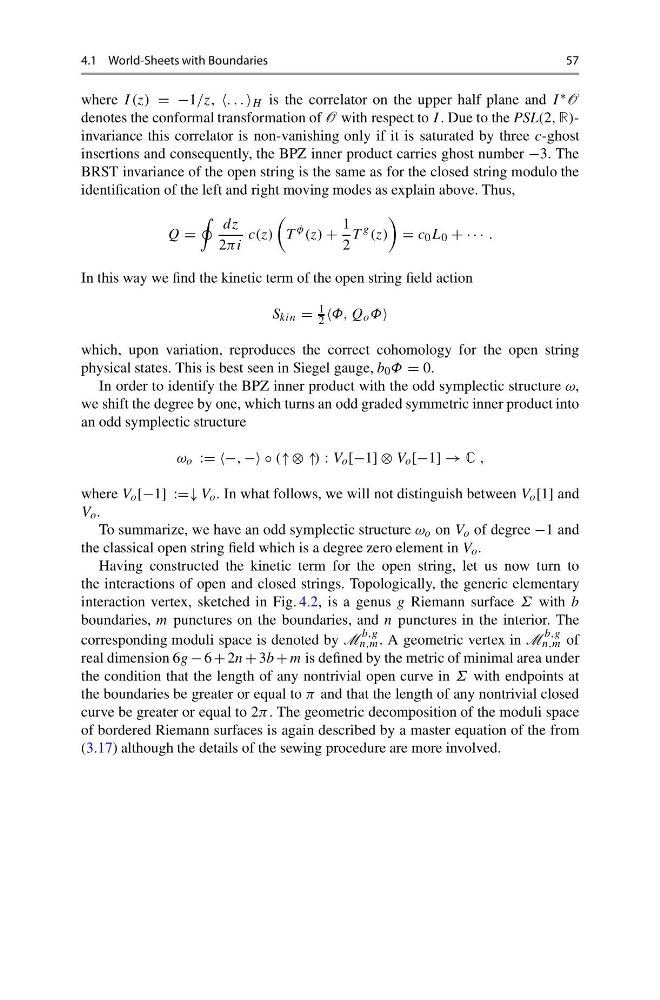
identification of the left and right moving modes as explain above. Thus,
Q =
dz
2πi
c(z)
T
φ (z) +
1
2
T
g (z)
= c 0 L 0 + · · · .
In this way we find the kinetic term of the open string field action
S kin =
1
2 Φ, Q o Φ
which, upon variation, reproduces the correct cohomology for the open string
physical states. This is best seen in Siegel gauge, b 0 Φ = 0.
In order to identify the BPZ inner product with the odd symplectic structure ω,
we shift the degree by one, which turns an odd graded symmetric inner product into
an odd symplectic structure
ω o := =−, −− ◦ (↑⊗ ↑) : V o [−1] ⊗ V o [−1] → C ,
where V o [−1] :=↓V o . In what follows, we will not distinguish between V o [1] and
V o .
To summarize, we have an odd symplectic structure ω o on V o of degree −1 and
the classical open string field which is a degree zero element in V o .
Having constructed the kinetic term for the open string, let us now turn to
the interactions of open and closed strings. Topologically, the generic elementary
interaction vertex, sketched in Fig. 4.2, is a genus g Riemann surface Σ with b
boundaries, m punctures on the boundaries, and n punctures in the interior. The
corresponding moduli space is denoted by M
b,g
n,m . A geometric vertex in M
b,g
n,m of
real dimension 6g − 6 + 2n + 3b + m is defined by the metric of minimal area under
the condition that the length of any nontrivial open curve in Σ with endpoints at
the boundaries be greater or equal to π and that the length of any nontrivial closed
curve be greater or equal to 2π. The geometric decomposition of the moduli space
of bordered Riemann surfaces is again described by a master equation of the from
(3.17) although the details of the sewing procedure are more involved.
57
where I (z) = −1/z, . . . H is the correlator on the upper half plane and I ∗ O
denotes the conformal transformation of O with respect to I . Due to the PSL(2, R)invariance this correlator is non-vanishing only if it is saturated by three c-ghost
insertions and consequently, the BPZ inner product carries ghost number −3. The
BRST invariance of the open string is the same as for the closed string modulo the
identification of the left and right moving modes as explain above. Thus,
Q =
dz
2πi
c(z)
T
φ (z) +
1
2
T
g (z)
= c 0 L 0 + · · · .
In this way we find the kinetic term of the open string field action
S kin =
1
2 Φ, Q o Φ
which, upon variation, reproduces the correct cohomology for the open string
physical states. This is best seen in Siegel gauge, b 0 Φ = 0.
In order to identify the BPZ inner product with the odd symplectic structure ω,
we shift the degree by one, which turns an odd graded symmetric inner product into
an odd symplectic structure
ω o := =−, −− ◦ (↑⊗ ↑) : V o [−1] ⊗ V o [−1] → C ,
where V o [−1] :=↓V o . In what follows, we will not distinguish between V o [1] and
V o .
To summarize, we have an odd symplectic structure ω o on V o of degree −1 and
the classical open string field which is a degree zero element in V o .
Having constructed the kinetic term for the open string, let us now turn to
the interactions of open and closed strings. Topologically, the generic elementary
interaction vertex, sketched in Fig. 4.2, is a genus g Riemann surface Σ with b
boundaries, m punctures on the boundaries, and n punctures in the interior. The
corresponding moduli space is denoted by M
b,g
n,m . A geometric vertex in M
b,g
n,m of
real dimension 6g − 6 + 2n + 3b + m is defined by the metric of minimal area under
the condition that the length of any nontrivial open curve in Σ with endpoints at
the boundaries be greater or equal to π and that the length of any nontrivial closed
curve be greater or equal to 2π. The geometric decomposition of the moduli space
of bordered Riemann surfaces is again described by a master equation of the from
(3.17) although the details of the sewing procedure are more involved.