

3.5 Algebraic Structure
45
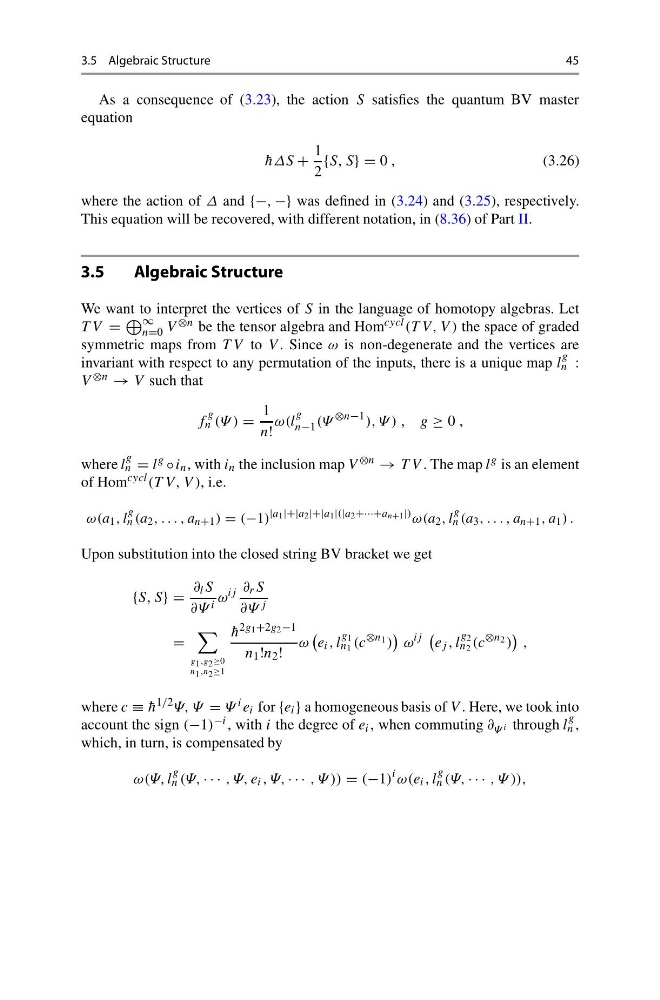
As a consequence of (3.23), the action S satisfies the quantum BV master
equation
¯
hΔS +
1
2
{S, S} = 0 ,
(3.26)
where the action of Δ and {−, −} was defined in (3.24) and (3.25), respectively.
This equation will be recovered, with different notation, in (8.36) of Part II.
3.5
Algebraic Structure
We want to interpret the vertices of S in the language of homotopy algebras. Let
T V =
∞
n=0 V ⊗n be the tensor algebra and Hom cycl (T V , V ) the space of graded
symmetric maps from T V to V . Since ω is non-degenerate and the vertices are
invariant with respect to any permutation of the inputs, there is a unique map l
g
n :
V ⊗n → V such that
f
g
n (Ψ ) =
1
n!
ω(l
g
n−1 (Ψ
⊗n−1 ), Ψ ) , g ≥ 0 ,
where l
g
n = l g ◦ i n , with i n the inclusion map V ⊗n → T V . The map l g is an element
of Hom
cycl (T V , V ), i.e.
ω(a 1 , l
g
n (a 2 , . . . , a n+1 ) = (−1)
|a 1 |+|a 2 |+|a 1 |(|a 2 +···+a n+1 |) ω(a 2 , l
g
n (a 3 , . . . , a n+1 , a 1 ) .
Upon substitution into the closed string BV bracket we get
{S, S} =
∂ l S
∂Ψ i ω
ij ∂ r S
∂Ψ j
=
g 1 ,g 2 ≥0
n 1 ,n 2 ≥1
¯
h
2g 1 +2g 2 −1
n 1 !n 2 !
ω
e i , l
g 1
n 1 (c
⊗n 1 )
ω
ij
e j , l
g 2
n 2 (c
⊗n 2 )
,
where c ≡ ¯
h
1/2 Ψ, Ψ = Ψ i e i for {e i } a homogeneous basis of V . Here, we took into
account the sign (−1) −i , with i the degree of e i , when commuting ∂ Ψ i through l
g
n ,
which, in turn, is compensated by
ω(Ψ, l
g
n (Ψ, · · · , Ψ, e i , Ψ, · · · , Ψ )) = (−1)
i ω(e i , l
g
n (Ψ, · · · , Ψ )),
45
As a consequence of (3.23), the action S satisfies the quantum BV master
equation
¯
hΔS +
1
2
{S, S} = 0 ,
(3.26)
where the action of Δ and {−, −} was defined in (3.24) and (3.25), respectively.
This equation will be recovered, with different notation, in (8.36) of Part II.
3.5
Algebraic Structure
We want to interpret the vertices of S in the language of homotopy algebras. Let
T V =
∞
n=0 V ⊗n be the tensor algebra and Hom cycl (T V , V ) the space of graded
symmetric maps from T V to V . Since ω is non-degenerate and the vertices are
invariant with respect to any permutation of the inputs, there is a unique map l
g
n :
V ⊗n → V such that
f
g
n (Ψ ) =
1
n!
ω(l
g
n−1 (Ψ
⊗n−1 ), Ψ ) , g ≥ 0 ,
where l
g
n = l g ◦ i n , with i n the inclusion map V ⊗n → T V . The map l g is an element
of Hom
cycl (T V , V ), i.e.
ω(a 1 , l
g
n (a 2 , . . . , a n+1 ) = (−1)
|a 1 |+|a 2 |+|a 1 |(|a 2 +···+a n+1 |) ω(a 2 , l
g
n (a 3 , . . . , a n+1 , a 1 ) .
Upon substitution into the closed string BV bracket we get
{S, S} =
∂ l S
∂Ψ i ω
ij ∂ r S
∂Ψ j
=
g 1 ,g 2 ≥0
n 1 ,n 2 ≥1
¯
h
2g 1 +2g 2 −1
n 1 !n 2 !
ω
e i , l
g 1
n 1 (c
⊗n 1 )
ω
ij
e j , l
g 2
n 2 (c
⊗n 2 )
,
where c ≡ ¯
h
1/2 Ψ, Ψ = Ψ i e i for {e i } a homogeneous basis of V . Here, we took into
account the sign (−1) −i , with i the degree of e i , when commuting ∂ Ψ i through l
g
n ,
which, in turn, is compensated by
ω(Ψ, l
g
n (Ψ, · · · , Ψ, e i , Ψ, · · · , Ψ )) = (−1)
i ω(e i , l
g
n (Ψ, · · · , Ψ )),