

46
3 String Theory
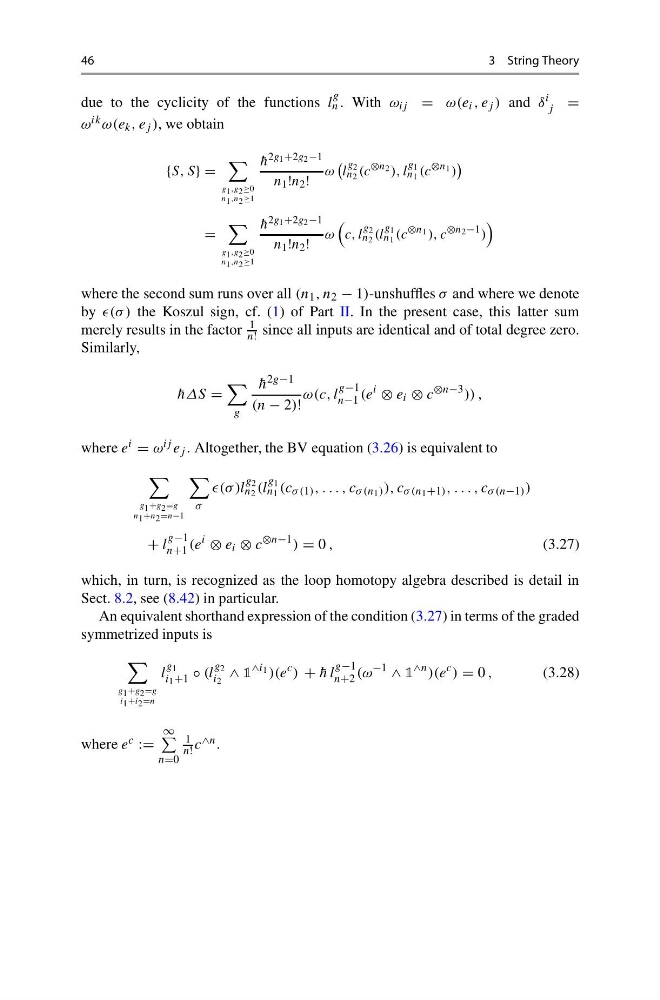
due to the cyclicity of the functions l
g
n . With ω ij = ω(e i , e j ) and δ
i
j =
ω ik ω(e k , e j ), we obtain
{S, S} =
g 1 ,g 2 ≥0
n 1 ,n 2 ≥1
¯
h 2g 1 +2g 2 −1
n 1 !n 2 !
ω
l
g 2
n 2 (c
⊗n 2 ), l
g 1
n 1 (c
⊗n 1 )
=
g 1 ,g 2 ≥0
n 1 ,n 2 ≥1
¯
h 2g 1 +2g 2 −1
n 1 !n 2 !
ω
c, l
g 2
n 2 (l
g 1
n 1 (c
⊗n 1 ), c
⊗n 2 −1 )
where the second sum runs over all (n 1 , n 2 − 1)-unshuffles σ and where we denote
by (σ ) the Koszul sign, cf. (1) of Part II. In the present case, this latter sum
merely results in the factor
1
n! since all inputs are identical and of total degree zero.
Similarly,
¯
hΔS =
g
¯
h
2g−1
(n − 2)!
ω(c, l
g−1
n−1 (e
i
⊗ e i ⊗ c
⊗n−3 )) ,
where e i = ω ij e j . Altogether, the BV equation (3.26) is equivalent to
g 1 +g 2 =g
n 1 +n 2 =n−1
σ
)l
g 2
n 2 (l
g 1
n 1 (c σ (1) , . . . , c σ (n 1 ) ), c σ (n 1 +1) , . . . , c σ (n−1) )
+ l
g−1
n+1 (e
i
⊗ e i ⊗ c
⊗n−1 ) = 0 ,
(3.27)
which, in turn, is recognized as the loop homotopy algebra described is detail in
Sect. 8.2, see (8.42) in particular.
An equivalent shorthand expression of the condition (3.27) in terms of the graded
symmetrized inputs is
g 1 +g 2 =g
i 1 +i 2 =n
l
g 1
i 1 +1 ◦ (l
g 2
i 2
∧ 1
∧i 1 )(e
c ) + ¯
h l
g−1
n+2 (ω
−1
∧ 1
∧n )(e
c ) = 0 ,
(3.28)
where e c :=
∞
n=0
1
n! c ∧n .
3 String Theory
due to the cyclicity of the functions l
g
n . With ω ij = ω(e i , e j ) and δ
i
j =
ω ik ω(e k , e j ), we obtain
{S, S} =
g 1 ,g 2 ≥0
n 1 ,n 2 ≥1
¯
h 2g 1 +2g 2 −1
n 1 !n 2 !
ω
l
g 2
n 2 (c
⊗n 2 ), l
g 1
n 1 (c
⊗n 1 )
=
g 1 ,g 2 ≥0
n 1 ,n 2 ≥1
¯
h 2g 1 +2g 2 −1
n 1 !n 2 !
ω
c, l
g 2
n 2 (l
g 1
n 1 (c
⊗n 1 ), c
⊗n 2 −1 )
where the second sum runs over all (n 1 , n 2 − 1)-unshuffles σ and where we denote
by (σ ) the Koszul sign, cf. (1) of Part II. In the present case, this latter sum
merely results in the factor
1
n! since all inputs are identical and of total degree zero.
Similarly,
¯
hΔS =
g
¯
h
2g−1
(n − 2)!
ω(c, l
g−1
n−1 (e
i
⊗ e i ⊗ c
⊗n−3 )) ,
where e i = ω ij e j . Altogether, the BV equation (3.26) is equivalent to
g 1 +g 2 =g
n 1 +n 2 =n−1
σ
)l
g 2
n 2 (l
g 1
n 1 (c σ (1) , . . . , c σ (n 1 ) ), c σ (n 1 +1) , . . . , c σ (n−1) )
+ l
g−1
n+1 (e
i
⊗ e i ⊗ c
⊗n−1 ) = 0 ,
(3.27)
which, in turn, is recognized as the loop homotopy algebra described is detail in
Sect. 8.2, see (8.42) in particular.
An equivalent shorthand expression of the condition (3.27) in terms of the graded
symmetrized inputs is
g 1 +g 2 =g
i 1 +i 2 =n
l
g 1
i 1 +1 ◦ (l
g 2
i 2
∧ 1
∧i 1 )(e
c ) + ¯
h l
g−1
n+2 (ω
−1
∧ 1
∧n )(e
c ) = 0 ,
(3.28)
where e c :=
∞
n=0
1
n! c ∧n .