

30
3 String Theory
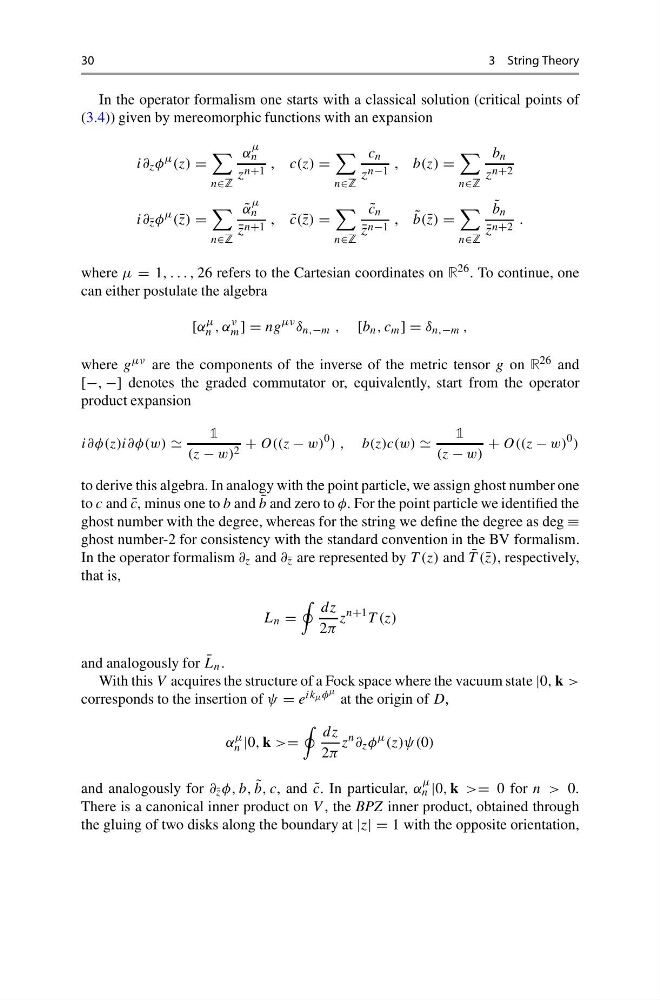
In the operator formalism one starts with a classical solution (critical points of
(3.4)) given by mereomorphic functions with an expansion
i∂ z φ
μ (z) =
n∈Z
α
μ
n
z n+1 , c(z) =
n∈Z
c n
z n−1 , b(z) =
n∈Z
b n
z n+2
i∂ ¯
z φ
μ (¯ z) =
n∈Z
˜
α
μ
n
¯
z n+1 , ˜
c(¯ z) =
n∈Z
˜
c n
¯
z n−1 , ˜
b(¯ z) =
n∈Z
˜
b n
¯
z n+2 .
where μ = 1, . . . , 26 refers to the Cartesian coordinates on R 26 . To continue, one
can either postulate the algebra
[α
μ
n , α
ν
m ] = ng
μν δ n,−m , [b n , c m ] = δ n,−m ,
where g μν are the components of the inverse of the metric tensor g on R 26 and
[−, −] denotes the graded commutator or, equivalently, start from the operator
product expansion
i∂φ(z)i∂φ(w)
1
(z − w) 2 + O((z − w)
0 ) , b(z)c(w)
1
(z − w)
+ O((z − w)
0 )
to derive this algebra. In analogy with the point particle, we assign ghost number one
to c and ˜
c, minus one to b and ˜
b and zero to φ. For the point particle we identified the
ghost number with the degree, whereas for the string we define the degree as deg ≡
ghost number-2 for consistency with the standard convention in the BV formalism.
In the operator formalism ∂ z and ∂ ¯
z are represented by T (z) and ¯
T (¯ z), respectively,
that is,
L n =
dz
2π
z
n+1 T (z)
and analogously for ¯
L n .
With this V acquires the structure of a Fock space where the vacuum state |0, k >
corresponds to the insertion of ψ = e ik μ φ μ at the origin of D,
α
μ
n |0, k >=
dz
2π
z
n ∂ z φ
μ (z)ψ(0)
and analogously for ∂ ¯
z φ, b, ˜
b, c, and ˜
c. In particular, α
μ
n |0, k >= 0 for n > 0.
There is a canonical inner product on V , the BPZ inner product, obtained through
the gluing of two disks along the boundary at |z| = 1 with the opposite orientation,
3 String Theory
In the operator formalism one starts with a classical solution (critical points of
(3.4)) given by mereomorphic functions with an expansion
i∂ z φ
μ (z) =
n∈Z
α
μ
n
z n+1 , c(z) =
n∈Z
c n
z n−1 , b(z) =
n∈Z
b n
z n+2
i∂ ¯
z φ
μ (¯ z) =
n∈Z
˜
α
μ
n
¯
z n+1 , ˜
c(¯ z) =
n∈Z
˜
c n
¯
z n−1 , ˜
b(¯ z) =
n∈Z
˜
b n
¯
z n+2 .
where μ = 1, . . . , 26 refers to the Cartesian coordinates on R 26 . To continue, one
can either postulate the algebra
[α
μ
n , α
ν
m ] = ng
μν δ n,−m , [b n , c m ] = δ n,−m ,
where g μν are the components of the inverse of the metric tensor g on R 26 and
[−, −] denotes the graded commutator or, equivalently, start from the operator
product expansion
i∂φ(z)i∂φ(w)
1
(z − w) 2 + O((z − w)
0 ) , b(z)c(w)
1
(z − w)
+ O((z − w)
0 )
to derive this algebra. In analogy with the point particle, we assign ghost number one
to c and ˜
c, minus one to b and ˜
b and zero to φ. For the point particle we identified the
ghost number with the degree, whereas for the string we define the degree as deg ≡
ghost number-2 for consistency with the standard convention in the BV formalism.
In the operator formalism ∂ z and ∂ ¯
z are represented by T (z) and ¯
T (¯ z), respectively,
that is,
L n =
dz
2π
z
n+1 T (z)
and analogously for ¯
L n .
With this V acquires the structure of a Fock space where the vacuum state |0, k >
corresponds to the insertion of ψ = e ik μ φ μ at the origin of D,
α
μ
n |0, k >=
dz
2π
z
n ∂ z φ
μ (z)ψ(0)
and analogously for ∂ ¯
z φ, b, ˜
b, c, and ˜
c. In particular, α
μ
n |0, k >= 0 for n > 0.
There is a canonical inner product on V , the BPZ inner product, obtained through
the gluing of two disks along the boundary at |z| = 1 with the opposite orientation,