

3.1 Closed Strings
31
that is
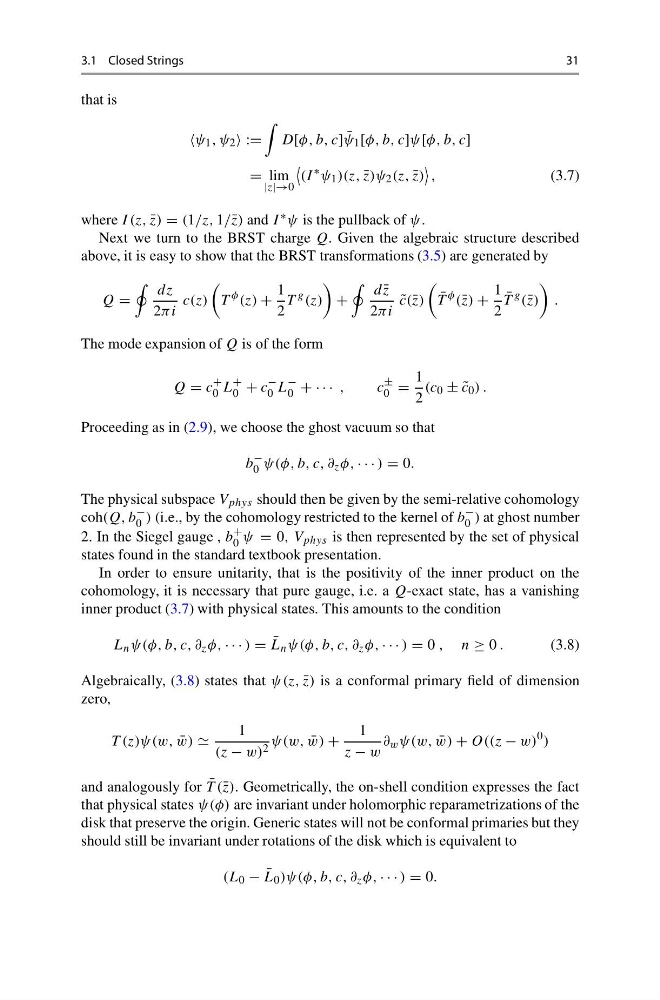
1 , ψ 2 :=
D[φ, b, c] ¯
ψ 1 [φ, b, c]ψ[φ, b, c]
= lim
|z|→0
(I
∗ ψ 1 )(z, ¯
z)ψ 2 (z, ¯
z)
,
(3.7)
where I (z, ¯
z) = (1/z, 1/¯ z) and I ∗ ψ is the pullback of ψ.
Next we turn to the BRST charge Q. Given the algebraic structure described
above, it is easy to show that the BRST transformations (3.5) are generated by
Q =
dz
2πi
c(z)
T
φ (z) +
1
2
T
g (z)
+
d ¯
z
2πi
˜
c(¯ z)
¯
T
φ (¯ z) +
1
2
¯
T
g (¯ z)
.
The mode expansion of Q is of the form
Q = c
+
0 L
+
0 + c
−
0 L
−
0 + · · · ,
c
±
0 =
1
2
(c 0 ± ˜
c 0 ) .
Proceeding as in (2.9), we choose the ghost vacuum so that
b
−
0 ψ(φ, b, c, ∂ z φ, · · · ) = 0.
The physical subspace V phys should then be given by the semi-relative cohomology
coh(Q, b
−
0 ) (i.e., by the cohomology restricted to the kernel of b
−
0 ) at ghost number
2. In the Siegel gauge , b
+
0 ψ = 0, V phys is then represented by the set of physical
states found in the standard textbook presentation.
In order to ensure unitarity, that is the positivity of the inner product on the
cohomology, it is necessary that pure gauge, i.e. a Q-exact state, has a vanishing
inner product (3.7) with physical states. This amounts to the condition
L n ψ(φ, b, c, ∂ z φ, · · · ) = ¯
L n ψ(φ, b, c, ∂ z φ, · · · ) = 0 , n ≥ 0 .
(3.8)
Algebraically, (3.8) states that ψ(z, ¯
z) is a conformal primary field of dimension
zero,
T (z)ψ(w, ¯
w)
1
(z − w) 2 ψ(w, ¯
w) +
1
z − w
∂ w ψ(w, ¯
w) + O((z − w)
0 )
and analogously for ¯
T (¯ z). Geometrically, the on-shell condition expresses the fact
that physical states ψ(φ) are invariant under holomorphic reparametrizations of the
disk that preserve the origin. Generic states will not be conformal primaries but they
should still be invariant under rotations of the disk which is equivalent to
(L 0 − ¯
L 0 )ψ(φ, b, c, ∂ z φ, · · · ) = 0.
31
that is
1 , ψ 2 :=
D[φ, b, c] ¯
ψ 1 [φ, b, c]ψ[φ, b, c]
= lim
|z|→0
(I
∗ ψ 1 )(z, ¯
z)ψ 2 (z, ¯
z)
,
(3.7)
where I (z, ¯
z) = (1/z, 1/¯ z) and I ∗ ψ is the pullback of ψ.
Next we turn to the BRST charge Q. Given the algebraic structure described
above, it is easy to show that the BRST transformations (3.5) are generated by
Q =
dz
2πi
c(z)
T
φ (z) +
1
2
T
g (z)
+
d ¯
z
2πi
˜
c(¯ z)
¯
T
φ (¯ z) +
1
2
¯
T
g (¯ z)
.
The mode expansion of Q is of the form
Q = c
+
0 L
+
0 + c
−
0 L
−
0 + · · · ,
c
±
0 =
1
2
(c 0 ± ˜
c 0 ) .
Proceeding as in (2.9), we choose the ghost vacuum so that
b
−
0 ψ(φ, b, c, ∂ z φ, · · · ) = 0.
The physical subspace V phys should then be given by the semi-relative cohomology
coh(Q, b
−
0 ) (i.e., by the cohomology restricted to the kernel of b
−
0 ) at ghost number
2. In the Siegel gauge , b
+
0 ψ = 0, V phys is then represented by the set of physical
states found in the standard textbook presentation.
In order to ensure unitarity, that is the positivity of the inner product on the
cohomology, it is necessary that pure gauge, i.e. a Q-exact state, has a vanishing
inner product (3.7) with physical states. This amounts to the condition
L n ψ(φ, b, c, ∂ z φ, · · · ) = ¯
L n ψ(φ, b, c, ∂ z φ, · · · ) = 0 , n ≥ 0 .
(3.8)
Algebraically, (3.8) states that ψ(z, ¯
z) is a conformal primary field of dimension
zero,
T (z)ψ(w, ¯
w)
1
(z − w) 2 ψ(w, ¯
w) +
1
z − w
∂ w ψ(w, ¯
w) + O((z − w)
0 )
and analogously for ¯
T (¯ z). Geometrically, the on-shell condition expresses the fact
that physical states ψ(φ) are invariant under holomorphic reparametrizations of the
disk that preserve the origin. Generic states will not be conformal primaries but they
should still be invariant under rotations of the disk which is equivalent to
(L 0 − ¯
L 0 )ψ(φ, b, c, ∂ z φ, · · · ) = 0.