

3.1 Closed Strings
29
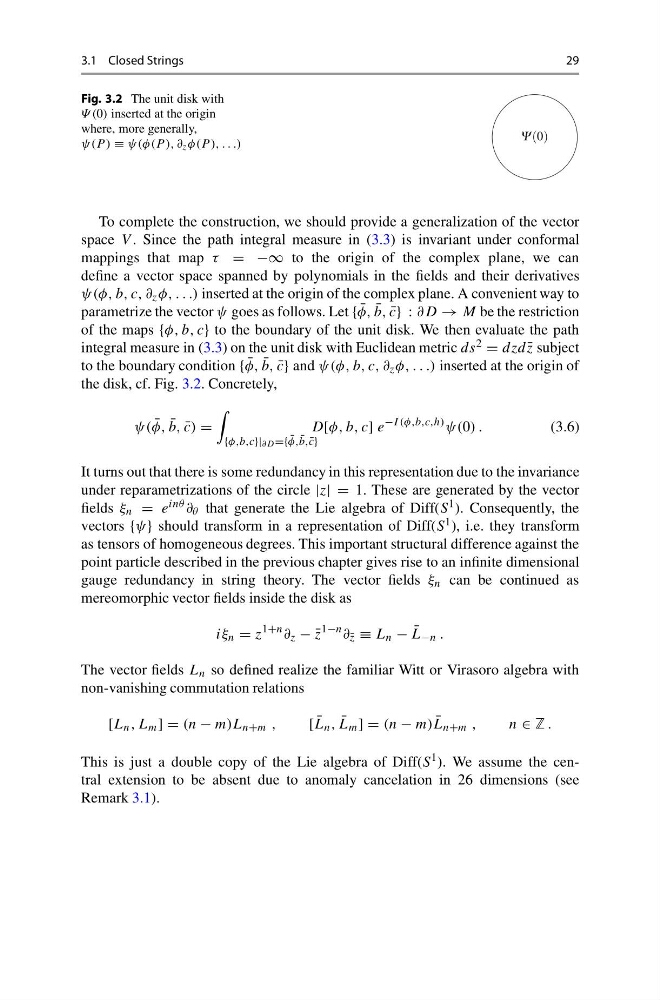
Fig. 3.2 The unit disk with
Ψ (0) inserted at the origin
where, more generally,
ψ(P ) ≡ ψ(φ(P ), ∂ z φ(P ), . . .)
Ψ (0)
To complete the construction, we should provide a generalization of the vector
space V . Since the path integral measure in (3.3) is invariant under conformal
mappings that map τ = −∞ to the origin of the complex plane, we can
define a vector space spanned by polynomials in the fields and their derivatives
ψ(φ, b, c, ∂ z φ, . . .) inserted at the origin of the complex plane. A convenient way to
parametrize the vector ψ goes as follows. Let { ¯
φ, ¯
b, ¯
c} : ∂D → M be the restriction
of the maps {φ, b, c} to the boundary of the unit disk. We then evaluate the path
integral measure in (3.3) on the unit disk with Euclidean metric ds 2 = dzd ¯
z subject
to the boundary condition { ¯
φ, ¯
b, ¯
c} and ψ(φ, b, c, ∂ z φ, . . .) inserted at the origin of
the disk, cf. Fig. 3.2. Concretely,
ψ( ¯
φ, ¯
b, ¯
c) =
{φ,b,c}| ∂D ={ ¯
φ, ¯
b, ¯
c}
D[φ, b, c] e
−I (φ,b,c,h) ψ(0) .
(3.6)
It turns out that there is some redundancy in this representation due to the invariance
under reparametrizations of the circle |z| = 1. These are generated by the vector
fields ξ n = e inθ ∂ θ that generate the Lie algebra of Diff(S 1 ). Consequently, the
vectors {ψ} should transform in a representation of Diff(S 1 ), i.e. they transform
as tensors of homogeneous degrees. This important structural difference against the
point particle described in the previous chapter gives rise to an infinite dimensional
gauge redundancy in string theory. The vector fields ξ n can be continued as
mereomorphic vector fields inside the disk as
iξ n = z
1+n ∂ z − ¯
z
1−n ∂ ¯
z ≡ L n − ¯
L −n .
The vector fields L n so defined realize the familiar Witt or Virasoro algebra with
non-vanishing commutation relations
[L n , L m ] = (n − m)L n+m ,
[ ¯
L n , ¯
L m ] = (n − m) ¯
L n+m ,
n∈ Z .
This is just a double copy of the Lie algebra of Diff(S 1 ). We assume the central extension to be absent due to anomaly cancelation in 26 dimensions (see
Remark 3.1).
29
Fig. 3.2 The unit disk with
Ψ (0) inserted at the origin
where, more generally,
ψ(P ) ≡ ψ(φ(P ), ∂ z φ(P ), . . .)
Ψ (0)
To complete the construction, we should provide a generalization of the vector
space V . Since the path integral measure in (3.3) is invariant under conformal
mappings that map τ = −∞ to the origin of the complex plane, we can
define a vector space spanned by polynomials in the fields and their derivatives
ψ(φ, b, c, ∂ z φ, . . .) inserted at the origin of the complex plane. A convenient way to
parametrize the vector ψ goes as follows. Let { ¯
φ, ¯
b, ¯
c} : ∂D → M be the restriction
of the maps {φ, b, c} to the boundary of the unit disk. We then evaluate the path
integral measure in (3.3) on the unit disk with Euclidean metric ds 2 = dzd ¯
z subject
to the boundary condition { ¯
φ, ¯
b, ¯
c} and ψ(φ, b, c, ∂ z φ, . . .) inserted at the origin of
the disk, cf. Fig. 3.2. Concretely,
ψ( ¯
φ, ¯
b, ¯
c) =
{φ,b,c}| ∂D ={ ¯
φ, ¯
b, ¯
c}
D[φ, b, c] e
−I (φ,b,c,h) ψ(0) .
(3.6)
It turns out that there is some redundancy in this representation due to the invariance
under reparametrizations of the circle |z| = 1. These are generated by the vector
fields ξ n = e inθ ∂ θ that generate the Lie algebra of Diff(S 1 ). Consequently, the
vectors {ψ} should transform in a representation of Diff(S 1 ), i.e. they transform
as tensors of homogeneous degrees. This important structural difference against the
point particle described in the previous chapter gives rise to an infinite dimensional
gauge redundancy in string theory. The vector fields ξ n can be continued as
mereomorphic vector fields inside the disk as
iξ n = z
1+n ∂ z − ¯
z
1−n ∂ ¯
z ≡ L n − ¯
L −n .
The vector fields L n so defined realize the familiar Witt or Virasoro algebra with
non-vanishing commutation relations
[L n , L m ] = (n − m)L n+m ,
[ ¯
L n , ¯
L m ] = (n − m) ¯
L n+m ,
n∈ Z .
This is just a double copy of the Lie algebra of Diff(S 1 ). We assume the central extension to be absent due to anomaly cancelation in 26 dimensions (see
Remark 3.1).