

8.1 BV Algebras and the Master Equation
197
where α → αg is the action dual to the action of G on V . Notice also that for
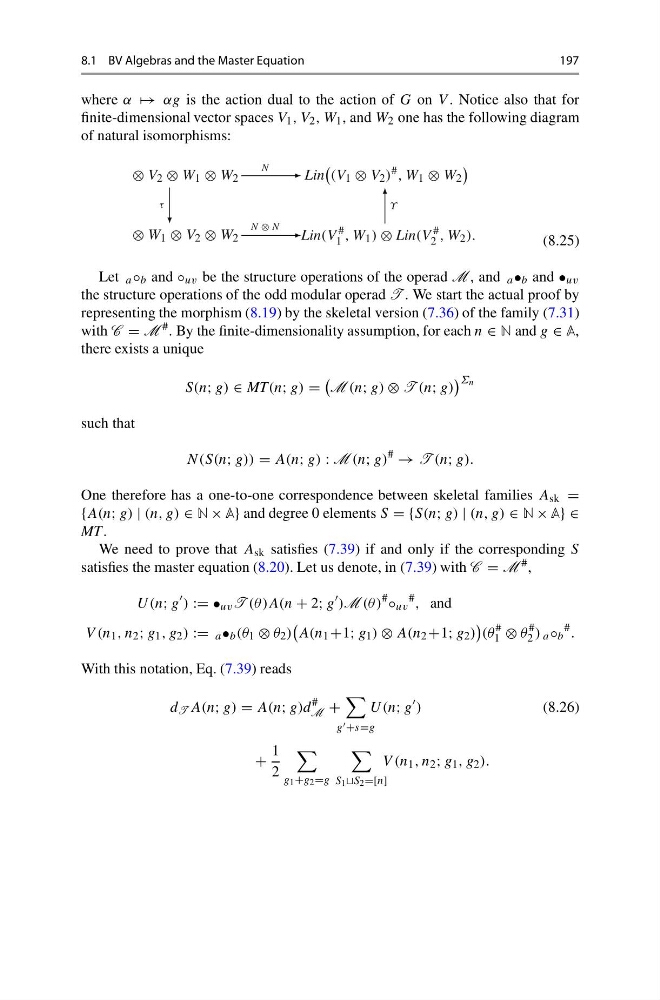
finite-dimensional vector spaces V 1 , V 2 , W 1 , and W 2 one has the following diagram
of natural isomorphisms:
N ⊗ N
Υ
τ
N
Lin(V #
1 , W 1 ) ⊗ Lin(V #
2 , W 2 ).
⊗ W 1 ⊗ V 2 ⊗ W 2
Lin (V 1 ⊗ V 2 ) # , W 1 ⊗ W 2
⊗ V 2 ⊗ W 1 ⊗ W 2
(8.25)
Let a ◦ b and ◦ uv be the structure operations of the operad M , and a • b and • uv
the structure operations of the odd modular operad T . We start the actual proof by
representing the morphism (8.19) by the skeletal version (7.36) of the family (7.31)
with C = M # . By the finite-dimensionality assumption, for each n ∈ N and g ∈ A,
there exists a unique
S(n; g) ∈ MT(n; g) =
M (n; g) ⊗ T (n; g)
Σ n
such that
N(S(n; g)) = A(n; g) : M (n; g)
#
→ T (n; g).
One therefore has a one-to-one correspondence between skeletal families A sk =
{A(n; g) | (n, g) ∈ N × A} and degree 0 elements S = {S(n; g) | (n, g) ∈ N × A} ∈
MT.
We need to prove that A sk satisfies (7.39) if and only if the corresponding S
satisfies the master equation (8.20). Let us denote, in (7.39) with C = M # ,
U(n; g
) := • uv T (θ )A(n + 2; g
)M (θ )
#
◦ uv
# , and
V (n 1 , n 2 ; g 1 , g 2 ) := a • b (θ 1 ⊗ θ 2 )
A(n 1 +1; g 1 ) ⊗ A(n 2 +1; g 2 )
(θ
#
1 ⊗ θ
#
2 ) a ◦ b
# .
With this notation, Eq. (7.39) reads
d T A(n; g) = A(n; g)d
#
M +
g +s=g
U(n; g
)
(8.26)
+
1
2
g 1 +g 2 =g
S 1 2 =[n]
V (n 1 , n 2 ; g 1 , g 2 ).
197
where α → αg is the action dual to the action of G on V . Notice also that for
finite-dimensional vector spaces V 1 , V 2 , W 1 , and W 2 one has the following diagram
of natural isomorphisms:
N ⊗ N
Υ
τ
N
Lin(V #
1 , W 1 ) ⊗ Lin(V #
2 , W 2 ).
⊗ W 1 ⊗ V 2 ⊗ W 2
Lin (V 1 ⊗ V 2 ) # , W 1 ⊗ W 2
⊗ V 2 ⊗ W 1 ⊗ W 2
(8.25)
Let a ◦ b and ◦ uv be the structure operations of the operad M , and a • b and • uv
the structure operations of the odd modular operad T . We start the actual proof by
representing the morphism (8.19) by the skeletal version (7.36) of the family (7.31)
with C = M # . By the finite-dimensionality assumption, for each n ∈ N and g ∈ A,
there exists a unique
S(n; g) ∈ MT(n; g) =
M (n; g) ⊗ T (n; g)
Σ n
such that
N(S(n; g)) = A(n; g) : M (n; g)
#
→ T (n; g).
One therefore has a one-to-one correspondence between skeletal families A sk =
{A(n; g) | (n, g) ∈ N × A} and degree 0 elements S = {S(n; g) | (n, g) ∈ N × A} ∈
MT.
We need to prove that A sk satisfies (7.39) if and only if the corresponding S
satisfies the master equation (8.20). Let us denote, in (7.39) with C = M # ,
U(n; g
) := • uv T (θ )A(n + 2; g
)M (θ )
#
◦ uv
# , and
V (n 1 , n 2 ; g 1 , g 2 ) := a • b (θ 1 ⊗ θ 2 )
A(n 1 +1; g 1 ) ⊗ A(n 2 +1; g 2 )
(θ
#
1 ⊗ θ
#
2 ) a ◦ b
# .
With this notation, Eq. (7.39) reads
d T A(n; g) = A(n; g)d
#
M +
g +s=g
U(n; g
)
(8.26)
+
1
2
g 1 +g 2 =g
S 1 2 =[n]
V (n 1 , n 2 ; g 1 , g 2 ).