

198
8 Structures Relevant to Physics
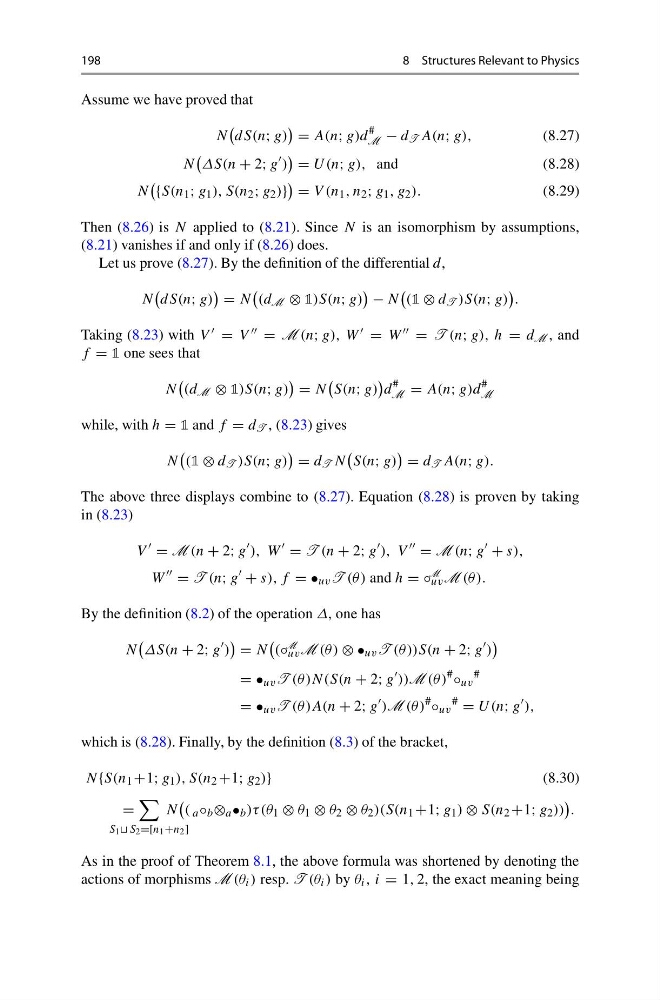
Assume we have proved that
N
dS(n; g)
= A(n; g)d
#
M − d T A(n; g),
(8.27)
N
ΔS(n + 2; g
)
= U(n; g), and
(8.28)
N
{S(n 1 ; g 1 ), S(n 2 ; g 2 )}
= V (n 1 , n 2 ; g 1 , g 2 ).
(8.29)
Then (8.26) is N applied to (8.21). Since N is an isomorphism by assumptions,
(8.21) vanishes if and only if (8.26) does.
Let us prove (8.27). By the definition of the differential d,
N
dS(n; g)
= N
(d M ⊗ 1)S(n; g)
− N
(1 ⊗ d T )S(n; g)
.
Taking (8.23) with V = V = M (n; g), W = W = T (n; g), h = d M , and
f = 1 one sees that
N
(d M ⊗ 1)S(n; g)
= N
S(n; g)
d
#
M = A(n; g)d
#
M
while, with h = 1 and f = d T , (8.23) gives
N
(1 ⊗ d T )S(n; g)
= d T N
S(n; g)
= d T A(n; g).
The above three displays combine to (8.27). Equation (8.28) is proven by taking
in (8.23)
V
= M (n + 2; g
), W
= T (n + 2; g
), V
= M (n; g
+ s),
W
= T (n; g
+ s), f = • uv T (θ ) and h = ◦
M
uv M (θ ).
By the definition (8.2) of the operation Δ, one has
N
ΔS(n + 2; g
)
= N
(◦
M
uv M (θ ) ⊗ • uv T (θ ))S(n + 2; g
)
= • uv T (θ )N(S(n + 2; g
))M (θ )
#
◦ uv
#
= • uv T (θ )A(n + 2; g
)M (θ )
#
◦ uv
#
= U(n; g
),
which is (8.28). Finally, by the definition (8.3) of the bracket,
N{S(n 1 +1; g 1 ), S(n 2 +1; g 2 )}
(8.30)
=
S 1 S 2 =[n 1 +n 2 ]
N
( a ◦ b ⊗ a • b )τ (θ 1 ⊗ θ 1 ⊗ θ 2 ⊗ θ 2 )(S(n 1 +1; g 1 ) ⊗ S(n 2 +1; g 2 ))
.
As in the proof of Theorem 8.1, the above formula was shortened by denoting the
actions of morphisms M (θ i ) resp. T (θ i ) by θ i , i = 1, 2, the exact meaning being
8 Structures Relevant to Physics
Assume we have proved that
N
dS(n; g)
= A(n; g)d
#
M − d T A(n; g),
(8.27)
N
ΔS(n + 2; g
)
= U(n; g), and
(8.28)
N
{S(n 1 ; g 1 ), S(n 2 ; g 2 )}
= V (n 1 , n 2 ; g 1 , g 2 ).
(8.29)
Then (8.26) is N applied to (8.21). Since N is an isomorphism by assumptions,
(8.21) vanishes if and only if (8.26) does.
Let us prove (8.27). By the definition of the differential d,
N
dS(n; g)
= N
(d M ⊗ 1)S(n; g)
− N
(1 ⊗ d T )S(n; g)
.
Taking (8.23) with V = V = M (n; g), W = W = T (n; g), h = d M , and
f = 1 one sees that
N
(d M ⊗ 1)S(n; g)
= N
S(n; g)
d
#
M = A(n; g)d
#
M
while, with h = 1 and f = d T , (8.23) gives
N
(1 ⊗ d T )S(n; g)
= d T N
S(n; g)
= d T A(n; g).
The above three displays combine to (8.27). Equation (8.28) is proven by taking
in (8.23)
V
= M (n + 2; g
), W
= T (n + 2; g
), V
= M (n; g
+ s),
W
= T (n; g
+ s), f = • uv T (θ ) and h = ◦
M
uv M (θ ).
By the definition (8.2) of the operation Δ, one has
N
ΔS(n + 2; g
)
= N
(◦
M
uv M (θ ) ⊗ • uv T (θ ))S(n + 2; g
)
= • uv T (θ )N(S(n + 2; g
))M (θ )
#
◦ uv
#
= • uv T (θ )A(n + 2; g
)M (θ )
#
◦ uv
#
= U(n; g
),
which is (8.28). Finally, by the definition (8.3) of the bracket,
N{S(n 1 +1; g 1 ), S(n 2 +1; g 2 )}
(8.30)
=
S 1 S 2 =[n 1 +n 2 ]
N
( a ◦ b ⊗ a • b )τ (θ 1 ⊗ θ 1 ⊗ θ 2 ⊗ θ 2 )(S(n 1 +1; g 1 ) ⊗ S(n 2 +1; g 2 ))
.
As in the proof of Theorem 8.1, the above formula was shortened by denoting the
actions of morphisms M (θ i ) resp. T (θ i ) by θ i , i = 1, 2, the exact meaning being