

196
8 Structures Relevant to Physics
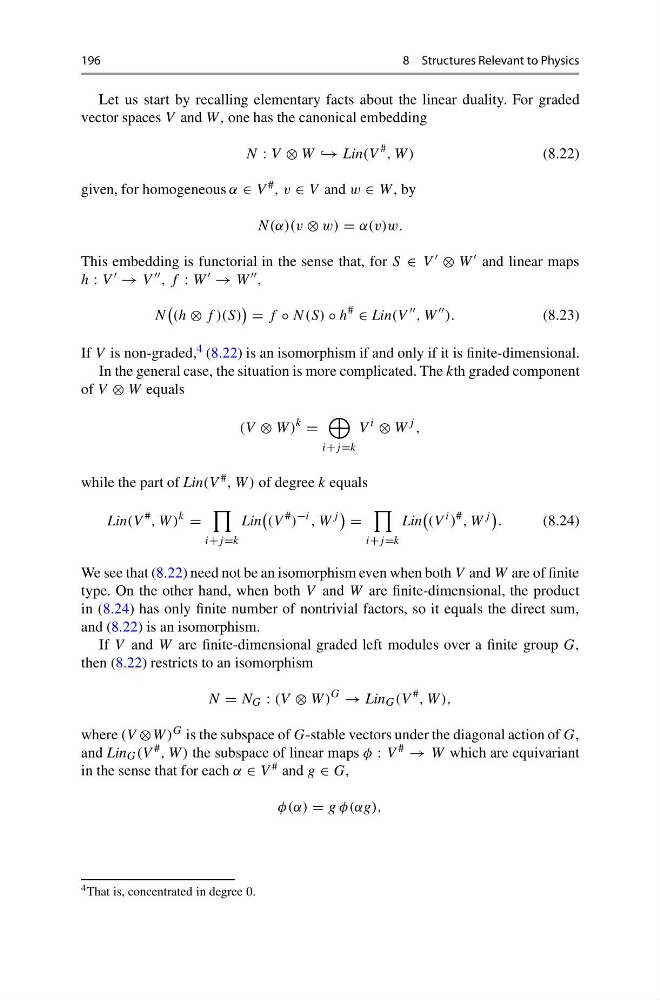
Let us start by recalling elementary facts about the linear duality. For graded
vector spaces V and W , one has the canonical embedding
N : V ⊗ W W→ Lin(V
# , W)
(8.22)
given, for homogeneous α ∈ V # , v ∈ V and w ∈ W , by
N(α)(v ⊗ w) = α(v)w.
This embedding is functorial in the sense that, for S ∈ V ⊗ W and linear maps
h : V → V , f : W → W ,
N
(h ⊗ f )(S)
= f ◦ N(S) ◦ h
#
∈ Lin(V
, W
).
(8.23)
If V is non-graded, 4 (8.22) is an isomorphism if and only if it is finite-dimensional.
In the general case, the situation is more complicated. The kth graded component
of V ⊗ W equals
(V ⊗ W )
k
=
i+j =k
V
i
⊗ W
j ,
while the part of Lin(V # , W) of degree k equals
Lin(V
# , W)
k
=
i+j =k
Lin
(V
# )
−i , W
j
=
i+j =k
Lin
(V
i )
# , W
j
.
(8.24)
We see that (8.22) need not be an isomorphism even when both V and W are of finite
type. On the other hand, when both V and W are finite-dimensional, the product
in (8.24) has only finite number of nontrivial factors, so it equals the direct sum,
and (8.22) is an isomorphism.
If V and W are finite-dimensional graded left modules over a finite group G,
then (8.22) restricts to an isomorphism
N = N G : (V ⊗ W )
G
→ Lin G (V
# , W),
where (V ⊗W ) G is the subspace of G-stable vectors under the diagonal action of G,
and Lin G (V # , W) the subspace of linear maps φ : V # → W which are equivariant
in the sense that for each α ∈ V # and g ∈ G,
φ(α) = g φ(αg),
4 That is, concentrated in degree 0.
8 Structures Relevant to Physics
Let us start by recalling elementary facts about the linear duality. For graded
vector spaces V and W , one has the canonical embedding
N : V ⊗ W W→ Lin(V
# , W)
(8.22)
given, for homogeneous α ∈ V # , v ∈ V and w ∈ W , by
N(α)(v ⊗ w) = α(v)w.
This embedding is functorial in the sense that, for S ∈ V ⊗ W and linear maps
h : V → V , f : W → W ,
N
(h ⊗ f )(S)
= f ◦ N(S) ◦ h
#
∈ Lin(V
, W
).
(8.23)
If V is non-graded, 4 (8.22) is an isomorphism if and only if it is finite-dimensional.
In the general case, the situation is more complicated. The kth graded component
of V ⊗ W equals
(V ⊗ W )
k
=
i+j =k
V
i
⊗ W
j ,
while the part of Lin(V # , W) of degree k equals
Lin(V
# , W)
k
=
i+j =k
Lin
(V
# )
−i , W
j
=
i+j =k
Lin
(V
i )
# , W
j
.
(8.24)
We see that (8.22) need not be an isomorphism even when both V and W are of finite
type. On the other hand, when both V and W are finite-dimensional, the product
in (8.24) has only finite number of nontrivial factors, so it equals the direct sum,
and (8.22) is an isomorphism.
If V and W are finite-dimensional graded left modules over a finite group G,
then (8.22) restricts to an isomorphism
N = N G : (V ⊗ W )
G
→ Lin G (V
# , W),
where (V ⊗W ) G is the subspace of G-stable vectors under the diagonal action of G,
and Lin G (V # , W) the subspace of linear maps φ : V # → W which are equivariant
in the sense that for each α ∈ V # and g ∈ G,
φ(α) = g φ(αg),
4 That is, concentrated in degree 0.