

156
6 Operads
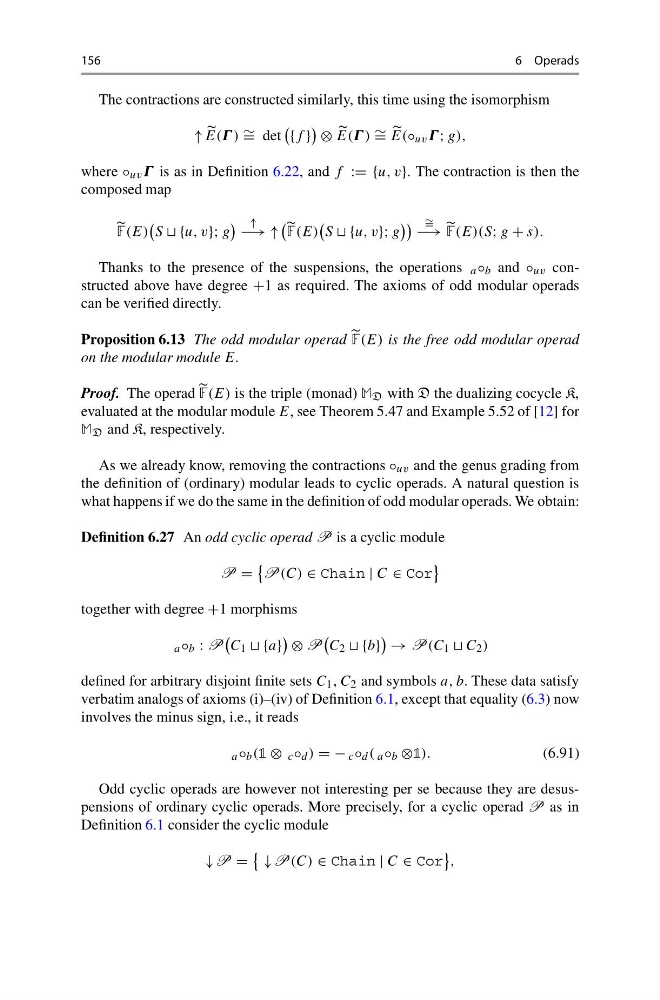
The contractions are constructed similarly, this time using the isomorphism
↑
E(Γ ) ∼ = det
{f }
⊗
E(Γ ) ∼ =
E(◦ uv Γ ; g),
where ◦ uv Γ is as in Definition 6.22, and f := {u, v}. The contraction is then the
composed map
F(E)
S {u, v}; g
↑
−→ ↑
F(E)
S {u, v}; g
∼ =
−→ F(E)(S; g + s).
Thanks to the presence of the suspensions, the operations a ◦ b and ◦ uv constructed above have degree +1 as required. The axioms of odd modular operads
can be verified directly.
Proposition 6.13 The odd modular operad F(E) is the free odd modular operad
on the modular module E.
Proof. The operad F(E) is the triple (monad) M D with D the dualizing cocycle K,
evaluated at the modular module E, see Theorem 5.47 and Example 5.52 of [12] for
M D and K, respectively.
As we already know, removing the contractions ◦ uv and the genus grading from
the definition of (ordinary) modular leads to cyclic operads. A natural question is
what happens if we do the same in the definition of odd modular operads. We obtain:
Definition 6.27 An odd cyclic operad P is a cyclic module
P =
P(C) ∈ Chain | C ∈ Cor
together with degree +1 morphisms
a ◦ b : P
C 1 {a}
⊗ P
C 2 {b}
→ P(C 1 C 2 )
defined for arbitrary disjoint finite sets C 1 , C 2 and symbols a, b. These data satisfy
verbatim analogs of axioms (i)–(iv) of Definition 6.1, except that equality (6.3) now
involves the minus sign, i.e., it reads
a ◦ b (1 ⊗ c ◦ d ) = − c ◦ d ( a ◦ b ⊗1).
(6.91)
Odd cyclic operads are however not interesting per se because they are desuspensions of ordinary cyclic operads. More precisely, for a cyclic operad P as in
Definition 6.1 consider the cyclic module
↓ P =
↓ P(C) ∈ Chain | C ∈ Cor
,
6 Operads
The contractions are constructed similarly, this time using the isomorphism
↑
E(Γ ) ∼ = det
{f }
⊗
E(Γ ) ∼ =
E(◦ uv Γ ; g),
where ◦ uv Γ is as in Definition 6.22, and f := {u, v}. The contraction is then the
composed map
F(E)
S {u, v}; g
↑
−→ ↑
F(E)
S {u, v}; g
∼ =
−→ F(E)(S; g + s).
Thanks to the presence of the suspensions, the operations a ◦ b and ◦ uv constructed above have degree +1 as required. The axioms of odd modular operads
can be verified directly.
Proposition 6.13 The odd modular operad F(E) is the free odd modular operad
on the modular module E.
Proof. The operad F(E) is the triple (monad) M D with D the dualizing cocycle K,
evaluated at the modular module E, see Theorem 5.47 and Example 5.52 of [12] for
M D and K, respectively.
As we already know, removing the contractions ◦ uv and the genus grading from
the definition of (ordinary) modular leads to cyclic operads. A natural question is
what happens if we do the same in the definition of odd modular operads. We obtain:
Definition 6.27 An odd cyclic operad P is a cyclic module
P =
P(C) ∈ Chain | C ∈ Cor
together with degree +1 morphisms
a ◦ b : P
C 1 {a}
⊗ P
C 2 {b}
→ P(C 1 C 2 )
defined for arbitrary disjoint finite sets C 1 , C 2 and symbols a, b. These data satisfy
verbatim analogs of axioms (i)–(iv) of Definition 6.1, except that equality (6.3) now
involves the minus sign, i.e., it reads
a ◦ b (1 ⊗ c ◦ d ) = − c ◦ d ( a ◦ b ⊗1).
(6.91)
Odd cyclic operads are however not interesting per se because they are desuspensions of ordinary cyclic operads. More precisely, for a cyclic operad P as in
Definition 6.1 consider the cyclic module
↓ P =
↓ P(C) ∈ Chain | C ∈ Cor
,