

6.5 Odd Modular Operads
155
where ∧ |X| (−) denotes the |X|th exterior (Grassmann) power. Since k X is the space
of k-valued functions on X, det(X) is “contravariant in X.”
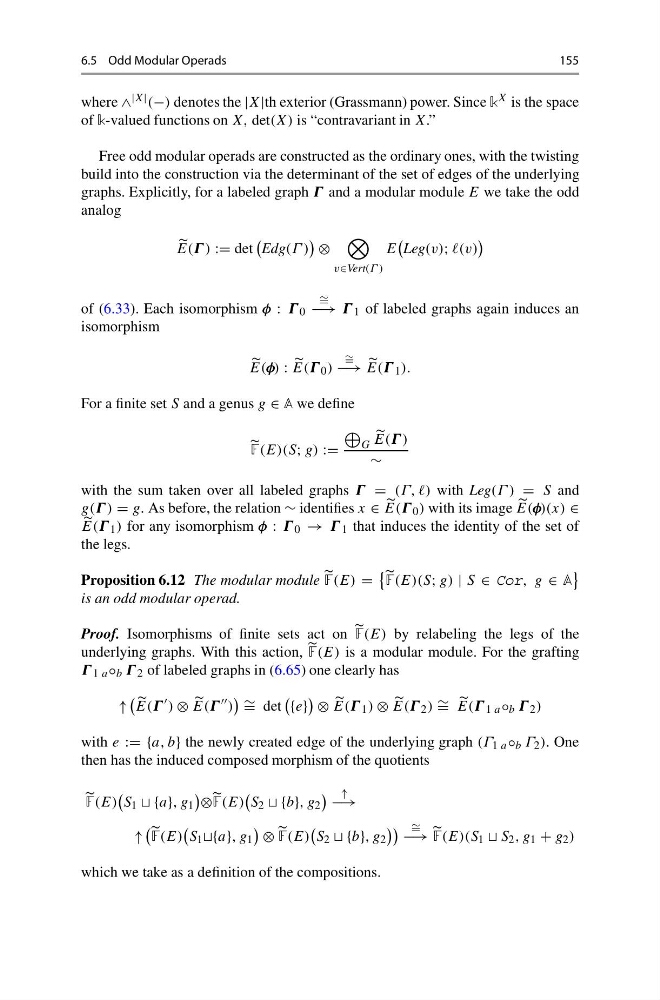
Free odd modular operads are constructed as the ordinary ones, with the twisting
build into the construction via the determinant of the set of edges of the underlying
graphs. Explicitly, for a labeled graph Γ and a modular module E we take the odd
analog
E(Γ ) := det
Edg(Γ )
⊗
v∈Vert(Γ )
E
Leg(v); (v)
of (6.33). Each isomorphism φ
φ : Γ 0
∼ =
−→ Γ 1 of labeled graphs again induces an
isomorphism
E(φ φ) :
E(Γ 0 )
∼ =
−→
E(Γ 1 ).
For a finite set S and a genus g ∈ A we define
F(E)(S; g) :=
G
E(Γ )
∼
with the sum taken over all labeled graphs Γ = (Γ, ,) with Leg(Γ ) = S and
g(Γ ) = g. As before, the relation ∼ identifies x ∈
E(Γ 0 ) with its image
E(φ φ)(x) ∈
E(Γ 1 ) for any isomorphism φ
φ : Γ 0 → Γ 1 that induces the identity of the set of
the legs.
Proposition 6.12 The modular module F(E) =
F(E)(S; g) | S ∈ Cor, g ∈ A
is an odd modular operad.
Proof. Isomorphisms of finite sets act on F(E) by relabeling the legs of the
underlying graphs. With this action, F(E) is a modular module. For the grafting
Γ 1 a ◦ b Γ 2 of labeled graphs in (6.65) one clearly has
↑
E(Γ
) ⊗
E(Γ
)
∼ = det
{e}
⊗
E(Γ 1 ) ⊗
E(Γ 2 ) ∼ =
E(Γ 1 a ◦ b Γ 2 )
with e := {a, b} the newly created edge of the underlying graph (Γ 1 a ◦ b Γ 2 ). One
then has the induced composed morphism of the quotients
F(E)
S 1 {a}, g 1
⊗ F(E)
S 2 {b}, g 2
↑
−→
↑
F(E)
S 1 g 1
⊗ F(E)
S 2 {b}, g 2
∼ =
−→ F(E)(S 1 S 2 , g 1 + g 2 )
which we take as a definition of the compositions.
155
where ∧ |X| (−) denotes the |X|th exterior (Grassmann) power. Since k X is the space
of k-valued functions on X, det(X) is “contravariant in X.”
Free odd modular operads are constructed as the ordinary ones, with the twisting
build into the construction via the determinant of the set of edges of the underlying
graphs. Explicitly, for a labeled graph Γ and a modular module E we take the odd
analog
E(Γ ) := det
Edg(Γ )
⊗
v∈Vert(Γ )
E
Leg(v); (v)
of (6.33). Each isomorphism φ
φ : Γ 0
∼ =
−→ Γ 1 of labeled graphs again induces an
isomorphism
E(φ φ) :
E(Γ 0 )
∼ =
−→
E(Γ 1 ).
For a finite set S and a genus g ∈ A we define
F(E)(S; g) :=
G
E(Γ )
∼
with the sum taken over all labeled graphs Γ = (Γ, ,) with Leg(Γ ) = S and
g(Γ ) = g. As before, the relation ∼ identifies x ∈
E(Γ 0 ) with its image
E(φ φ)(x) ∈
E(Γ 1 ) for any isomorphism φ
φ : Γ 0 → Γ 1 that induces the identity of the set of
the legs.
Proposition 6.12 The modular module F(E) =
F(E)(S; g) | S ∈ Cor, g ∈ A
is an odd modular operad.
Proof. Isomorphisms of finite sets act on F(E) by relabeling the legs of the
underlying graphs. With this action, F(E) is a modular module. For the grafting
Γ 1 a ◦ b Γ 2 of labeled graphs in (6.65) one clearly has
↑
E(Γ
) ⊗
E(Γ
)
∼ = det
{e}
⊗
E(Γ 1 ) ⊗
E(Γ 2 ) ∼ =
E(Γ 1 a ◦ b Γ 2 )
with e := {a, b} the newly created edge of the underlying graph (Γ 1 a ◦ b Γ 2 ). One
then has the induced composed morphism of the quotients
F(E)
S 1 {a}, g 1
⊗ F(E)
S 2 {b}, g 2
↑
−→
↑
F(E)
S 1 g 1
⊗ F(E)
S 2 {b}, g 2
∼ =
−→ F(E)(S 1 S 2 , g 1 + g 2 )
which we take as a definition of the compositions.