

References
157
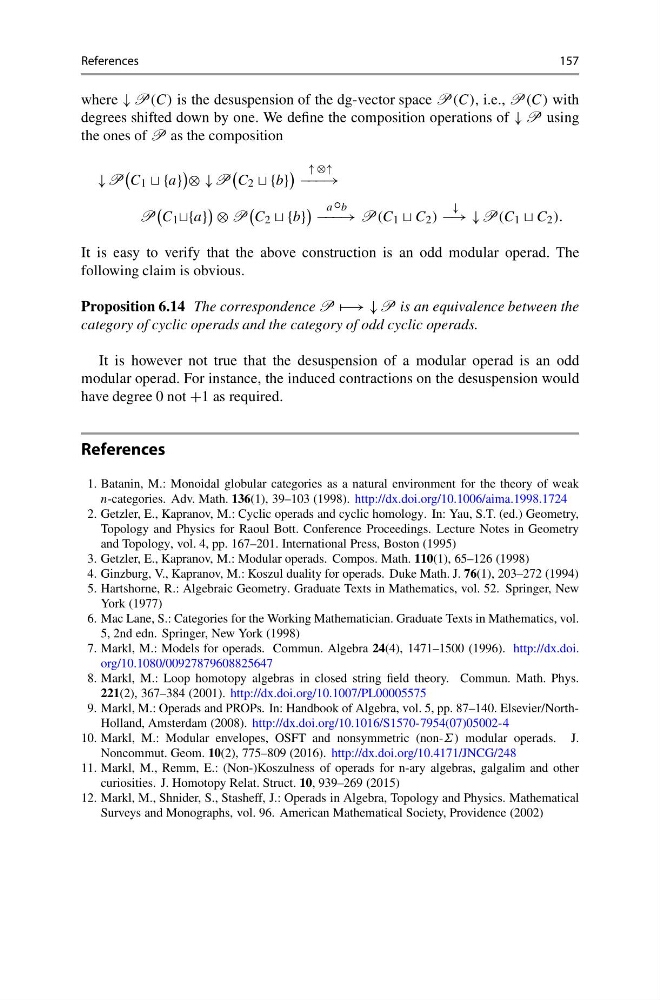
where ↓ P(C) is the desuspension of the dg-vector space P(C), i.e., P(C) with
degrees shifted down by one. We define the composition operations of ↓ P using
the ones of P as the composition
↓ P
C 1 {a}
⊗ ↓P
C 2 {b}
↑ ⊗↑
−−−→
P
C 1
⊗ P
C 2 {b}
a ◦ b
−−−→ P(C 1 C 2 )
↓
−→ ↓ P(C 1 C 2 ).
It is easy to verify that the above construction is an odd modular operad. The
following claim is obvious.
Proposition 6.14 The correspondence P −→ ↓ P is an equivalence between the
category of cyclic operads and the category of odd cyclic operads.
It is however not true that the desuspension of a modular operad is an odd
modular operad. For instance, the induced contractions on the desuspension would
have degree 0 not +1 as required.
References
1. Batanin, M.: Monoidal globular categories as a natural environment for the theory of weak
n-categories. Adv. Math. 136(1), 39–103 (1998). http://dx.doi.org/10.1006/aima.1998.1724
2. Getzler, E., Kapranov, M.: Cyclic operads and cyclic homology. In: Yau, S.T. (ed.) Geometry,
Topology and Physics for Raoul Bott. Conference Proceedings. Lecture Notes in Geometry
and Topology, vol. 4, pp. 167–201. International Press, Boston (1995)
3. Getzler, E., Kapranov, M.: Modular operads. Compos. Math. 110(1), 65–126 (1998)
4. Ginzburg, V., Kapranov, M.: Koszul duality for operads. Duke Math. J. 76(1), 203–272 (1994)
5. Hartshorne, R.: Algebraic Geometry. Graduate Texts in Mathematics, vol. 52. Springer, New
York (1977)
6. Mac Lane, S.: Categories for the Working Mathematician. Graduate Texts in Mathematics, vol.
5, 2nd edn. Springer, New York (1998)
7. Markl, M.: Models for operads. Commun. Algebra 24(4), 1471–1500 (1996). http://dx.doi.
org/10.1080/00927879608825647
8. Markl, M.: Loop homotopy algebras in closed string field theory. Commun. Math. Phys.
221(2), 367–384 (2001). http://dx.doi.org/10.1007/PL00005575
9. Markl, M.: Operads and PROPs. In: Handbook of Algebra, vol. 5, pp. 87–140. Elsevier/NorthHolland, Amsterdam (2008). http://dx.doi.org/10.1016/S1570-7954(07)05002-4
10. Markl, M.: Modular envelopes, OSFT and nonsymmetric (non-Σ) modular operads. J.
Noncommut. Geom. 10(2), 775–809 (2016). http://dx.doi.org/10.4171/JNCG/248
11. Markl, M., Remm, E.: (Non-)Koszulness of operads for n-ary algebras, galgalim and other
curiosities. J. Homotopy Relat. Struct. 10, 939–269 (2015)
12. Markl, M., Shnider, S., Stasheff, J.: Operads in Algebra, Topology and Physics. Mathematical
Surveys and Monographs, vol. 96. American Mathematical Society, Providence (2002)
157
where ↓ P(C) is the desuspension of the dg-vector space P(C), i.e., P(C) with
degrees shifted down by one. We define the composition operations of ↓ P using
the ones of P as the composition
↓ P
C 1 {a}
⊗ ↓P
C 2 {b}
↑ ⊗↑
−−−→
P
C 1
⊗ P
C 2 {b}
a ◦ b
−−−→ P(C 1 C 2 )
↓
−→ ↓ P(C 1 C 2 ).
It is easy to verify that the above construction is an odd modular operad. The
following claim is obvious.
Proposition 6.14 The correspondence P −→ ↓ P is an equivalence between the
category of cyclic operads and the category of odd cyclic operads.
It is however not true that the desuspension of a modular operad is an odd
modular operad. For instance, the induced contractions on the desuspension would
have degree 0 not +1 as required.
References
1. Batanin, M.: Monoidal globular categories as a natural environment for the theory of weak
n-categories. Adv. Math. 136(1), 39–103 (1998). http://dx.doi.org/10.1006/aima.1998.1724
2. Getzler, E., Kapranov, M.: Cyclic operads and cyclic homology. In: Yau, S.T. (ed.) Geometry,
Topology and Physics for Raoul Bott. Conference Proceedings. Lecture Notes in Geometry
and Topology, vol. 4, pp. 167–201. International Press, Boston (1995)
3. Getzler, E., Kapranov, M.: Modular operads. Compos. Math. 110(1), 65–126 (1998)
4. Ginzburg, V., Kapranov, M.: Koszul duality for operads. Duke Math. J. 76(1), 203–272 (1994)
5. Hartshorne, R.: Algebraic Geometry. Graduate Texts in Mathematics, vol. 52. Springer, New
York (1977)
6. Mac Lane, S.: Categories for the Working Mathematician. Graduate Texts in Mathematics, vol.
5, 2nd edn. Springer, New York (1998)
7. Markl, M.: Models for operads. Commun. Algebra 24(4), 1471–1500 (1996). http://dx.doi.
org/10.1080/00927879608825647
8. Markl, M.: Loop homotopy algebras in closed string field theory. Commun. Math. Phys.
221(2), 367–384 (2001). http://dx.doi.org/10.1007/PL00005575
9. Markl, M.: Operads and PROPs. In: Handbook of Algebra, vol. 5, pp. 87–140. Elsevier/NorthHolland, Amsterdam (2008). http://dx.doi.org/10.1016/S1570-7954(07)05002-4
10. Markl, M.: Modular envelopes, OSFT and nonsymmetric (non-Σ) modular operads. J.
Noncommut. Geom. 10(2), 775–809 (2016). http://dx.doi.org/10.4171/JNCG/248
11. Markl, M., Remm, E.: (Non-)Koszulness of operads for n-ary algebras, galgalim and other
curiosities. J. Homotopy Relat. Struct. 10, 939–269 (2015)
12. Markl, M., Shnider, S., Stasheff, J.: Operads in Algebra, Topology and Physics. Mathematical
Surveys and Monographs, vol. 96. American Mathematical Society, Providence (2002)