

6.2 Non-Σ Cyclic Operads
127
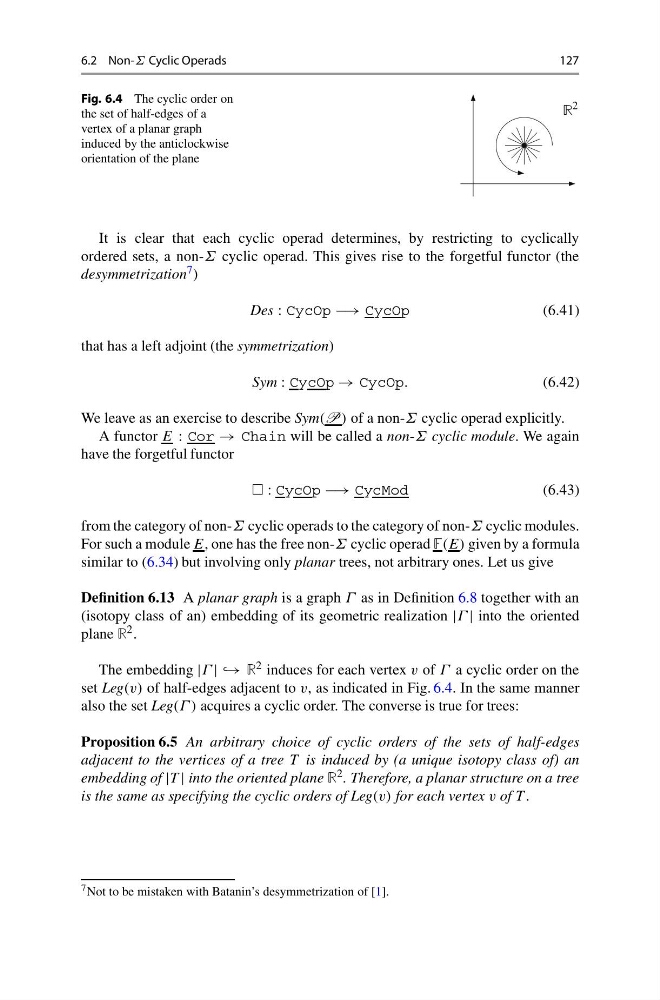
Fig. 6.4 The cyclic order on
the set of half-edges of a
vertex of a planar graph
induced by the anticlockwise
orientation of the plane
2
It is clear that each cyclic operad determines, by restricting to cyclically
ordered sets, a non-Σ cyclic operad. This gives rise to the forgetful functor (the
desymmetrization 7 )
Des : CycOp −→ CycOp
(6.41)
that has a left adjoint (the symmetrization)
Sym : CycOp → CycOp.
(6.42)
We leave as an exercise to describe Sym(P) of a non-Σ cyclic operad explicitly.
A functor E : Cor → Chain will be called a non-Σ cyclic module. We again
have the forgetful functor
: CycOp −→ CycMod
(6.43)
from the category of non-Σ cyclic operads to the category of non-Σ cyclic modules.
For such a module E, one has the free non-Σ cyclic operad F(E) given by a formula
similar to (6.34) but involving only planar trees, not arbitrary ones. Let us give
Definition 6.13 A planar graph is a graph Γ as in Definition 6.8 together with an
(isotopy class of an) embedding of its geometric realization |Γ | into the oriented
plane R 2 .
The embedding |Γ | R 2 induces for each vertex v of Γ a cyclic order on the
set Leg(v) of half-edges adjacent to v, as indicated in Fig. 6.4. In the same manner
also the set Leg(Γ ) acquires a cyclic order. The converse is true for trees:
Proposition 6.5 An arbitrary choice of cyclic orders of the sets of half-edges
adjacent to the vertices of a tree T is induced by (a unique isotopy class of) an
embedding of |T | into the oriented plane R 2 . Therefore, a planar structure on a tree
is the same as specifying the cyclic orders of Leg(v) for each vertex v of T .
7 Not to be mistaken with Batanin’s desymmetrization of [1].
127
Fig. 6.4 The cyclic order on
the set of half-edges of a
vertex of a planar graph
induced by the anticlockwise
orientation of the plane
2
It is clear that each cyclic operad determines, by restricting to cyclically
ordered sets, a non-Σ cyclic operad. This gives rise to the forgetful functor (the
desymmetrization 7 )
Des : CycOp −→ CycOp
(6.41)
that has a left adjoint (the symmetrization)
Sym : CycOp → CycOp.
(6.42)
We leave as an exercise to describe Sym(P) of a non-Σ cyclic operad explicitly.
A functor E : Cor → Chain will be called a non-Σ cyclic module. We again
have the forgetful functor
: CycOp −→ CycMod
(6.43)
from the category of non-Σ cyclic operads to the category of non-Σ cyclic modules.
For such a module E, one has the free non-Σ cyclic operad F(E) given by a formula
similar to (6.34) but involving only planar trees, not arbitrary ones. Let us give
Definition 6.13 A planar graph is a graph Γ as in Definition 6.8 together with an
(isotopy class of an) embedding of its geometric realization |Γ | into the oriented
plane R 2 .
The embedding |Γ | R 2 induces for each vertex v of Γ a cyclic order on the
set Leg(v) of half-edges adjacent to v, as indicated in Fig. 6.4. In the same manner
also the set Leg(Γ ) acquires a cyclic order. The converse is true for trees:
Proposition 6.5 An arbitrary choice of cyclic orders of the sets of half-edges
adjacent to the vertices of a tree T is induced by (a unique isotopy class of) an
embedding of |T | into the oriented plane R 2 . Therefore, a planar structure on a tree
is the same as specifying the cyclic orders of Leg(v) for each vertex v of T .
7 Not to be mistaken with Batanin’s desymmetrization of [1].