

128
6 Operads
Proposition 6.4 is so obvious that we are not going to prove it here. Notice that it
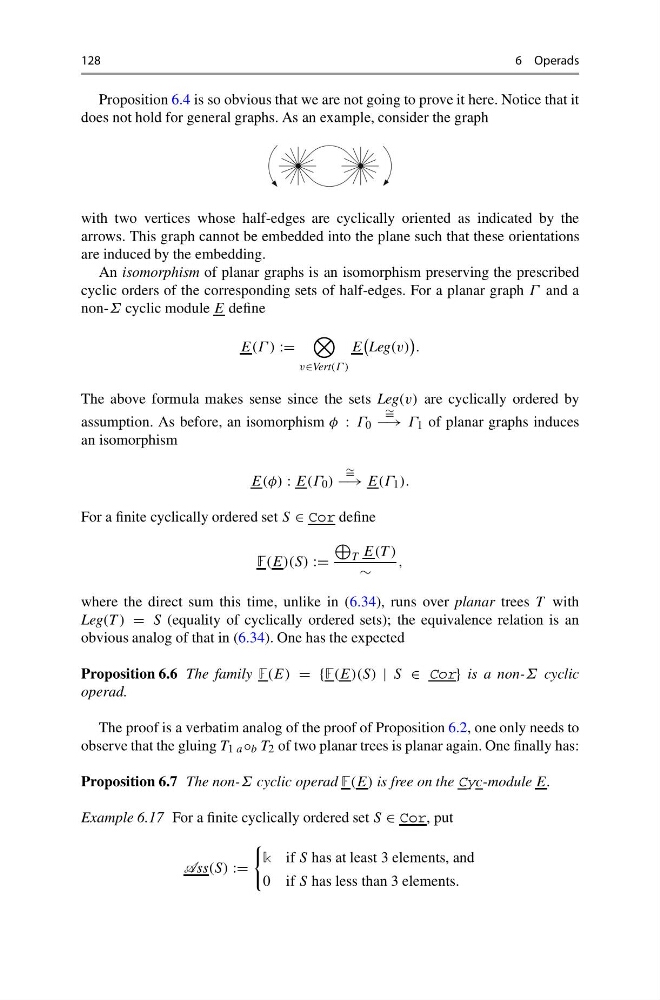
does not hold for general graphs. As an example, consider the graph
with two vertices whose half-edges are cyclically oriented as indicated by the
arrows. This graph cannot be embedded into the plane such that these orientations
are induced by the embedding.
An isomorphism of planar graphs is an isomorphism preserving the prescribed
cyclic orders of the corresponding sets of half-edges. For a planar graph Γ and a
non-Σ cyclic module E define
E(Γ ) :=
v∈Vert(Γ )
E
Leg(v)
.
The above formula makes sense since the sets Leg(v) are cyclically ordered by
assumption. As before, an isomorphism φ : Γ 0
∼ =
−→ Γ 1 of planar graphs induces
an isomorphism
E(φ) : E(Γ 0 )
∼ =
−→ E(Γ 1 ).
For a finite cyclically ordered set S ∈ Cor define
F(E)(S) :=
T E(T )
∼
,
where the direct sum this time, unlike in (6.34), runs over planar trees T with
Leg(T ) = S (equality of cyclically ordered sets); the equivalence relation is an
obvious analog of that in (6.34). One has the expected
Proposition 6.6 The family F(E) = {F(E)(S) | S ∈ Cor} is a non-Σ cyclic
operad.
The proof is a verbatim analog of the proof of Proposition 6.2, one only needs to
observe that the gluing T 1 a ◦ b T 2 of two planar trees is planar again. One finally has:
Proposition 6.7 The non-Σ cyclic operad F(E) is free on the Cyc-module E.
Example 6.17 For a finite cyclically ordered set S ∈ Cor, put
Ass(S) :=
k if S has at least 3 elements, and
0 if S has less than 3 elements.
6 Operads
Proposition 6.4 is so obvious that we are not going to prove it here. Notice that it
does not hold for general graphs. As an example, consider the graph
with two vertices whose half-edges are cyclically oriented as indicated by the
arrows. This graph cannot be embedded into the plane such that these orientations
are induced by the embedding.
An isomorphism of planar graphs is an isomorphism preserving the prescribed
cyclic orders of the corresponding sets of half-edges. For a planar graph Γ and a
non-Σ cyclic module E define
E(Γ ) :=
v∈Vert(Γ )
E
Leg(v)
.
The above formula makes sense since the sets Leg(v) are cyclically ordered by
assumption. As before, an isomorphism φ : Γ 0
∼ =
−→ Γ 1 of planar graphs induces
an isomorphism
E(φ) : E(Γ 0 )
∼ =
−→ E(Γ 1 ).
For a finite cyclically ordered set S ∈ Cor define
F(E)(S) :=
T E(T )
∼
,
where the direct sum this time, unlike in (6.34), runs over planar trees T with
Leg(T ) = S (equality of cyclically ordered sets); the equivalence relation is an
obvious analog of that in (6.34). One has the expected
Proposition 6.6 The family F(E) = {F(E)(S) | S ∈ Cor} is a non-Σ cyclic
operad.
The proof is a verbatim analog of the proof of Proposition 6.2, one only needs to
observe that the gluing T 1 a ◦ b T 2 of two planar trees is planar again. One finally has:
Proposition 6.7 The non-Σ cyclic operad F(E) is free on the Cyc-module E.
Example 6.17 For a finite cyclically ordered set S ∈ Cor, put
Ass(S) :=
k if S has at least 3 elements, and
0 if S has less than 3 elements.