

126
6 Operads
Proof. It is clear from definitions that F(E μ )(S) is spanned by trees with trivalent
vertices and legs indexed by S. Modding out by (R) means identifying two such
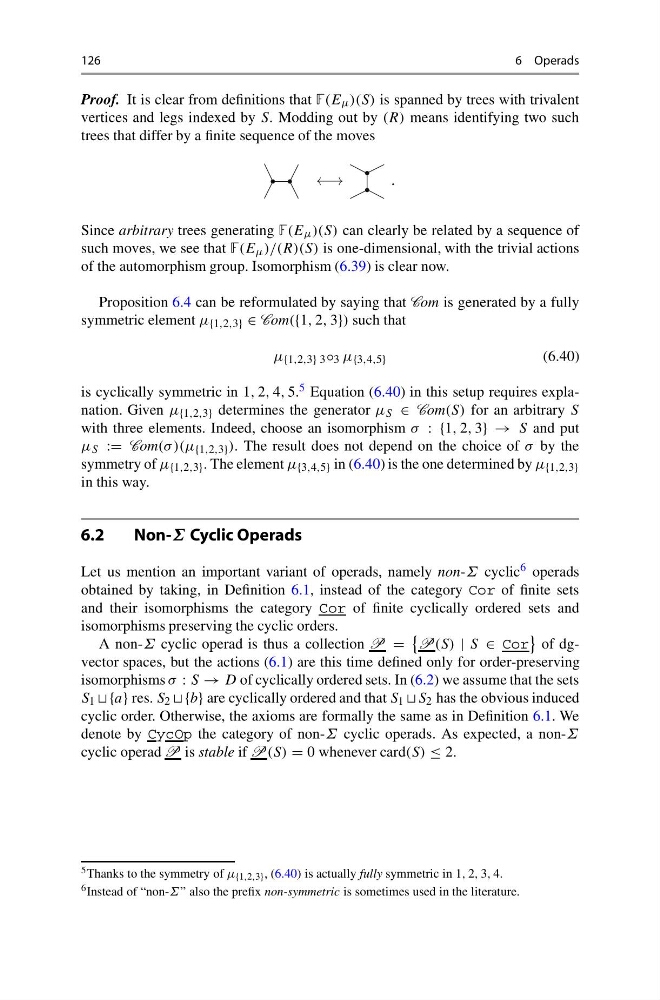
trees that differ by a finite sequence of the moves
. .
Since arbitrary trees generating F(E μ )(S) can clearly be related by a sequence of
such moves, we see that F(E μ )/(R)(S) is one-dimensional, with the trivial actions
of the automorphism group. Isomorphism (6.39) is clear now.
Proposition 6.4 can be reformulated by saying that Com is generated by a fully
symmetric element μ {1,2,3} ∈ Com({1, 2, 3}) such that
μ {1,2,3} 3 ◦ 3 μ {3,4,5}
(6.40)
is cyclically symmetric in 1, 2, 4, 5. 5 Equation (6.40) in this setup requires explanation. Given μ {1,2,3} determines the generator μ S ∈ Com(S) for an arbitrary S
with three elements. Indeed, choose an isomorphism σ : {1, 2, 3} → S and put
μ S := Com(σ )(μ {1,2,3} ). The result does not depend on the choice of σ by the
symmetry of μ {1,2,3} . The element μ {3,4,5} in (6.40) is the one determined by μ {1,2,3}
in this way.
6.2
Non-Σ Cyclic Operads
Let us mention an important variant of operads, namely non-Σ cyclic 6 operads
obtained by taking, in Definition 6.1, instead of the category Cor of finite sets
and their isomorphisms the category Cor of finite cyclically ordered sets and
isomorphisms preserving the cyclic orders.
A non-Σ cyclic operad is thus a collection P =
P(S) | S ∈ Cor
of dgvector spaces, but the actions (6.1) are this time defined only for order-preserving
isomorphisms σ : S → D of cyclically ordered sets. In (6.2) we assume that the sets
S 1 {a} res. S 2 {b} are cyclically ordered and that S 1 S 2 has the obvious induced
cyclic order. Otherwise, the axioms are formally the same as in Definition 6.1. We
denote by CycOp the category of non-Σ cyclic operads. As expected, a non-Σ
cyclic operad P is stable if P(S) = 0 whenever card(S) ≤ 2.
5 Thanks to the symmetry of μ {1,2,3} , (6.40) is actually fully symmetric in 1, 2, 3, 4.
6 Instead of “non-Σ” also the prefix non-symmetric is sometimes used in the literature.
6 Operads
Proof. It is clear from definitions that F(E μ )(S) is spanned by trees with trivalent
vertices and legs indexed by S. Modding out by (R) means identifying two such
trees that differ by a finite sequence of the moves
. .
Since arbitrary trees generating F(E μ )(S) can clearly be related by a sequence of
such moves, we see that F(E μ )/(R)(S) is one-dimensional, with the trivial actions
of the automorphism group. Isomorphism (6.39) is clear now.
Proposition 6.4 can be reformulated by saying that Com is generated by a fully
symmetric element μ {1,2,3} ∈ Com({1, 2, 3}) such that
μ {1,2,3} 3 ◦ 3 μ {3,4,5}
(6.40)
is cyclically symmetric in 1, 2, 4, 5. 5 Equation (6.40) in this setup requires explanation. Given μ {1,2,3} determines the generator μ S ∈ Com(S) for an arbitrary S
with three elements. Indeed, choose an isomorphism σ : {1, 2, 3} → S and put
μ S := Com(σ )(μ {1,2,3} ). The result does not depend on the choice of σ by the
symmetry of μ {1,2,3} . The element μ {3,4,5} in (6.40) is the one determined by μ {1,2,3}
in this way.
6.2
Non-Σ Cyclic Operads
Let us mention an important variant of operads, namely non-Σ cyclic 6 operads
obtained by taking, in Definition 6.1, instead of the category Cor of finite sets
and their isomorphisms the category Cor of finite cyclically ordered sets and
isomorphisms preserving the cyclic orders.
A non-Σ cyclic operad is thus a collection P =
P(S) | S ∈ Cor
of dgvector spaces, but the actions (6.1) are this time defined only for order-preserving
isomorphisms σ : S → D of cyclically ordered sets. In (6.2) we assume that the sets
S 1 {a} res. S 2 {b} are cyclically ordered and that S 1 S 2 has the obvious induced
cyclic order. Otherwise, the axioms are formally the same as in Definition 6.1. We
denote by CycOp the category of non-Σ cyclic operads. As expected, a non-Σ
cyclic operad P is stable if P(S) = 0 whenever card(S) ≤ 2.
5 Thanks to the symmetry of μ {1,2,3} , (6.40) is actually fully symmetric in 1, 2, 3, 4.
6 Instead of “non-Σ” also the prefix non-symmetric is sometimes used in the literature.