

4.1 XPS Derivatives
61
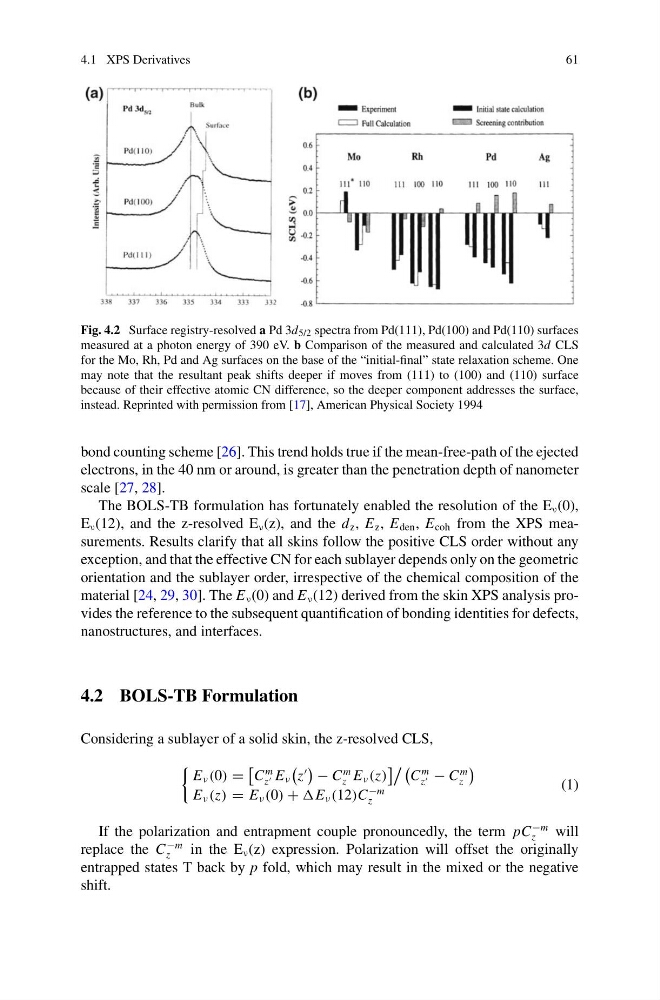
Fig. 4.2 Surface registry-resolved a Pd 3d 5/2 spectra from Pd(111), Pd(100) and Pd(110) surfaces
measured at a photon energy of 390 eV. b Comparison of the measured and calculated 3d CLS
for the Mo, Rh, Pd and Ag surfaces on the base of the “initial-final” state relaxation scheme. One
may note that the resultant peak shifts deeper if moves from (111) to (100) and (110) surface
because of their effective atomic CN difference, so the deeper component addresses the surface,
instead. Reprinted with permission from [17], American Physical Society 1994
bond counting scheme [26]. This trend holds true if the mean-free-path of the ejected
electrons, in the 40 nm or around, is greater than the penetration depth of nanometer
scale [27, 28].
The BOLS-TB formulation has fortunately enabled the resolution of the E ν (0),
E ν (12), and the z-resolved E ν (z), and the d z , E z , E den , E coh from the XPS measurements. Results clarify that all skins follow the positive CLS order without any
exception, and that the effective CN for each sublayer depends only on the geometric
orientation and the sublayer order, irrespective of the chemical composition of the
material [24, 29, 30]. The E ν (0) and E ν (12) derived from the skin XPS analysis provides the reference to the subsequent quantification of bonding identities for defects,
nanostructures, and interfaces.
4.2 BOLS-TB Formulation
Considering a sublayer of a solid skin, the z-resolved CLS,
E ν (0) =
C
m
z E ν
z
− C
m
z E ν (z)
C
m
z − C
m
z
E ν (z) = E ν (0) + E ν (12)C
−m
z
(1)
If the polarization and entrapment couple pronouncedly, the term pC
−m
z
will
replace the C
−m
z
in the E ν (z) expression. Polarization will offset the originally
entrapped states T back by p fold, which may result in the mixed or the negative
shift.
61
Fig. 4.2 Surface registry-resolved a Pd 3d 5/2 spectra from Pd(111), Pd(100) and Pd(110) surfaces
measured at a photon energy of 390 eV. b Comparison of the measured and calculated 3d CLS
for the Mo, Rh, Pd and Ag surfaces on the base of the “initial-final” state relaxation scheme. One
may note that the resultant peak shifts deeper if moves from (111) to (100) and (110) surface
because of their effective atomic CN difference, so the deeper component addresses the surface,
instead. Reprinted with permission from [17], American Physical Society 1994
bond counting scheme [26]. This trend holds true if the mean-free-path of the ejected
electrons, in the 40 nm or around, is greater than the penetration depth of nanometer
scale [27, 28].
The BOLS-TB formulation has fortunately enabled the resolution of the E ν (0),
E ν (12), and the z-resolved E ν (z), and the d z , E z , E den , E coh from the XPS measurements. Results clarify that all skins follow the positive CLS order without any
exception, and that the effective CN for each sublayer depends only on the geometric
orientation and the sublayer order, irrespective of the chemical composition of the
material [24, 29, 30]. The E ν (0) and E ν (12) derived from the skin XPS analysis provides the reference to the subsequent quantification of bonding identities for defects,
nanostructures, and interfaces.
4.2 BOLS-TB Formulation
Considering a sublayer of a solid skin, the z-resolved CLS,
E ν (0) =
C
m
z E ν
z
− C
m
z E ν (z)
C
m
z − C
m
z
E ν (z) = E ν (0) + E ν (12)C
−m
z
(1)
If the polarization and entrapment couple pronouncedly, the term pC
−m
z
will
replace the C
−m
z
in the E ν (z) expression. Polarization will offset the originally
entrapped states T back by p fold, which may result in the mixed or the negative
shift.