

62
4 Solid and Liquid Skins
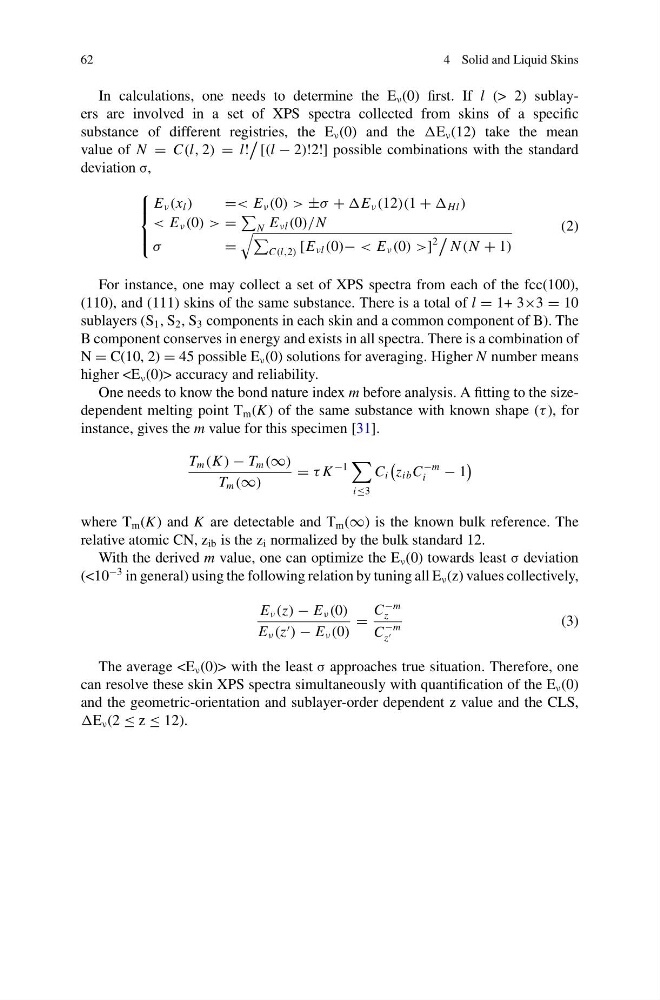
In calculations, one needs to determine the E ν (0) first. If l (> 2) sublayers are involved in a set of XPS spectra collected from skins of a specific
substance of different registries, the E ν (0) and the E ν (12) take the mean
value of N = C(l, 2) = l!
[(l − 2)!2!] possible combinations with the standard
deviation σ,
⎧
⎪ ⎨
⎪ ⎩
E ν (x l )
=< E ν (0) > ±σ + E ν (12)(1 + Hl )
< E ν (0) > =
N E νl (0)/N
σ
=
C(l,2) [E νl (0)− < E ν (0) >]
2
N (N + 1)
(2)
For instance, one may collect a set of XPS spectra from each of the fcc(100),
(110), and (111) skins of the same substance. There is a total of l = 1+ 3×3 = 10
sublayers (S 1 , S 2 , S 3 components in each skin and a common component of B). The
B component conserves in energy and exists in all spectra. There is a combination of
N = C(10, 2) = 45 possible E ν (0) solutions for averaging. Higher N number means
higher accuracy and reliability.
One needs to know the bond nature index m before analysis. A fitting to the sizedependent melting point T m (K) of the same substance with known shape (τ ), for
instance, gives the m value for this specimen [31].
T m (K ) − T m (∞)
T m (∞)
= τ K
−1
i≤3
C i
z ib C
−m
i
− 1
where T m (K) and K are detectable and T m (∞) is the known bulk reference. The
relative atomic CN, z ib is the z i normalized by the bulk standard 12.
With the derived m value, one can optimize the E ν (0) towards least σ deviation
(<10
−3 in general) using the following relation by tuning all E ν (z) values collectively,
E ν (z) − E ν (0)
E ν (z ) − E ν (0)
=
C
−m
z
C
−m
z
(3)
The average with the least σ approaches true situation. Therefore, one
can resolve these skin XPS spectra simultaneously with quantification of the E ν (0)
and the geometric-orientation and sublayer-order dependent z value and the CLS,
E ν (2 ≤ z ≤ 12).
4 Solid and Liquid Skins
In calculations, one needs to determine the E ν (0) first. If l (> 2) sublayers are involved in a set of XPS spectra collected from skins of a specific
substance of different registries, the E ν (0) and the E ν (12) take the mean
value of N = C(l, 2) = l!
[(l − 2)!2!] possible combinations with the standard
deviation σ,
⎧
⎪ ⎨
⎪ ⎩
E ν (x l )
=< E ν (0) > ±σ + E ν (12)(1 + Hl )
< E ν (0) > =
N E νl (0)/N
σ
=
C(l,2) [E νl (0)− < E ν (0) >]
2
N (N + 1)
(2)
For instance, one may collect a set of XPS spectra from each of the fcc(100),
(110), and (111) skins of the same substance. There is a total of l = 1+ 3×3 = 10
sublayers (S 1 , S 2 , S 3 components in each skin and a common component of B). The
B component conserves in energy and exists in all spectra. There is a combination of
N = C(10, 2) = 45 possible E ν (0) solutions for averaging. Higher N number means
higher
One needs to know the bond nature index m before analysis. A fitting to the sizedependent melting point T m (K) of the same substance with known shape (τ ), for
instance, gives the m value for this specimen [31].
T m (K ) − T m (∞)
T m (∞)
= τ K
−1
i≤3
C i
z ib C
−m
i
− 1
where T m (K) and K are detectable and T m (∞) is the known bulk reference. The
relative atomic CN, z ib is the z i normalized by the bulk standard 12.
With the derived m value, one can optimize the E ν (0) towards least σ deviation
(<10
−3 in general) using the following relation by tuning all E ν (z) values collectively,
E ν (z) − E ν (0)
E ν (z ) − E ν (0)
=
C
−m
z
C
−m
z
(3)
The average
can resolve these skin XPS spectra simultaneously with quantification of the E ν (0)
and the geometric-orientation and sublayer-order dependent z value and the CLS,
E ν (2 ≤ z ≤ 12).