

60
4 Solid and Liquid Skins
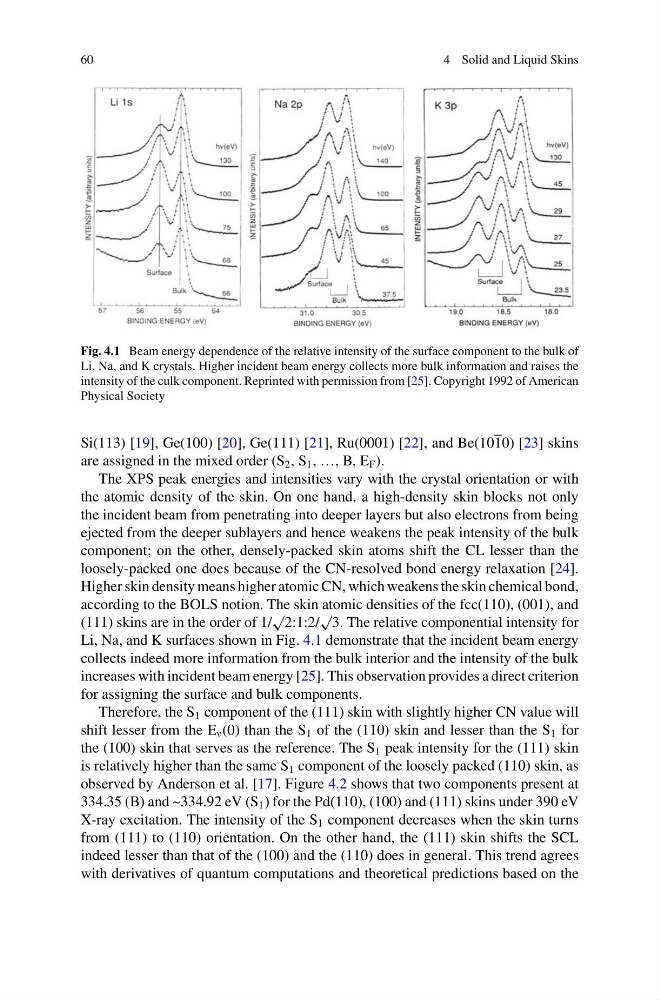
Fig. 4.1 Beam energy dependence of the relative intensity of the surface component to the bulk of
Li, Na, and K crystals. Higher incident beam energy collects more bulk information and raises the
intensity of the culk component. Reprinted with permission from [25]. Copyright 1992 of American
Physical Society
Si(113) [19], Ge(100) [20], Ge(111) [21], Ru(0001) [22], and Be(1010) [23] skins
are assigned in the mixed order (S 2 , S 1 , …, B, E F ).
The XPS peak energies and intensities vary with the crystal orientation or with
the atomic density of the skin. On one hand, a high-density skin blocks not only
the incident beam from penetrating into deeper layers but also electrons from being
ejected from the deeper sublayers and hence weakens the peak intensity of the bulk
component; on the other, densely-packed skin atoms shift the CL lesser than the
loosely-packed one does because of the CN-resolved bond energy relaxation [24].
Higher skin density means higher atomic CN, which weakens the skin chemical bond,
according to the BOLS notion. The skin atomic densities of the fcc(110), (001), and
(111) skins are in the order of 1/
√
2:1:2/
√
3. The relative componential intensity for
Li, Na, and K surfaces shown in Fig. 4.1 demonstrate that the incident beam energy
collects indeed more information from the bulk interior and the intensity of the bulk
increases with incident beam energy [25]. This observation provides a direct criterion
for assigning the surface and bulk components.
Therefore, the S 1 component of the (111) skin with slightly higher CN value will
shift lesser from the E ν (0) than the S 1 of the (110) skin and lesser than the S 1 for
the (100) skin that serves as the reference. The S 1 peak intensity for the (111) skin
is relatively higher than the same S 1 component of the loosely packed (110) skin, as
observed by Anderson et al. [17]. Figure 4.2 shows that two components present at
334.35 (B) and ~334.92 eV (S 1 ) for the Pd(110), (100) and (111) skins under 390 eV
X-ray excitation. The intensity of the S 1 component decreases when the skin turns
from (111) to (110) orientation. On the other hand, the (111) skin shifts the SCL
indeed lesser than that of the (100) and the (110) does in general. This trend agrees
with derivatives of quantum computations and theoretical predictions based on the
4 Solid and Liquid Skins
Fig. 4.1 Beam energy dependence of the relative intensity of the surface component to the bulk of
Li, Na, and K crystals. Higher incident beam energy collects more bulk information and raises the
intensity of the culk component. Reprinted with permission from [25]. Copyright 1992 of American
Physical Society
Si(113) [19], Ge(100) [20], Ge(111) [21], Ru(0001) [22], and Be(1010) [23] skins
are assigned in the mixed order (S 2 , S 1 , …, B, E F ).
The XPS peak energies and intensities vary with the crystal orientation or with
the atomic density of the skin. On one hand, a high-density skin blocks not only
the incident beam from penetrating into deeper layers but also electrons from being
ejected from the deeper sublayers and hence weakens the peak intensity of the bulk
component; on the other, densely-packed skin atoms shift the CL lesser than the
loosely-packed one does because of the CN-resolved bond energy relaxation [24].
Higher skin density means higher atomic CN, which weakens the skin chemical bond,
according to the BOLS notion. The skin atomic densities of the fcc(110), (001), and
(111) skins are in the order of 1/
√
2:1:2/
√
3. The relative componential intensity for
Li, Na, and K surfaces shown in Fig. 4.1 demonstrate that the incident beam energy
collects indeed more information from the bulk interior and the intensity of the bulk
increases with incident beam energy [25]. This observation provides a direct criterion
for assigning the surface and bulk components.
Therefore, the S 1 component of the (111) skin with slightly higher CN value will
shift lesser from the E ν (0) than the S 1 of the (110) skin and lesser than the S 1 for
the (100) skin that serves as the reference. The S 1 peak intensity for the (111) skin
is relatively higher than the same S 1 component of the loosely packed (110) skin, as
observed by Anderson et al. [17]. Figure 4.2 shows that two components present at
334.35 (B) and ~334.92 eV (S 1 ) for the Pd(110), (100) and (111) skins under 390 eV
X-ray excitation. The intensity of the S 1 component decreases when the skin turns
from (111) to (110) orientation. On the other hand, the (111) skin shifts the SCL
indeed lesser than that of the (100) and the (110) does in general. This trend agrees
with derivatives of quantum computations and theoretical predictions based on the