

3.4 APECS/XAS: Dual Energy-Level Shifts
53
and revealing than its conventional form because it employs the dimension of crystal
size or the effective atomic CN with a focus on the relative energy shift [13].
3.4.4 XAS/XES: Dual-Level Resultant Shift
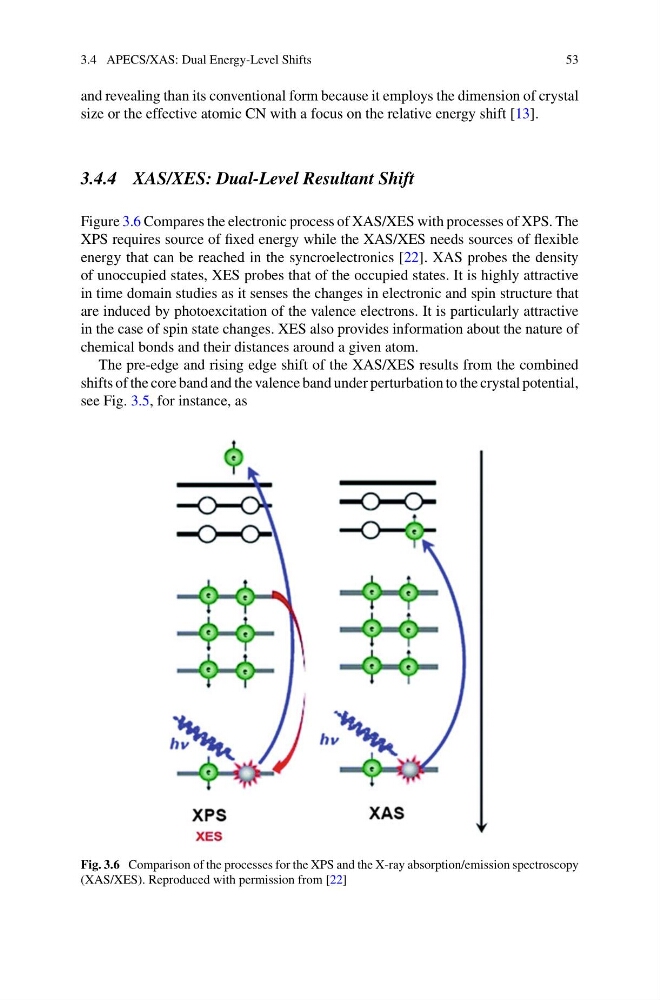
Figure 3.6 Compares the electronic process of XAS/XES with processes of XPS. The
XPS requires source of fixed energy while the XAS/XES needs sources of flexible
energy that can be reached in the syncroelectronics [22]. XAS probes the density
of unoccupied states, XES probes that of the occupied states. It is highly attractive
in time domain studies as it senses the changes in electronic and spin structure that
are induced by photoexcitation of the valence electrons. It is particularly attractive
in the case of spin state changes. XES also provides information about the nature of
chemical bonds and their distances around a given atom.
The pre-edge and rising edge shift of the XAS/XES results from the combined
shifts of the core band and the valence band under perturbation to the crystal potential,
see Fig. 3.5, for instance, as
Fig. 3.6 Comparison of the processes for the XPS and the X-ray absorption/emission spectroscopy
(XAS/XES). Reproduced with permission from [22]
53
and revealing than its conventional form because it employs the dimension of crystal
size or the effective atomic CN with a focus on the relative energy shift [13].
3.4.4 XAS/XES: Dual-Level Resultant Shift
Figure 3.6 Compares the electronic process of XAS/XES with processes of XPS. The
XPS requires source of fixed energy while the XAS/XES needs sources of flexible
energy that can be reached in the syncroelectronics [22]. XAS probes the density
of unoccupied states, XES probes that of the occupied states. It is highly attractive
in time domain studies as it senses the changes in electronic and spin structure that
are induced by photoexcitation of the valence electrons. It is particularly attractive
in the case of spin state changes. XES also provides information about the nature of
chemical bonds and their distances around a given atom.
The pre-edge and rising edge shift of the XAS/XES results from the combined
shifts of the core band and the valence band under perturbation to the crystal potential,
see Fig. 3.5, for instance, as
Fig. 3.6 Comparison of the processes for the XPS and the X-ray absorption/emission spectroscopy
(XAS/XES). Reproduced with permission from [22]