

54
3 Probing Methods: STM/S, PES, APECS, XAS, ZPS
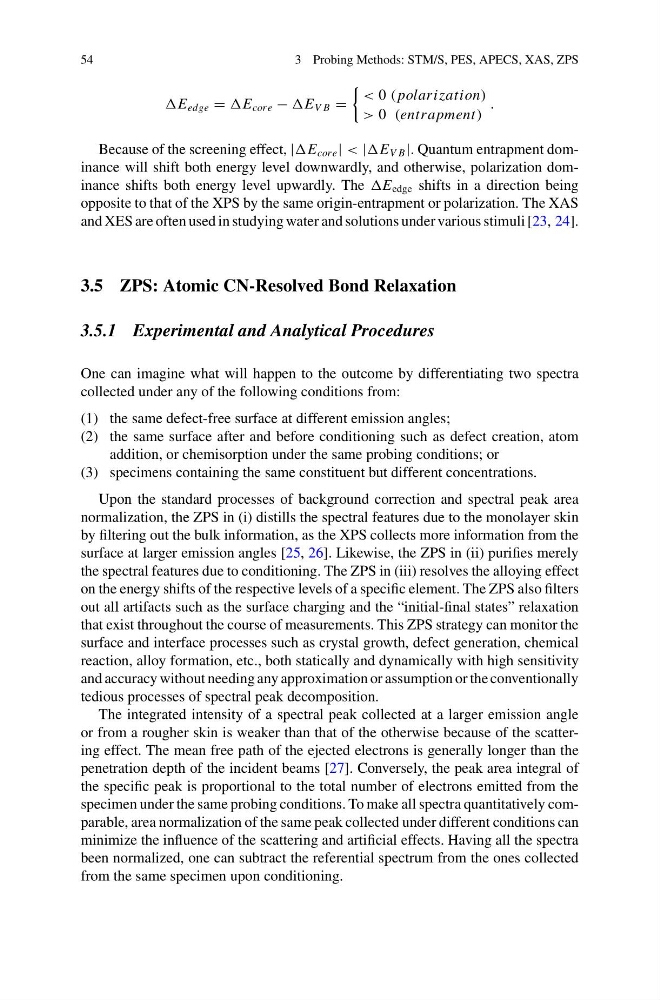
E edge = E core − E V B =
< 0 ( polari zation)
> 0 (entrapment)
.
Because of the screening effect, |E core | < |E V B |. Quantum entrapment dominance will shift both energy level downwardly, and otherwise, polarization dominance shifts both energy level upwardly. The E edge shifts in a direction being
opposite to that of the XPS by the same origin-entrapment or polarization. The XAS
and XES are often used in studying water and solutions under various stimuli [23, 24].
3.5 ZPS: Atomic CN-Resolved Bond Relaxation
3.5.1 Experimental and Analytical Procedures
One can imagine what will happen to the outcome by differentiating two spectra
collected under any of the following conditions from:
(1) the same defect-free surface at different emission angles;
(2) the same surface after and before conditioning such as defect creation, atom
addition, or chemisorption under the same probing conditions; or
(3) specimens containing the same constituent but different concentrations.
Upon the standard processes of background correction and spectral peak area
normalization, the ZPS in (i) distills the spectral features due to the monolayer skin
by filtering out the bulk information, as the XPS collects more information from the
surface at larger emission angles [25, 26]. Likewise, the ZPS in (ii) purifies merely
the spectral features due to conditioning. The ZPS in (iii) resolves the alloying effect
on the energy shifts of the respective levels of a specific element. The ZPS also filters
out all artifacts such as the surface charging and the “initial-final states” relaxation
that exist throughout the course of measurements. This ZPS strategy can monitor the
surface and interface processes such as crystal growth, defect generation, chemical
reaction, alloy formation, etc., both statically and dynamically with high sensitivity
and accuracy without needing any approximation or assumption or the conventionally
tedious processes of spectral peak decomposition.
The integrated intensity of a spectral peak collected at a larger emission angle
or from a rougher skin is weaker than that of the otherwise because of the scattering effect. The mean free path of the ejected electrons is generally longer than the
penetration depth of the incident beams [27]. Conversely, the peak area integral of
the specific peak is proportional to the total number of electrons emitted from the
specimen under the same probing conditions. To make all spectra quantitatively comparable, area normalization of the same peak collected under different conditions can
minimize the influence of the scattering and artificial effects. Having all the spectra
been normalized, one can subtract the referential spectrum from the ones collected
from the same specimen upon conditioning.
3 Probing Methods: STM/S, PES, APECS, XAS, ZPS
E edge = E core − E V B =
< 0 ( polari zation)
> 0 (entrapment)
.
Because of the screening effect, |E core | < |E V B |. Quantum entrapment dominance will shift both energy level downwardly, and otherwise, polarization dominance shifts both energy level upwardly. The E edge shifts in a direction being
opposite to that of the XPS by the same origin-entrapment or polarization. The XAS
and XES are often used in studying water and solutions under various stimuli [23, 24].
3.5 ZPS: Atomic CN-Resolved Bond Relaxation
3.5.1 Experimental and Analytical Procedures
One can imagine what will happen to the outcome by differentiating two spectra
collected under any of the following conditions from:
(1) the same defect-free surface at different emission angles;
(2) the same surface after and before conditioning such as defect creation, atom
addition, or chemisorption under the same probing conditions; or
(3) specimens containing the same constituent but different concentrations.
Upon the standard processes of background correction and spectral peak area
normalization, the ZPS in (i) distills the spectral features due to the monolayer skin
by filtering out the bulk information, as the XPS collects more information from the
surface at larger emission angles [25, 26]. Likewise, the ZPS in (ii) purifies merely
the spectral features due to conditioning. The ZPS in (iii) resolves the alloying effect
on the energy shifts of the respective levels of a specific element. The ZPS also filters
out all artifacts such as the surface charging and the “initial-final states” relaxation
that exist throughout the course of measurements. This ZPS strategy can monitor the
surface and interface processes such as crystal growth, defect generation, chemical
reaction, alloy formation, etc., both statically and dynamically with high sensitivity
and accuracy without needing any approximation or assumption or the conventionally
tedious processes of spectral peak decomposition.
The integrated intensity of a spectral peak collected at a larger emission angle
or from a rougher skin is weaker than that of the otherwise because of the scattering effect. The mean free path of the ejected electrons is generally longer than the
penetration depth of the incident beams [27]. Conversely, the peak area integral of
the specific peak is proportional to the total number of electrons emitted from the
specimen under the same probing conditions. To make all spectra quantitatively comparable, area normalization of the same peak collected under different conditions can
minimize the influence of the scattering and artificial effects. Having all the spectra
been normalized, one can subtract the referential spectrum from the ones collected
from the same specimen upon conditioning.