

24.6 Phase Transition by Compression and Ionic Polarization
487
0
1 0
2 0
3 0
4 0
2400
2800
3200
3600
ω
H
(cm
-1
)
P (GPa)
v1 B1g pure
v3 Eg pure
v1 A1g pure
v1 B1g salt
v3 Eg salt
v1 A1g salt
0 20 40 60 80 100 120 140 160 180
2.2
2.4
2.6
2.8
O-O distance(A)
P(GPa)
Pure Ice
LiCl-ice
LiCl-ice:O near Li
NaCl-ice(I)
NaCl-ice(I):O near Na
(a)
(b)
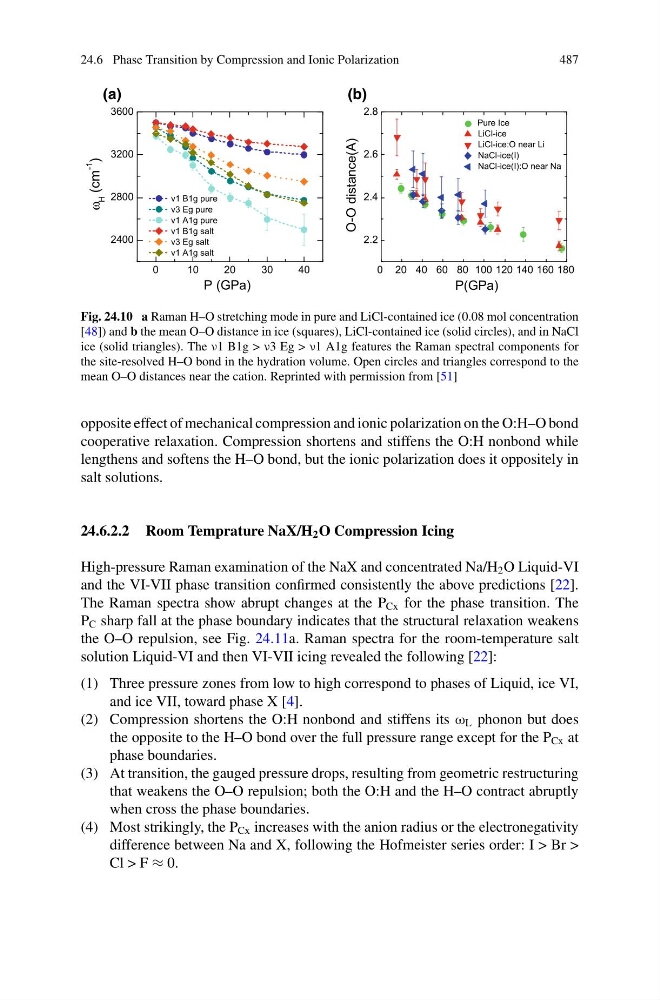
Fig. 24.10 a Raman H–O stretching mode in pure and LiCl-contained ice (0.08 mol concentration
[48]) and b the mean O–O distance in ice (squares), LiCl-contained ice (solid circles), and in NaCl
ice (solid triangles). The ν1 B1g > ν3 Eg > ν1 A1g features the Raman spectral components for
the site-resolved H–O bond in the hydration volume. Open circles and triangles correspond to the
mean O–O distances near the cation. Reprinted with permission from [51]
opposite effect of mechanical compression and ionic polarization on the O:H–O bond
cooperative relaxation. Compression shortens and stiffens the O:H nonbond while
lengthens and softens the H–O bond, but the ionic polarization does it oppositely in
salt solutions.
24.6.2.2 Room Temprature NaX/H 2 O Compression Icing
High-pressure Raman examination of the NaX and concentrated Na/H 2 O Liquid-VI
and the VI-VII phase transition confirmed consistently the above predictions [22].
The Raman spectra show abrupt changes at the P Cx for the phase transition. The
P C sharp fall at the phase boundary indicates that the structural relaxation weakens
the O–O repulsion, see Fig. 24.11a. Raman spectra for the room-temperature salt
solution Liquid-VI and then VI-VII icing revealed the following [22]:
(1) Three pressure zones from low to high correspond to phases of Liquid, ice VI,
and ice VII, toward phase X [4].
(2) Compression shortens the O:H nonbond and stiffens its ω L phonon but does
the opposite to the H–O bond over the full pressure range except for the P Cx at
phase boundaries.
(3) At transition, the gauged pressure drops, resulting from geometric restructuring
that weakens the O–O repulsion; both the O:H and the H–O contract abruptly
when cross the phase boundaries.
(4) Most strikingly, the P Cx increases with the anion radius or the electronegativity
difference between Na and X, following the Hofmeister series order: I > Br >
Cl > F ≈ 0.
487
0
1 0
2 0
3 0
4 0
2400
2800
3200
3600
ω
H
(cm
-1
)
P (GPa)
v1 B1g pure
v3 Eg pure
v1 A1g pure
v1 B1g salt
v3 Eg salt
v1 A1g salt
0 20 40 60 80 100 120 140 160 180
2.2
2.4
2.6
2.8
O-O distance(A)
P(GPa)
Pure Ice
LiCl-ice
LiCl-ice:O near Li
NaCl-ice(I)
NaCl-ice(I):O near Na
(a)
(b)
Fig. 24.10 a Raman H–O stretching mode in pure and LiCl-contained ice (0.08 mol concentration
[48]) and b the mean O–O distance in ice (squares), LiCl-contained ice (solid circles), and in NaCl
ice (solid triangles). The ν1 B1g > ν3 Eg > ν1 A1g features the Raman spectral components for
the site-resolved H–O bond in the hydration volume. Open circles and triangles correspond to the
mean O–O distances near the cation. Reprinted with permission from [51]
opposite effect of mechanical compression and ionic polarization on the O:H–O bond
cooperative relaxation. Compression shortens and stiffens the O:H nonbond while
lengthens and softens the H–O bond, but the ionic polarization does it oppositely in
salt solutions.
24.6.2.2 Room Temprature NaX/H 2 O Compression Icing
High-pressure Raman examination of the NaX and concentrated Na/H 2 O Liquid-VI
and the VI-VII phase transition confirmed consistently the above predictions [22].
The Raman spectra show abrupt changes at the P Cx for the phase transition. The
P C sharp fall at the phase boundary indicates that the structural relaxation weakens
the O–O repulsion, see Fig. 24.11a. Raman spectra for the room-temperature salt
solution Liquid-VI and then VI-VII icing revealed the following [22]:
(1) Three pressure zones from low to high correspond to phases of Liquid, ice VI,
and ice VII, toward phase X [4].
(2) Compression shortens the O:H nonbond and stiffens its ω L phonon but does
the opposite to the H–O bond over the full pressure range except for the P Cx at
phase boundaries.
(3) At transition, the gauged pressure drops, resulting from geometric restructuring
that weakens the O–O repulsion; both the O:H and the H–O contract abruptly
when cross the phase boundaries.
(4) Most strikingly, the P Cx increases with the anion radius or the electronegativity
difference between Na and X, following the Hofmeister series order: I > Br >
Cl > F ≈ 0.