

488
24 Water and Aqueous Solutions
1.0
1.5
2.0
2.5
3.0
3.5
P(GPa)
P C2
P C1
P C0,1
P C0,2
H 2 O
NaF
NaCl
NaBr
NaI
VI
L
VII
NaX/H 2 O = 0.016
1.0
1.5
2.0
2.5
3.0
3.5
pure water
P(GPa)
111
62
30
20
10
N H2O /N NaI
VII
VI
Liquid
(a)
(b)
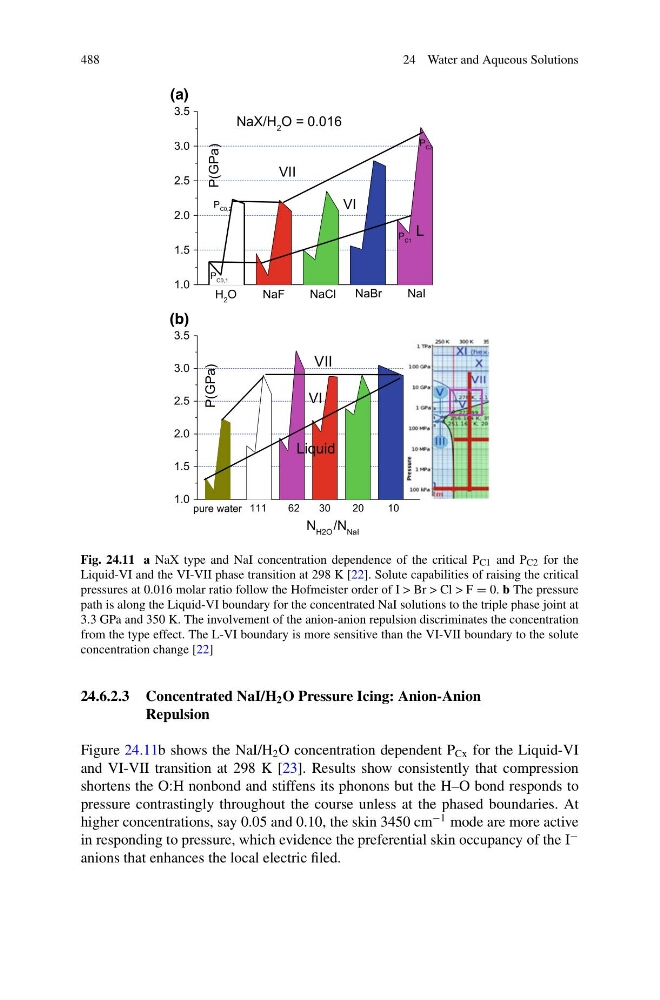
Fig. 24.11 a NaX type and NaI concentration dependence of the critical P C1 and P C2 for the
Liquid-VI and the VI-VII phase transition at 298 K [22]. Solute capabilities of raising the critical
pressures at 0.016 molar ratio follow the Hofmeister order of I > Br > Cl > F = 0. b The pressure
path is along the Liquid-VI boundary for the concentrated NaI solutions to the triple phase joint at
3.3 GPa and 350 K. The involvement of the anion-anion repulsion discriminates the concentration
from the type effect. The L-VI boundary is more sensitive than the VI-VII boundary to the solute
concentration change [22]
24.6.2.3 Concentrated NaI/H 2 O Pressure Icing: Anion-Anion
Repulsion
Figure 24.11b shows the NaI/H 2 O concentration dependent P Cx for the Liquid-VI
and VI-VII transition at 298 K [23]. Results show consistently that compression
shortens the O:H nonbond and stiffens its phonons but the H–O bond responds to
pressure contrastingly throughout the course unless at the phased boundaries. At
higher concentrations, say 0.05 and 0.10, the skin 3450 cm
−1 mode are more active
in responding to pressure, which evidence the preferential skin occupancy of the I
−
anions that enhances the local electric filed.
24 Water and Aqueous Solutions
1.0
1.5
2.0
2.5
3.0
3.5
P(GPa)
P C2
P C1
P C0,1
P C0,2
H 2 O
NaF
NaCl
NaBr
NaI
VI
L
VII
NaX/H 2 O = 0.016
1.0
1.5
2.0
2.5
3.0
3.5
pure water
P(GPa)
111
62
30
20
10
N H2O /N NaI
VII
VI
Liquid
(a)
(b)
Fig. 24.11 a NaX type and NaI concentration dependence of the critical P C1 and P C2 for the
Liquid-VI and the VI-VII phase transition at 298 K [22]. Solute capabilities of raising the critical
pressures at 0.016 molar ratio follow the Hofmeister order of I > Br > Cl > F = 0. b The pressure
path is along the Liquid-VI boundary for the concentrated NaI solutions to the triple phase joint at
3.3 GPa and 350 K. The involvement of the anion-anion repulsion discriminates the concentration
from the type effect. The L-VI boundary is more sensitive than the VI-VII boundary to the solute
concentration change [22]
24.6.2.3 Concentrated NaI/H 2 O Pressure Icing: Anion-Anion
Repulsion
Figure 24.11b shows the NaI/H 2 O concentration dependent P Cx for the Liquid-VI
and VI-VII transition at 298 K [23]. Results show consistently that compression
shortens the O:H nonbond and stiffens its phonons but the H–O bond responds to
pressure contrastingly throughout the course unless at the phased boundaries. At
higher concentrations, say 0.05 and 0.10, the skin 3450 cm
−1 mode are more active
in responding to pressure, which evidence the preferential skin occupancy of the I
−
anions that enhances the local electric filed.