

486
24 Water and Aqueous Solutions
E x − s x
⎛
⎝
P c
P 0
p
dd x
dp
dp−
P c0
P 0
p
dd x
dp
dp
⎞
⎠ = 0
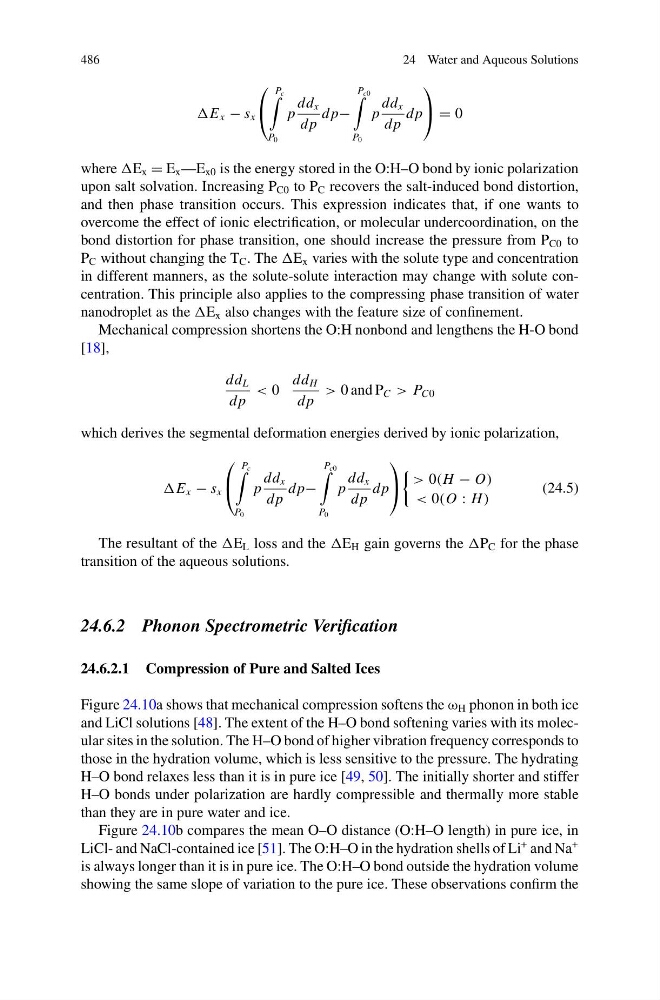
where E x = E x —E x0 is the energy stored in the O:H–O bond by ionic polarization
upon salt solvation. Increasing P C0 to P C recovers the salt-induced bond distortion,
and then phase transition occurs. This expression indicates that, if one wants to
overcome the effect of ionic electrification, or molecular undercoordination, on the
bond distortion for phase transition, one should increase the pressure from P C0 to
P C without changing the T C . The E x varies with the solute type and concentration
in different manners, as the solute-solute interaction may change with solute concentration. This principle also applies to the compressing phase transition of water
nanodroplet as the E x also changes with the feature size of confinement.
Mechanical compression shortens the O:H nonbond and lengthens the H-O bond
[18],
dd L
dp
< 0
dd H
dp
> 0 and P C > P C0
which derives the segmental deformation energies derived by ionic polarization,
E x − s x
⎛
⎝
P c
P 0
p
dd x
dp
dp−
P c0
P 0
p
dd x
dp
dp
⎞
⎠
> 0(H − O)
< 0(O : H )
(24.5)
The resultant of the E L loss and the E H gain governs the P C for the phase
transition of the aqueous solutions.
24.6.2 Phonon Spectrometric Verification
24.6.2.1 Compression of Pure and Salted Ices
Figure 24.10a shows that mechanical compression softens the ω H phonon in both ice
and LiCl solutions [48]. The extent of the H–O bond softening varies with its molecular sites in the solution. The H–O bond of higher vibration frequency corresponds to
those in the hydration volume, which is less sensitive to the pressure. The hydrating
H–O bond relaxes less than it is in pure ice [49, 50]. The initially shorter and stiffer
H–O bonds under polarization are hardly compressible and thermally more stable
than they are in pure water and ice.
Figure 24.10b compares the mean O–O distance (O:H–O length) in pure ice, in
LiCl- and NaCl-contained ice [51]. The O:H–O in the hydration shells of Li
+ and Na
+
is always longer than it is in pure ice. The O:H–O bond outside the hydration volume
showing the same slope of variation to the pure ice. These observations confirm the
24 Water and Aqueous Solutions
E x − s x
⎛
⎝
P c
P 0
p
dd x
dp
dp−
P c0
P 0
p
dd x
dp
dp
⎞
⎠ = 0
where E x = E x —E x0 is the energy stored in the O:H–O bond by ionic polarization
upon salt solvation. Increasing P C0 to P C recovers the salt-induced bond distortion,
and then phase transition occurs. This expression indicates that, if one wants to
overcome the effect of ionic electrification, or molecular undercoordination, on the
bond distortion for phase transition, one should increase the pressure from P C0 to
P C without changing the T C . The E x varies with the solute type and concentration
in different manners, as the solute-solute interaction may change with solute concentration. This principle also applies to the compressing phase transition of water
nanodroplet as the E x also changes with the feature size of confinement.
Mechanical compression shortens the O:H nonbond and lengthens the H-O bond
[18],
dd L
dp
< 0
dd H
dp
> 0 and P C > P C0
which derives the segmental deformation energies derived by ionic polarization,
E x − s x
⎛
⎝
P c
P 0
p
dd x
dp
dp−
P c0
P 0
p
dd x
dp
dp
⎞
⎠
> 0(H − O)
< 0(O : H )
(24.5)
The resultant of the E L loss and the E H gain governs the P C for the phase
transition of the aqueous solutions.
24.6.2 Phonon Spectrometric Verification
24.6.2.1 Compression of Pure and Salted Ices
Figure 24.10a shows that mechanical compression softens the ω H phonon in both ice
and LiCl solutions [48]. The extent of the H–O bond softening varies with its molecular sites in the solution. The H–O bond of higher vibration frequency corresponds to
those in the hydration volume, which is less sensitive to the pressure. The hydrating
H–O bond relaxes less than it is in pure ice [49, 50]. The initially shorter and stiffer
H–O bonds under polarization are hardly compressible and thermally more stable
than they are in pure water and ice.
Figure 24.10b compares the mean O–O distance (O:H–O length) in pure ice, in
LiCl- and NaCl-contained ice [51]. The O:H–O in the hydration shells of Li
+ and Na
+
is always longer than it is in pure ice. The O:H–O bond outside the hydration volume
showing the same slope of variation to the pure ice. These observations confirm the