

24.5 Surface Stress, Diffusivity and Viscosity
485
One may note that the relative viscosity and the measured surface stress due
to salt solvation are in the same manner of the f YX (C). One can adjust the Jones–
Dole viscosity coefficients A and B and fit the surface stress to match the measured
f YX (C) curve in Fig. 24.9 c and d. The trend consistency clarifies that the linear term
corresponds to Y
+ hydration shell size and the nonlinear part to the resultant of X
− –
water and X
− –X
− interactions. It is clear now that both the solution viscosity and the
surface stress are proportional to the extent of polarization or to the sum of O:H–O
bonds in the hydration shells for the monovalent salt solutions, at least. Therefore,
polarization raises the surface stress, solution viscosity and rigidity, H–O phonon
frequency, and H–O phonon lifetime but decreases the molecular drift mobility,
consistently by shortening the H–O bond and lengthening the O:H nonbond.
24.6 Phase Transition by Compression and Ionic
Polarization
24.6.1 Spectrometric Varification
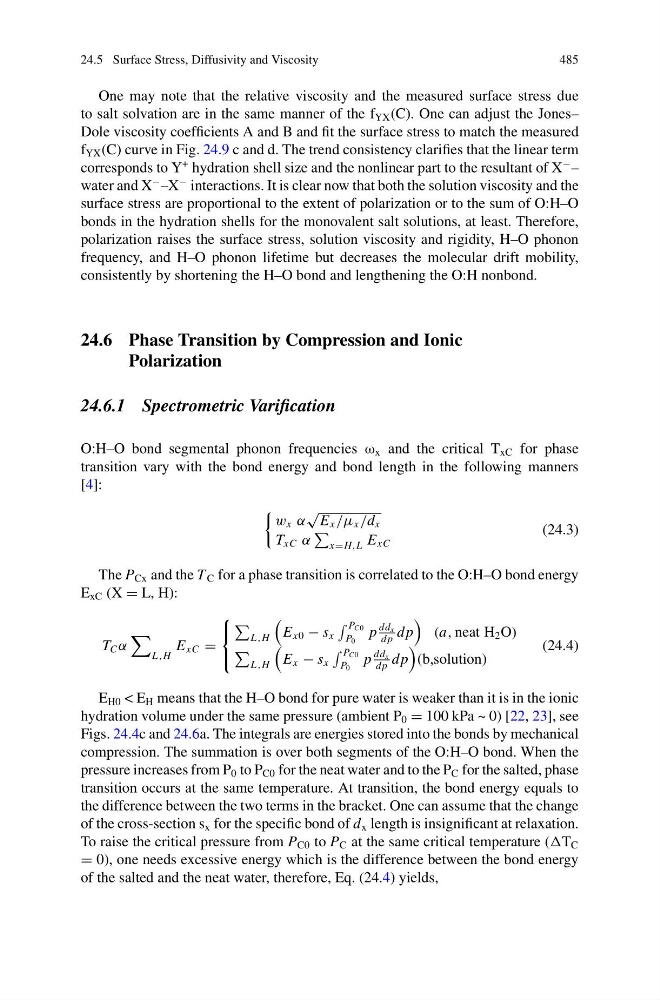
O:H–O bond segmental phonon frequencies ω x and the critical T xC for phase
transition vary with the bond energy and bond length in the following manners
[4]:
w x α
√
E x /μ x /d x
T xC α
x=H,L E xC
(24.3)
The P Cx and the T C for a phase transition is correlated to the O:H–O bond energy
E xC (X = L, H):
T C α
L ,H
E xC =
⎧
⎨
⎩
L ,H
E x0 − s x
P C0
P 0
p
dd x
dp
dp
(a, neat H 2 O)
L ,H
E x − s x
P C0
P 0
p
dd x
dp
dp
(b,solution)
(24.4)
E H0 < E H means that the H–O bond for pure water is weaker than it is in the ionic
hydration volume under the same pressure (ambient P 0 = 100 kPa ~ 0) [22, 23], see
Figs. 24.4c and 24.6a. The integrals are energies stored into the bonds by mechanical
compression. The summation is over both segments of the O:H–O bond. When the
pressure increases from P 0 to P C0 for the neat water and to the P C for the salted, phase
transition occurs at the same temperature. At transition, the bond energy equals to
the difference between the two terms in the bracket. One can assume that the change
of the cross-section s x for the specific bond of d x length is insignificant at relaxation.
To raise the critical pressure from P C0 to P C at the same critical temperature (T C
= 0), one needs excessive energy which is the difference between the bond energy
of the salted and the neat water, therefore, Eq. (24.4) yields,
485
One may note that the relative viscosity and the measured surface stress due
to salt solvation are in the same manner of the f YX (C). One can adjust the Jones–
Dole viscosity coefficients A and B and fit the surface stress to match the measured
f YX (C) curve in Fig. 24.9 c and d. The trend consistency clarifies that the linear term
corresponds to Y
+ hydration shell size and the nonlinear part to the resultant of X
− –
water and X
− –X
− interactions. It is clear now that both the solution viscosity and the
surface stress are proportional to the extent of polarization or to the sum of O:H–O
bonds in the hydration shells for the monovalent salt solutions, at least. Therefore,
polarization raises the surface stress, solution viscosity and rigidity, H–O phonon
frequency, and H–O phonon lifetime but decreases the molecular drift mobility,
consistently by shortening the H–O bond and lengthening the O:H nonbond.
24.6 Phase Transition by Compression and Ionic
Polarization
24.6.1 Spectrometric Varification
O:H–O bond segmental phonon frequencies ω x and the critical T xC for phase
transition vary with the bond energy and bond length in the following manners
[4]:
w x α
√
E x /μ x /d x
T xC α
x=H,L E xC
(24.3)
The P Cx and the T C for a phase transition is correlated to the O:H–O bond energy
E xC (X = L, H):
T C α
L ,H
E xC =
⎧
⎨
⎩
L ,H
E x0 − s x
P C0
P 0
p
dd x
dp
dp
(a, neat H 2 O)
L ,H
E x − s x
P C0
P 0
p
dd x
dp
dp
(b,solution)
(24.4)
E H0 < E H means that the H–O bond for pure water is weaker than it is in the ionic
hydration volume under the same pressure (ambient P 0 = 100 kPa ~ 0) [22, 23], see
Figs. 24.4c and 24.6a. The integrals are energies stored into the bonds by mechanical
compression. The summation is over both segments of the O:H–O bond. When the
pressure increases from P 0 to P C0 for the neat water and to the P C for the salted, phase
transition occurs at the same temperature. At transition, the bond energy equals to
the difference between the two terms in the bracket. One can assume that the change
of the cross-section s x for the specific bond of d x length is insignificant at relaxation.
To raise the critical pressure from P C0 to P C at the same critical temperature (T C
= 0), one needs excessive energy which is the difference between the bond energy
of the salted and the neat water, therefore, Eq. (24.4) yields,