

484
24 Water and Aqueous Solutions
0.00 0.02 0.04 0.06 0.08 0.10
60
65
70
75
80
85
90
95
Contact angle (
o
)
C
0.00 0.02 0.04 0.06 0.08 0.10
C
NaF
NaCl
NaBr
NaI
HCl
HBr
HI
NaOH
KOH
γ s (T)=78.80-0.17(T-273) mN/m
0
100
200
300
400
0.6
0.8
1.0
1.2
1.4
γ
s
(T)/γ
b
T (K)
Theory
Experiment
Θ D =192 Κ; Ε L = 0.095 eV
α = 0.162 mJ/(m
2 K)
0.0
0.1
0.2
0.3
Fraction
Δη/η NaI = 0.42C
1/2 +1.75C
f NaI = 0.5252(1-exp(-C/0.1142)
Δη/η NaCl = 0.10C
1/2 +1.75C
f NaCl = 0.6180(1-exp(-C/0.2473)
C
0.00 0.02 0.04 0.06 0.08 0.10
0.0
0.1
0.2
0.3
Δγ (C)/γ(0)
0.9C
1/2 +0.05C
Experiment
0.32[1-exp(-C/0.05)]
(a)
(b)
(c)
(d)
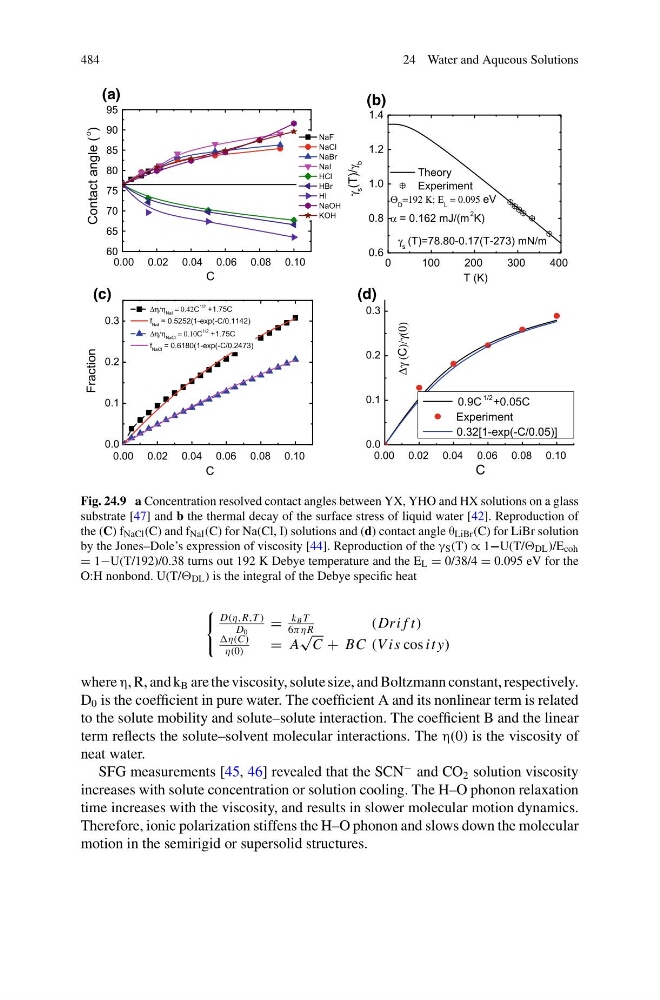
Fig. 24.9 a Concentration resolved contact angles between YX, YHO and HX solutions on a glass
substrate [47] and b the thermal decay of the surface stress of liquid water [42]. Reproduction of
the (C) f NaCl (C) and f NaI (C) for Na(Cl, I) solutions and (d) contact angle θ LiBr (C) for LiBr solution
by the Jones–Dole’s expression of viscosity [44]. Reproduction of the γ S (T) ∝ 1−U(T/ DL )/E coh
= 1−U(T/192)/0.38 turns out 192 K Debye temperature and the E L = 0/38/4 = 0.095 eV for the
O:H nonbond. U(T/ DL ) is the integral of the Debye specific heat
D(η,R,T )
D 0
=
k B T
6πηR
(Dri f t)
η(C)
η(0)
= A
√
C + BC (V is cos it y)
where η, R, and k B are the viscosity, solute size, and Boltzmann constant, respectively.
D 0 is the coefficient in pure water. The coefficient A and its nonlinear term is related
to the solute mobility and solute–solute interaction. The coefficient B and the linear
term reflects the solute–solvent molecular interactions. The η(0) is the viscosity of
neat water.
SFG measurements [45, 46] revealed that the SCN
− and CO 2 solution viscosity
increases with solute concentration or solution cooling. The H–O phonon relaxation
time increases with the viscosity, and results in slower molecular motion dynamics.
Therefore, ionic polarization stiffens the H–O phonon and slows down the molecular
motion in the semirigid or supersolid structures.
24 Water and Aqueous Solutions
0.00 0.02 0.04 0.06 0.08 0.10
60
65
70
75
80
85
90
95
Contact angle (
o
)
C
0.00 0.02 0.04 0.06 0.08 0.10
C
NaF
NaCl
NaBr
NaI
HCl
HBr
HI
NaOH
KOH
γ s (T)=78.80-0.17(T-273) mN/m
0
100
200
300
400
0.6
0.8
1.0
1.2
1.4
γ
s
(T)/γ
b
T (K)
Theory
Experiment
Θ D =192 Κ; Ε L = 0.095 eV
α = 0.162 mJ/(m
2 K)
0.0
0.1
0.2
0.3
Fraction
Δη/η NaI = 0.42C
1/2 +1.75C
f NaI = 0.5252(1-exp(-C/0.1142)
Δη/η NaCl = 0.10C
1/2 +1.75C
f NaCl = 0.6180(1-exp(-C/0.2473)
C
0.00 0.02 0.04 0.06 0.08 0.10
0.0
0.1
0.2
0.3
Δγ (C)/γ(0)
0.9C
1/2 +0.05C
Experiment
0.32[1-exp(-C/0.05)]
(a)
(b)
(c)
(d)
Fig. 24.9 a Concentration resolved contact angles between YX, YHO and HX solutions on a glass
substrate [47] and b the thermal decay of the surface stress of liquid water [42]. Reproduction of
the (C) f NaCl (C) and f NaI (C) for Na(Cl, I) solutions and (d) contact angle θ LiBr (C) for LiBr solution
by the Jones–Dole’s expression of viscosity [44]. Reproduction of the γ S (T) ∝ 1−U(T/ DL )/E coh
= 1−U(T/192)/0.38 turns out 192 K Debye temperature and the E L = 0/38/4 = 0.095 eV for the
O:H nonbond. U(T/ DL ) is the integral of the Debye specific heat
D(η,R,T )
D 0
=
k B T
6πηR
(Dri f t)
η(C)
η(0)
= A
√
C + BC (V is cos it y)
where η, R, and k B are the viscosity, solute size, and Boltzmann constant, respectively.
D 0 is the coefficient in pure water. The coefficient A and its nonlinear term is related
to the solute mobility and solute–solute interaction. The coefficient B and the linear
term reflects the solute–solvent molecular interactions. The η(0) is the viscosity of
neat water.
SFG measurements [45, 46] revealed that the SCN
− and CO 2 solution viscosity
increases with solute concentration or solution cooling. The H–O phonon relaxation
time increases with the viscosity, and results in slower molecular motion dynamics.
Therefore, ionic polarization stiffens the H–O phonon and slows down the molecular
motion in the semirigid or supersolid structures.