

24.5 Surface Stress, Diffusivity and Viscosity
483
0.00 0.02 0.04 0.06 0.08 0.10
0.00
0.04
0.08
0.12
0.16
Fraction
C
f NaOH,L = 1.7727c
f KOH,L = 0.8749c
f LiOH,L = 0.9812c
f NaOH,H = 0.9695c
f KOH,H = 0.3712c
f LiOH,H = 0.3206c
0.00 0.02 0.04 0.06 0.08 0.10
0.00
0.04
0.08
0.12
0.16
Fraction
C
0.00 0.02 0.04 0.06 0.08 0.10
25
30
35
40
45
50
55
60
Solution Temperature ( °
C)
C
t LiHO = 253.8C
t NaHO = 296.1C
t KHO = 285.4C
(a)
(c)
(b)
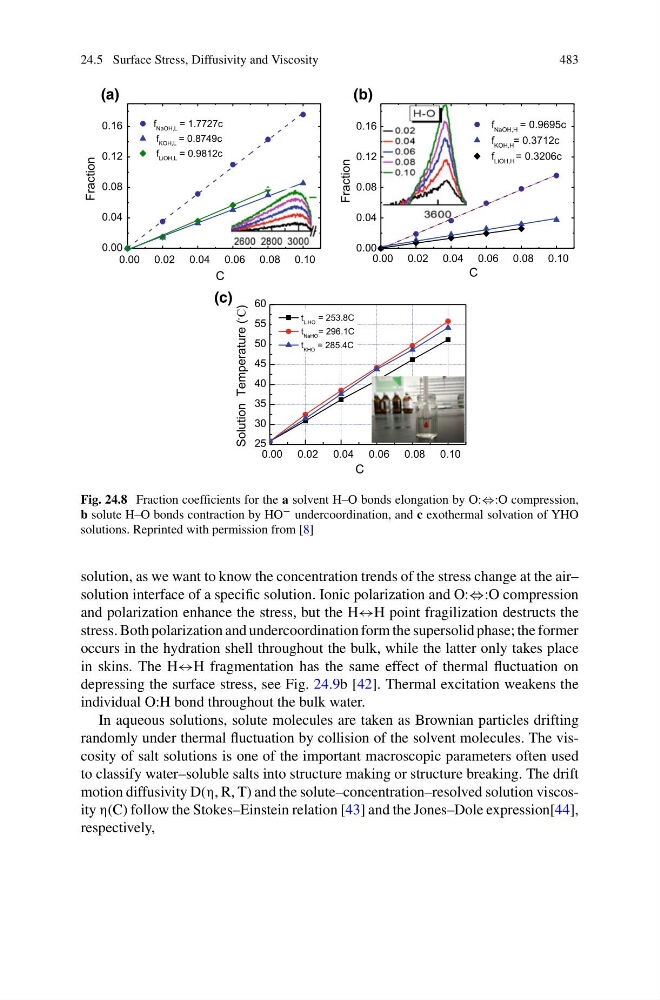
Fig. 24.8 Fraction coefficients for the a solvent H–O bonds elongation by O:⇔:O compression,
b solute H–O bonds contraction by HO − undercoordination, and c exothermal solvation of YHO
solutions. Reprinted with permission from [8]
solution, as we want to know the concentration trends of the stress change at the air–
solution interface of a specific solution. Ionic polarization and O:⇔:O compression
and polarization enhance the stress, but the H↔H point fragilization destructs the
stress. Both polarization and undercoordination form the supersolid phase; the former
occurs in the hydration shell throughout the bulk, while the latter only takes place
in skins. The H↔H fragmentation has the same effect of thermal fluctuation on
depressing the surface stress, see Fig. 24.9b [42]. Thermal excitation weakens the
individual O:H bond throughout the bulk water.
In aqueous solutions, solute molecules are taken as Brownian particles drifting
randomly under thermal fluctuation by collision of the solvent molecules. The viscosity of salt solutions is one of the important macroscopic parameters often used
to classify water–soluble salts into structure making or structure breaking. The drift
motion diffusivity D(η, R, T) and the solute–concentration–resolved solution viscosity η(C) follow the Stokes–Einstein relation [43] and the Jones–Dole expression[44],
respectively,
483
0.00 0.02 0.04 0.06 0.08 0.10
0.00
0.04
0.08
0.12
0.16
Fraction
C
f NaOH,L = 1.7727c
f KOH,L = 0.8749c
f LiOH,L = 0.9812c
f NaOH,H = 0.9695c
f KOH,H = 0.3712c
f LiOH,H = 0.3206c
0.00 0.02 0.04 0.06 0.08 0.10
0.00
0.04
0.08
0.12
0.16
Fraction
C
0.00 0.02 0.04 0.06 0.08 0.10
25
30
35
40
45
50
55
60
Solution Temperature ( °
C)
C
t LiHO = 253.8C
t NaHO = 296.1C
t KHO = 285.4C
(a)
(c)
(b)
Fig. 24.8 Fraction coefficients for the a solvent H–O bonds elongation by O:⇔:O compression,
b solute H–O bonds contraction by HO − undercoordination, and c exothermal solvation of YHO
solutions. Reprinted with permission from [8]
solution, as we want to know the concentration trends of the stress change at the air–
solution interface of a specific solution. Ionic polarization and O:⇔:O compression
and polarization enhance the stress, but the H↔H point fragilization destructs the
stress. Both polarization and undercoordination form the supersolid phase; the former
occurs in the hydration shell throughout the bulk, while the latter only takes place
in skins. The H↔H fragmentation has the same effect of thermal fluctuation on
depressing the surface stress, see Fig. 24.9b [42]. Thermal excitation weakens the
individual O:H bond throughout the bulk water.
In aqueous solutions, solute molecules are taken as Brownian particles drifting
randomly under thermal fluctuation by collision of the solvent molecules. The viscosity of salt solutions is one of the important macroscopic parameters often used
to classify water–soluble salts into structure making or structure breaking. The drift
motion diffusivity D(η, R, T) and the solute–concentration–resolved solution viscosity η(C) follow the Stokes–Einstein relation [43] and the Jones–Dole expression[44],
respectively,