

482
24 Water and Aqueous Solutions
0.0
0.1
0.2
0.3
f KCl (0.3382, 0.1367)
f HCl = f Cl (0.0671, 0.0478)
f KCl -f HCl = f K (3.2226, 2.6739)
Fraction
0.0
0.1
0.2
0.3
f NaBr (0.8070, 0.2558)
f HBr = f H (0.1020, 0.0385)
f NaBr -f HBr = f Na (-0.1400, -0.1190)
Fraction
C
0.00
0.02
0.04
0.06
0.08
0.00
0.02
0.04
0.06
0.08
0.00
0.02
0.04
0.06
0.08
0.10
0.0
0.1
0.2
0.3
A
(0.44411, 0.1013)
(0.1652, 0.0529)
f NaI
f HI ~ f I
f NaI - f HI ~ f Na
Fraction
C
C
(0.4958, 0.2869)
f = a[1-exp(-C/C 0 )]; (a, C 0 )
(a)
(b)
(c)
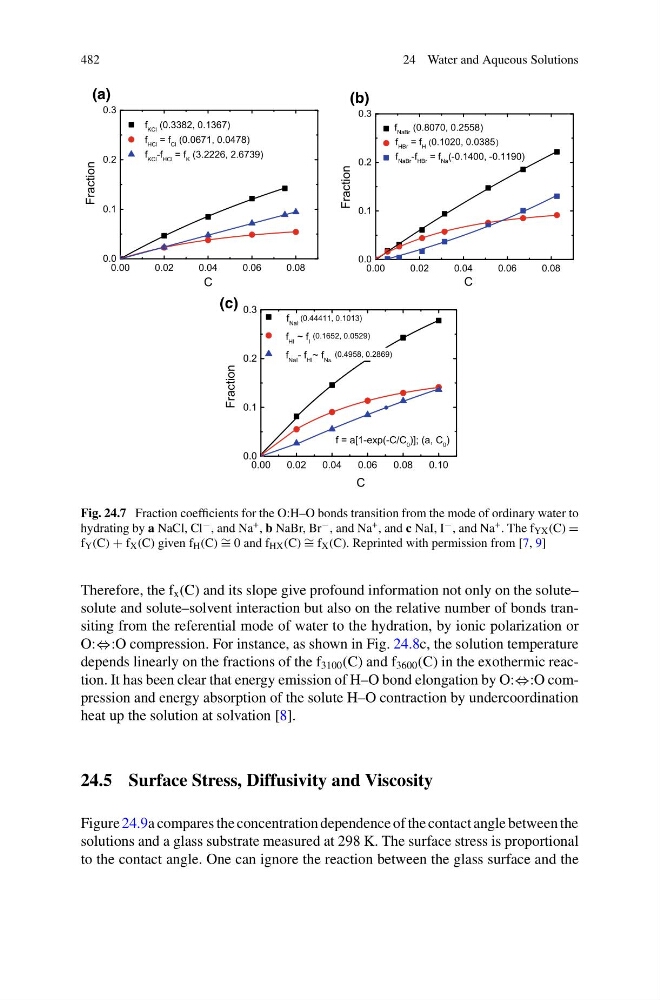
Fig. 24.7 Fraction coefficients for the O:H–O bonds transition from the mode of ordinary water to
hydrating by a NaCl, Cl − , and Na + , b NaBr, Br − , and Na + , and c NaI, I − , and Na + . The f YX (C) =
f Y (C) + f X (C) given f H (C) ∼ = 0 and f HX (C) ∼ = f X (C). Reprinted with permission from [7, 9]
Therefore, the f x (C) and its slope give profound information not only on the solute–
solute and solute–solvent interaction but also on the relative number of bonds transiting from the referential mode of water to the hydration, by ionic polarization or
O:⇔:O compression. For instance, as shown in Fig. 24.8c, the solution temperature
depends linearly on the fractions of the f 3100 (C) and f 3600 (C) in the exothermic reaction. It has been clear that energy emission of H–O bond elongation by O:⇔:O compression and energy absorption of the solute H–O contraction by undercoordination
heat up the solution at solvation [8].
24.5 Surface Stress, Diffusivity and Viscosity
Figure 24.9a compares the concentration dependence of the contact angle between the
solutions and a glass substrate measured at 298 K. The surface stress is proportional
to the contact angle. One can ignore the reaction between the glass surface and the
24 Water and Aqueous Solutions
0.0
0.1
0.2
0.3
f KCl (0.3382, 0.1367)
f HCl = f Cl (0.0671, 0.0478)
f KCl -f HCl = f K (3.2226, 2.6739)
Fraction
0.0
0.1
0.2
0.3
f NaBr (0.8070, 0.2558)
f HBr = f H (0.1020, 0.0385)
f NaBr -f HBr = f Na (-0.1400, -0.1190)
Fraction
C
0.00
0.02
0.04
0.06
0.08
0.00
0.02
0.04
0.06
0.08
0.00
0.02
0.04
0.06
0.08
0.10
0.0
0.1
0.2
0.3
A
(0.44411, 0.1013)
(0.1652, 0.0529)
f NaI
f HI ~ f I
f NaI - f HI ~ f Na
Fraction
C
C
(0.4958, 0.2869)
f = a[1-exp(-C/C 0 )]; (a, C 0 )
(a)
(b)
(c)
Fig. 24.7 Fraction coefficients for the O:H–O bonds transition from the mode of ordinary water to
hydrating by a NaCl, Cl − , and Na + , b NaBr, Br − , and Na + , and c NaI, I − , and Na + . The f YX (C) =
f Y (C) + f X (C) given f H (C) ∼ = 0 and f HX (C) ∼ = f X (C). Reprinted with permission from [7, 9]
Therefore, the f x (C) and its slope give profound information not only on the solute–
solute and solute–solvent interaction but also on the relative number of bonds transiting from the referential mode of water to the hydration, by ionic polarization or
O:⇔:O compression. For instance, as shown in Fig. 24.8c, the solution temperature
depends linearly on the fractions of the f 3100 (C) and f 3600 (C) in the exothermic reaction. It has been clear that energy emission of H–O bond elongation by O:⇔:O compression and energy absorption of the solute H–O contraction by undercoordination
heat up the solution at solvation [8].
24.5 Surface Stress, Diffusivity and Viscosity
Figure 24.9a compares the concentration dependence of the contact angle between the
solutions and a glass substrate measured at 298 K. The surface stress is proportional
to the contact angle. One can ignore the reaction between the glass surface and the