

23.3 Bulk Crystals: Compression and Thermal Excitation
459
Table 23.5 Melting temperature (T m ), Debye temperature (θ D ), and the thermal expansion
coefficient α(T ) for group III-N bulk crystals. The intrinsic Raman frequency at ω(1) is extrapolated
from experimental data to 0 K. The fitting results, that is the mode cohesive energy at 0 K, E coh (0),
of various Raman active modes [75, 76]
T m (K) θ D (K) α [64]
(Ref)
Raman
mode
ω(1)
(cm −1 )
E coh (0)
(eV)
σ (10 −4 )
AlN 3273
1150
[77]
E 2 (high)
658.6
1.13
0.94
A 1 (LO)
892.6
1.21
1.54
A 1 (TO)
613
0.71
1.74
E 1 (LO)
914.7
1.31
1.52
E 1 (TO)
671.6
1.19
1.04
GaN 2773
600
[78]
E 2 (high)
570.2
1.44
0.57
A 1 (LO)
738
0.97
1.20
A 1 (TO)
534
1.26
1.28
E 1 (LO)
745
0.95
0.68
E 1 (TO)
561.2
1.59
1.12
InN
1373
600
[79]
E 2 (high)
495.1
0.76
1.15
A 1 (LO)
595.8
0.50
0.92
Table 23.6 Parameters derived from theoretical reproduction of the size, pressure, and temperature
dependence of the bulk modulus and the Raman shift for TiO 2 [85] and ZnO [85, 90, 102]
Stimulus
Quantity
TiO 2 [80, 81, 96]
ZnO [90, 102]
T
Cohesive energy
E c = z b E 0 (eV/atom)
1.56
0.75
Debye temperature, θ D (K)
768 (778 [84])
310
P
Bulk modulus, B 0 /B 0 (GPa/-)
143/8.86 (167/- [103])
160/4.4
Compressibility, β/β
(GPa −1 /GPa −2 )
6.84×10 −3
(1.21 ± 0.05)×10 −4
6.55×10 −3
1.25×10 −4
Energy density, E den (eV/Å 3 )
0.182
0.097
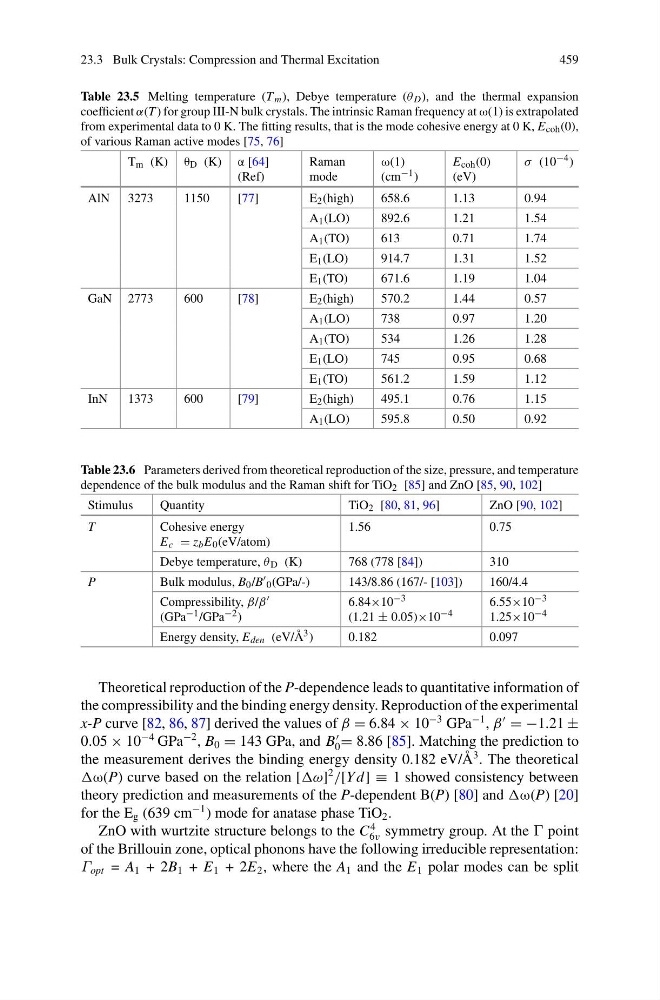
Theoretical reproduction of the P-dependence leads to quantitative information of
the compressibility and the binding energy density. Reproduction of the experimental
x-P curve [82, 86, 87] derived the values of β = 6.84 × 10
−3 GPa
−1 , β
= −1.21 ±
0.05 × 10
−4 GPa
−2 , B 0 = 143 GPa, and B
0 = 8.86 [85]. Matching the prediction to
the measurement derives the binding energy density 0.182 eV/Å
3 . The theoretical
ω(P) curve based on the relation [ω]
2
/[Y d] ≡ 1 showed consistency between
theory prediction and measurements of the P-dependent B(P) [80] and ω(P) [20]
for the E g (639 cm
−1 ) mode for anatase phase TiO 2 .
ZnO with wurtzite structure belongs to the C
4
6v symmetry group. At the G point
of the Brillouin zone, optical phonons have the following irreducible representation:
G opt = A 1 + 2B 1 + E 1 + 2E 2 , where the A 1 and the E 1 polar modes can be split
459
Table 23.5 Melting temperature (T m ), Debye temperature (θ D ), and the thermal expansion
coefficient α(T ) for group III-N bulk crystals. The intrinsic Raman frequency at ω(1) is extrapolated
from experimental data to 0 K. The fitting results, that is the mode cohesive energy at 0 K, E coh (0),
of various Raman active modes [75, 76]
T m (K) θ D (K) α [64]
(Ref)
Raman
mode
ω(1)
(cm −1 )
E coh (0)
(eV)
σ (10 −4 )
AlN 3273
1150
[77]
E 2 (high)
658.6
1.13
0.94
A 1 (LO)
892.6
1.21
1.54
A 1 (TO)
613
0.71
1.74
E 1 (LO)
914.7
1.31
1.52
E 1 (TO)
671.6
1.19
1.04
GaN 2773
600
[78]
E 2 (high)
570.2
1.44
0.57
A 1 (LO)
738
0.97
1.20
A 1 (TO)
534
1.26
1.28
E 1 (LO)
745
0.95
0.68
E 1 (TO)
561.2
1.59
1.12
InN
1373
600
[79]
E 2 (high)
495.1
0.76
1.15
A 1 (LO)
595.8
0.50
0.92
Table 23.6 Parameters derived from theoretical reproduction of the size, pressure, and temperature
dependence of the bulk modulus and the Raman shift for TiO 2 [85] and ZnO [85, 90, 102]
Stimulus
Quantity
TiO 2 [80, 81, 96]
ZnO [90, 102]
T
Cohesive energy
E c = z b E 0 (eV/atom)
1.56
0.75
Debye temperature, θ D (K)
768 (778 [84])
310
P
Bulk modulus, B 0 /B 0 (GPa/-)
143/8.86 (167/- [103])
160/4.4
Compressibility, β/β
(GPa −1 /GPa −2 )
6.84×10 −3
(1.21 ± 0.05)×10 −4
6.55×10 −3
1.25×10 −4
Energy density, E den (eV/Å 3 )
0.182
0.097
Theoretical reproduction of the P-dependence leads to quantitative information of
the compressibility and the binding energy density. Reproduction of the experimental
x-P curve [82, 86, 87] derived the values of β = 6.84 × 10
−3 GPa
−1 , β
= −1.21 ±
0.05 × 10
−4 GPa
−2 , B 0 = 143 GPa, and B
0 = 8.86 [85]. Matching the prediction to
the measurement derives the binding energy density 0.182 eV/Å
3 . The theoretical
ω(P) curve based on the relation [ω]
2
/[Y d] ≡ 1 showed consistency between
theory prediction and measurements of the P-dependent B(P) [80] and ω(P) [20]
for the E g (639 cm
−1 ) mode for anatase phase TiO 2 .
ZnO with wurtzite structure belongs to the C
4
6v symmetry group. At the G point
of the Brillouin zone, optical phonons have the following irreducible representation:
G opt = A 1 + 2B 1 + E 1 + 2E 2 , where the A 1 and the E 1 polar modes can be split