

23.2 Nanocrystals: Size and Thermal Effects
453
-40
-30
-20
-10
0
K
Δ(Δω)/Δω
InP
CeO 2
SnO 2 -1
SnO 2 -2
ZnO-1
ZnO-2
m=2.4,dot
m=4,dot
m=4,rod
(a)
0
10
20
30
40
50
60
5
1 0
1 5
2 0
2 5
-30
-25
-20
-15
-10
-5
(b)
K
Δ(Δω)/Δω
CdS 0.65 Se 0.35 -1
CdS 0.65 Se 0.35 -2
CdSe-1
CdSe-2
CdSe-3
CdSe-4
m=4,dot
m=4,rod
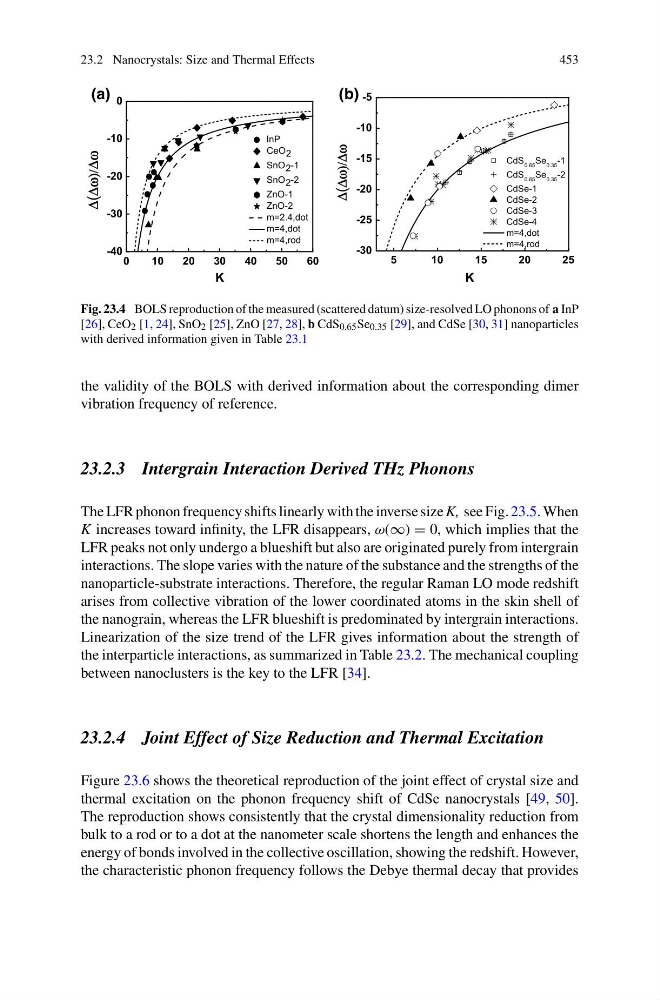
Fig. 23.4 BOLS reproduction of the measured (scattered datum) size-resolved LO phonons of a InP
[26], CeO 2 [1, 24], SnO 2 [25], ZnO [27, 28], b CdS 0.65 Se 0.35 [29], and CdSe [30, 31] nanoparticles
with derived information given in Table 23.1
the validity of the BOLS with derived information about the corresponding dimer
vibration frequency of reference.
23.2.3 Intergrain Interaction Derived THz Phonons
The LFR phonon frequency shifts linearly with the inverse size K, see Fig. 23.5. When
K increases toward infinity, the LFR disappears, ω(∞) = 0, which implies that the
LFR peaks not only undergo a blueshift but also are originated purely from intergrain
interactions. The slope varies with the nature of the substance and the strengths of the
nanoparticle-substrate interactions. Therefore, the regular Raman LO mode redshift
arises from collective vibration of the lower coordinated atoms in the skin shell of
the nanograin, whereas the LFR blueshift is predominated by intergrain interactions.
Linearization of the size trend of the LFR gives information about the strength of
the interparticle interactions, as summarized in Table 23.2. The mechanical coupling
between nanoclusters is the key to the LFR [34].
23.2.4 Joint Effect of Size Reduction and Thermal Excitation
Figure 23.6 shows the theoretical reproduction of the joint effect of crystal size and
thermal excitation on the phonon frequency shift of CdSe nanocrystals [49, 50].
The reproduction shows consistently that the crystal dimensionality reduction from
bulk to a rod or to a dot at the nanometer scale shortens the length and enhances the
energy of bonds involved in the collective oscillation, showing the redshift. However,
the characteristic phonon frequency follows the Debye thermal decay that provides
453
-40
-30
-20
-10
0
K
Δ(Δω)/Δω
InP
CeO 2
SnO 2 -1
SnO 2 -2
ZnO-1
ZnO-2
m=2.4,dot
m=4,dot
m=4,rod
(a)
0
10
20
30
40
50
60
5
1 0
1 5
2 0
2 5
-30
-25
-20
-15
-10
-5
(b)
K
Δ(Δω)/Δω
CdS 0.65 Se 0.35 -1
CdS 0.65 Se 0.35 -2
CdSe-1
CdSe-2
CdSe-3
CdSe-4
m=4,dot
m=4,rod
Fig. 23.4 BOLS reproduction of the measured (scattered datum) size-resolved LO phonons of a InP
[26], CeO 2 [1, 24], SnO 2 [25], ZnO [27, 28], b CdS 0.65 Se 0.35 [29], and CdSe [30, 31] nanoparticles
with derived information given in Table 23.1
the validity of the BOLS with derived information about the corresponding dimer
vibration frequency of reference.
23.2.3 Intergrain Interaction Derived THz Phonons
The LFR phonon frequency shifts linearly with the inverse size K, see Fig. 23.5. When
K increases toward infinity, the LFR disappears, ω(∞) = 0, which implies that the
LFR peaks not only undergo a blueshift but also are originated purely from intergrain
interactions. The slope varies with the nature of the substance and the strengths of the
nanoparticle-substrate interactions. Therefore, the regular Raman LO mode redshift
arises from collective vibration of the lower coordinated atoms in the skin shell of
the nanograin, whereas the LFR blueshift is predominated by intergrain interactions.
Linearization of the size trend of the LFR gives information about the strength of
the interparticle interactions, as summarized in Table 23.2. The mechanical coupling
between nanoclusters is the key to the LFR [34].
23.2.4 Joint Effect of Size Reduction and Thermal Excitation
Figure 23.6 shows the theoretical reproduction of the joint effect of crystal size and
thermal excitation on the phonon frequency shift of CdSe nanocrystals [49, 50].
The reproduction shows consistently that the crystal dimensionality reduction from
bulk to a rod or to a dot at the nanometer scale shortens the length and enhances the
energy of bonds involved in the collective oscillation, showing the redshift. However,
the characteristic phonon frequency follows the Debye thermal decay that provides