

454
23 Sized Crystals
0
10
20
30
(a)
Ag-a (SiO 2 )
Ag-b (SiO 2 )
Ag-c (Al 2 O 3 )
Δω (cm
-1
)
1/R (nm
-1 )
0
50
100
150
(b)
Si-a
Si-b
Si-c
Si-d
Si-e
Δω (cm
-1
)
1/R (nm
-1 )
0
20
40
60
(c)
1/R (nm
-1
)
Δω (cm
-1
)
TiO 2 -a
TiO 2 -b
SnO 2 -a
0
20
40
60
80
(d)
CdSe-a
CdSe-b
CdSe-c
1/R (nm
-1
)
Δω (cm
-1
)
0
10
20
30
40
50
(e)
1/R (nm
-1
)
Δω (cm
-1
)
CdS 0.65 Se 0.35 -a
CdS 0.65 Se 0.35 -b
0.0
0.5
1.0
1.5
0.0
0.5
1.0
1.5
0.0
0.2
0.4
0.6
0.0
0.2
0.4
0.6
0.0
0.1
0.2
0.3
0.4
0.0 0.1 0.2 0.3 0.4 0.5 0.6
0
20
40
60
80
100
(f)
Δω (cm
-1
)
1/K
Theory breathing mode
Stretching
Data-1
Data-2
Data-3
Data-4
Data-5
Data-6
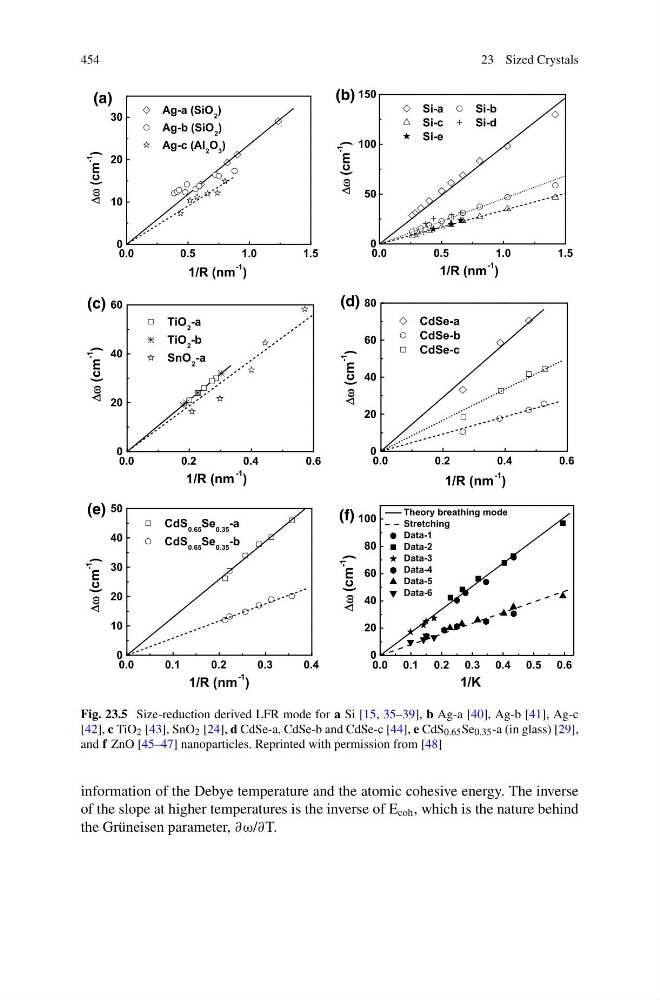
Fig. 23.5 Size-reduction derived LFR mode for a Si [15, 35–39], b Ag-a [40], Ag-b [41], Ag-c
[42], c TiO 2 [43], SnO 2 [24], d CdSe-a, CdSe-b and CdSe-c [44], e CdS 0.65 Se 0.35 -a (in glass) [29],
and f ZnO [45–47] nanoparticles. Reprinted with permission from [48]
information of the Debye temperature and the atomic cohesive energy. The inverse
of the slope at higher temperatures is the inverse of E coh , which is the nature behind
the Grüneisen parameter, ∂ω/∂T.
23 Sized Crystals
0
10
20
30
(a)
Ag-a (SiO 2 )
Ag-b (SiO 2 )
Ag-c (Al 2 O 3 )
Δω (cm
-1
)
1/R (nm
-1 )
0
50
100
150
(b)
Si-a
Si-b
Si-c
Si-d
Si-e
Δω (cm
-1
)
1/R (nm
-1 )
0
20
40
60
(c)
1/R (nm
-1
)
Δω (cm
-1
)
TiO 2 -a
TiO 2 -b
SnO 2 -a
0
20
40
60
80
(d)
CdSe-a
CdSe-b
CdSe-c
1/R (nm
-1
)
Δω (cm
-1
)
0
10
20
30
40
50
(e)
1/R (nm
-1
)
Δω (cm
-1
)
CdS 0.65 Se 0.35 -a
CdS 0.65 Se 0.35 -b
0.0
0.5
1.0
1.5
0.0
0.5
1.0
1.5
0.0
0.2
0.4
0.6
0.0
0.2
0.4
0.6
0.0
0.1
0.2
0.3
0.4
0.0 0.1 0.2 0.3 0.4 0.5 0.6
0
20
40
60
80
100
(f)
Δω (cm
-1
)
1/K
Theory breathing mode
Stretching
Data-1
Data-2
Data-3
Data-4
Data-5
Data-6
Fig. 23.5 Size-reduction derived LFR mode for a Si [15, 35–39], b Ag-a [40], Ag-b [41], Ag-c
[42], c TiO 2 [43], SnO 2 [24], d CdSe-a, CdSe-b and CdSe-c [44], e CdS 0.65 Se 0.35 -a (in glass) [29],
and f ZnO [45–47] nanoparticles. Reprinted with permission from [48]
information of the Debye temperature and the atomic cohesive energy. The inverse
of the slope at higher temperatures is the inverse of E coh , which is the nature behind
the Grüneisen parameter, ∂ω/∂T.