

22.3 Numerical Reproduction of Phonon Relaxation
427
From the C 3v bond configuration shown as inset in Fig. 22.7a, and the derived
effective force constant κ = 6.283 N/m, one can estimate the force constant of the
single C–C bond in the monolayer graphene. One may define the C–C bond force
constant k 0 , the bonds labeled 1 and 3 are approximated as in parallel and the resultant
κ 13 = 2κ 0 . This resultant bond connects to bond 2 in series and therefore the resultant
force constant of the three bonds is κ 123 = 2κ 0 /3. Hence, the C–C bond force constant
κ 0 ≈ 9.424 N/m. Likewise, the force constant κ per M–X bond is derived as κ 0 ≈
2.56 N/m.
22.3.3 Mechanical Compression and Thermal Excitation
22.3.3.1 Formulation
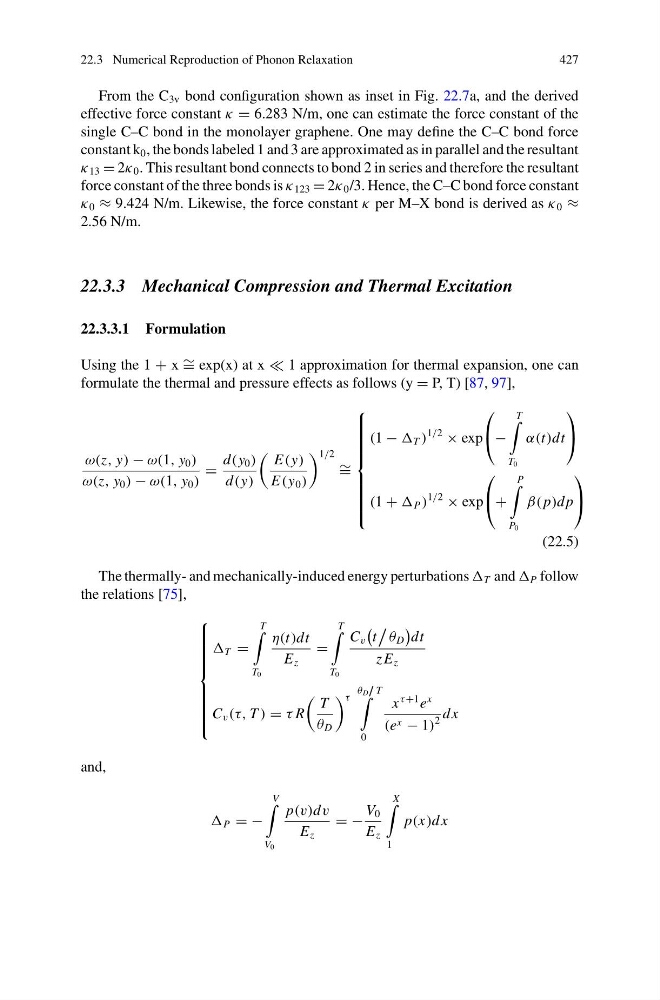
Using the 1 + x ∼ = exp(x) at x 1 approximation for thermal expansion, one can
formulate the thermal and pressure effects as follows (y = P, T) [87, 97],
ω(z, y) − ω(1, y 0 )
ω(z, y 0 ) − ω(1, y 0 )
=
d(y 0 )
d(y)
E(y)
E(y 0 )
1/2 ∼ =
⎧
⎪ ⎪ ⎪ ⎪ ⎪ ⎪ ⎪ ⎨
⎪ ⎪ ⎪ ⎪ ⎪ ⎪ ⎪ ⎩
(1 − T )
1/2
× exp
⎛
⎝ −
T
T 0
α(t)dt
⎞
⎠
(1 + P )
1/2
× exp
⎛
⎝ +
P
P 0
β( p)dp
⎞
⎠
(22.5)
The thermally- and mechanically-induced energy perturbations T and P follow
the relations [75],
⎧
⎪ ⎪ ⎪ ⎪ ⎪ ⎪ ⎪ ⎨
⎪ ⎪ ⎪ ⎪ ⎪ ⎪ ⎪ ⎩
T =
T
T 0
η(t)dt
E z
=
T
T 0
C v
t
θ D
dt
z E z
C v (τ, T ) = τ R
T
θ D
τ
θ D / T
0
x
τ +1 e
x
(e x − 1)
2
dx
and,
P = −
V
V 0
p(v)dv
E z
= −
V 0
E z
X
1
p(x)dx
427
From the C 3v bond configuration shown as inset in Fig. 22.7a, and the derived
effective force constant κ = 6.283 N/m, one can estimate the force constant of the
single C–C bond in the monolayer graphene. One may define the C–C bond force
constant k 0 , the bonds labeled 1 and 3 are approximated as in parallel and the resultant
κ 13 = 2κ 0 . This resultant bond connects to bond 2 in series and therefore the resultant
force constant of the three bonds is κ 123 = 2κ 0 /3. Hence, the C–C bond force constant
κ 0 ≈ 9.424 N/m. Likewise, the force constant κ per M–X bond is derived as κ 0 ≈
2.56 N/m.
22.3.3 Mechanical Compression and Thermal Excitation
22.3.3.1 Formulation
Using the 1 + x ∼ = exp(x) at x 1 approximation for thermal expansion, one can
formulate the thermal and pressure effects as follows (y = P, T) [87, 97],
ω(z, y) − ω(1, y 0 )
ω(z, y 0 ) − ω(1, y 0 )
=
d(y 0 )
d(y)
E(y)
E(y 0 )
1/2 ∼ =
⎧
⎪ ⎪ ⎪ ⎪ ⎪ ⎪ ⎪ ⎨
⎪ ⎪ ⎪ ⎪ ⎪ ⎪ ⎪ ⎩
(1 − T )
1/2
× exp
⎛
⎝ −
T
T 0
α(t)dt
⎞
⎠
(1 + P )
1/2
× exp
⎛
⎝ +
P
P 0
β( p)dp
⎞
⎠
(22.5)
The thermally- and mechanically-induced energy perturbations T and P follow
the relations [75],
⎧
⎪ ⎪ ⎪ ⎪ ⎪ ⎪ ⎪ ⎨
⎪ ⎪ ⎪ ⎪ ⎪ ⎪ ⎪ ⎩
T =
T
T 0
η(t)dt
E z
=
T
T 0
C v
t
θ D
dt
z E z
C v (τ, T ) = τ R
T
θ D
τ
θ D / T
0
x
τ +1 e
x
(e x − 1)
2
dx
and,
P = −
V
V 0
p(v)dv
E z
= −
V 0
E z
X
1
p(x)dx