

428
22 Layered Structures
=
P
P 0
v( p)dp −
VP
(VP) 0
d( pv)
E den
With,
p(x) =
3B 0
2
x
−7/3
− x
−5/3
×
1 + 3 (B
0 −4)(x
−2/3 −1)
4
(B − M)
x( p) = 1 − β P + β
P
2
(Polynominal)
(22.6)
The T is the integral of the specific heat reduced by the bond energy in a τdimensional Debye approximation. When the measuring temperature T is higher
than θ D , the two-dimensional specific heat C v converges a constant of τR (R is
the idea gas constant). The atomic cohesive energy E coh = zE z and the θ D are the
uniquely adjustable parameters in calculating the T . The P is calculated based on
the integral of the Birch-Mürnaghan equation [98, 99]. V 0 is the volume of a bond
without compression.
The variables in P are the binding energy density E den = E z /V 0 and the compressibility β and its first derivative, β
. The x(P) is another form of the equation of
states, which can be derived from the BM equation to obtain the nonlinear compressibility. Matching the BM equation to the measured x(P) curve, one can derive the
nonlinear compressibility β and β
, the bulk modulus B 0 (βB 0 ∼ = 1) and its first-order
differentiation B
0 . Substituting the integrals (22.6) into (22.5), one can reproduce
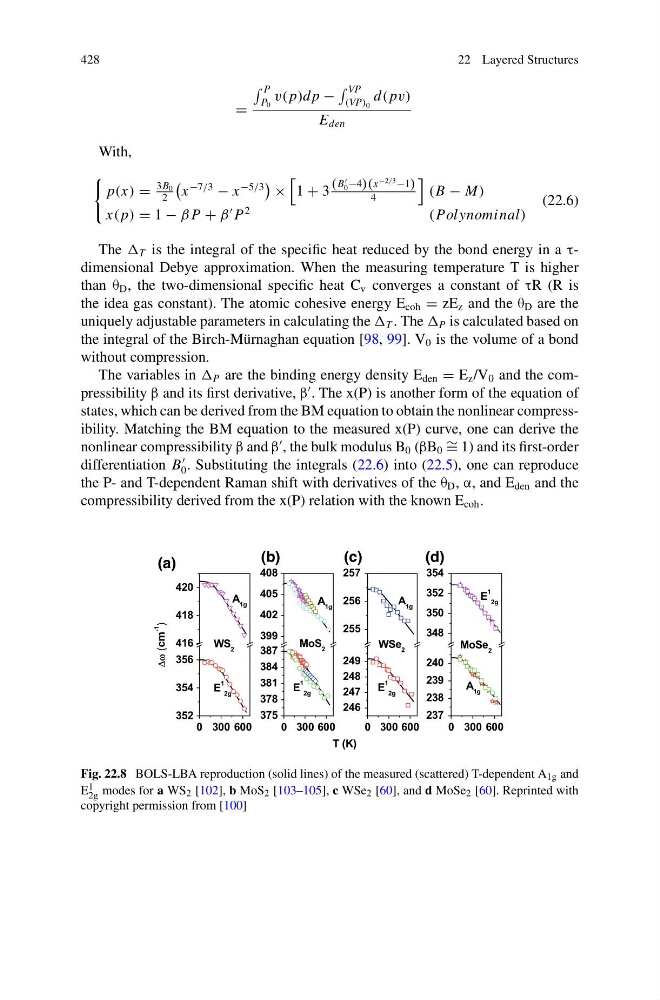
the P- and T-dependent Raman shift with derivatives of the θ D , α, and E den and the
compressibility derived from the x(P) relation with the known E coh .
352
354
356
416
418
420
E
1
2g
A 1g
WS 2
(cm
-1
)
375
378
381
384
387
399
402
405
408
A 1g
E
1
2g
T (K)
MoS 2
246
247
248
249
255
256
257
A 1g
E
1
2g
WSe 2
0 300 600
0 300 600
0 300 600
0 300 600
237
238
239
240
348
350
352
354
E
1
2g
MoSe 2
A 1g
(a)
(b)
(c)
(d)
Fig. 22.8 BOLS-LBA reproduction (solid lines) of the measured (scattered) T-dependent A 1g and
E 1
2g modes for a WS 2 [102], b MoS 2 [103–105], c WSe 2 [60], and d MoSe 2 [60]. Reprinted with
copyright permission from [100]
22 Layered Structures
=
P
P 0
v( p)dp −
VP
(VP) 0
d( pv)
E den
With,
p(x) =
3B 0
2
x
−7/3
− x
−5/3
×
1 + 3 (B
0 −4)(x
−2/3 −1)
4
(B − M)
x( p) = 1 − β P + β
P
2
(Polynominal)
(22.6)
The T is the integral of the specific heat reduced by the bond energy in a τdimensional Debye approximation. When the measuring temperature T is higher
than θ D , the two-dimensional specific heat C v converges a constant of τR (R is
the idea gas constant). The atomic cohesive energy E coh = zE z and the θ D are the
uniquely adjustable parameters in calculating the T . The P is calculated based on
the integral of the Birch-Mürnaghan equation [98, 99]. V 0 is the volume of a bond
without compression.
The variables in P are the binding energy density E den = E z /V 0 and the compressibility β and its first derivative, β
. The x(P) is another form of the equation of
states, which can be derived from the BM equation to obtain the nonlinear compressibility. Matching the BM equation to the measured x(P) curve, one can derive the
nonlinear compressibility β and β
, the bulk modulus B 0 (βB 0 ∼ = 1) and its first-order
differentiation B
0 . Substituting the integrals (22.6) into (22.5), one can reproduce
the P- and T-dependent Raman shift with derivatives of the θ D , α, and E den and the
compressibility derived from the x(P) relation with the known E coh .
352
354
356
416
418
420
E
1
2g
A 1g
WS 2
(cm
-1
)
375
378
381
384
387
399
402
405
408
A 1g
E
1
2g
T (K)
MoS 2
246
247
248
249
255
256
257
A 1g
E
1
2g
WSe 2
0 300 600
0 300 600
0 300 600
0 300 600
237
238
239
240
348
350
352
354
E
1
2g
MoSe 2
A 1g
(a)
(b)
(c)
(d)
Fig. 22.8 BOLS-LBA reproduction (solid lines) of the measured (scattered) T-dependent A 1g and
E 1
2g modes for a WS 2 [102], b MoS 2 [103–105], c WSe 2 [60], and d MoSe 2 [60]. Reprinted with
copyright permission from [100]