

21.4 Formulation of Multifield Perturbation
407
0.00 0.25 0.50 0.75 1.00 1.25 1.50
0.0
0.2
0.4
0.6
0.8
1.0
1-U(T)/E
b
(0)
T/ D
0
5
10
15
20
25
0.90
0.92
0.94
0.96
0.98
1.00
V/V
0
P (GPa)
(VP)
(a)
(b)
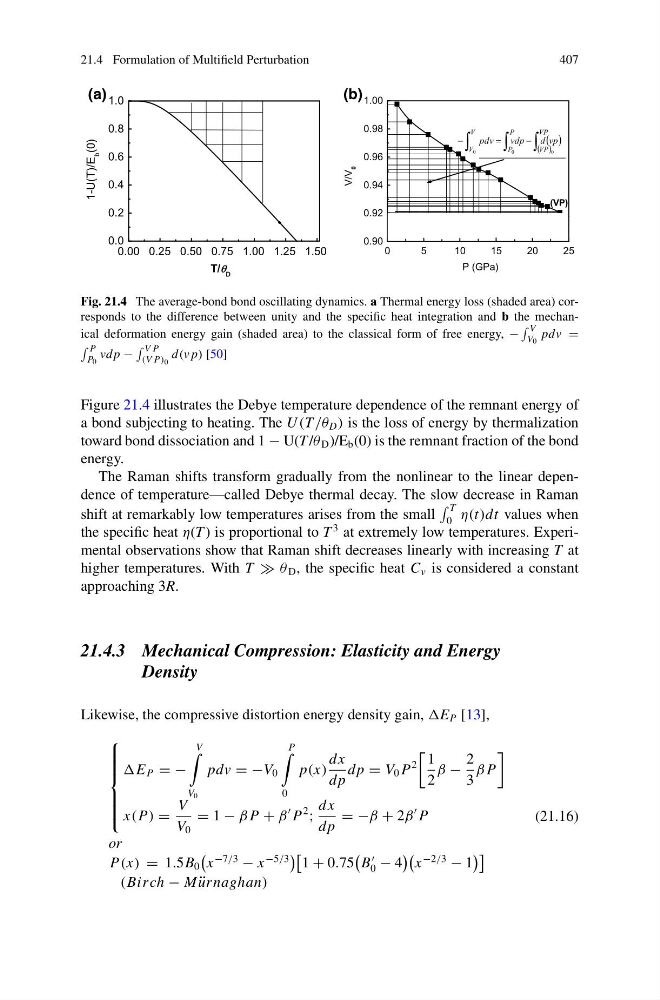
Fig. 21.4 The average-bond bond oscillating dynamics. a Thermal energy loss (shaded area) corresponds to the difference between unity and the specific heat integration and b the mechanical deformation energy gain (shaded area) to the classical form of free energy, −
V
V0 pdv =
P
P0 vdp −
V P
(V P) 0
d(v p) [50]
Figure 21.4 illustrates the Debye temperature dependence of the remnant energy of
a bond subjecting to heating. The U (T /θ D ) is the loss of energy by thermalization
toward bond dissociation and 1 − U(T /θ D )/E b (0) is the remnant fraction of the bond
energy.
The Raman shifts transform gradually from the nonlinear to the linear dependence of temperature—called Debye thermal decay. The slow decrease in Raman
shift at remarkably low temperatures arises from the small
T
0 η(t)dt values when
the specific heat η(T ) is proportional to T
3 at extremely low temperatures. Experimental observations show that Raman shift decreases linearly with increasing T at
higher temperatures. With T θ D , the specific heat C v is considered a constant
approaching 3R.
21.4.3 Mechanical Compression: Elasticity and Energy
Density
Likewise, the compressive distortion energy density gain, P [13],
⎧
⎪ ⎪ ⎪ ⎪ ⎨
⎪ ⎪ ⎪ ⎪ ⎩
P = −
V
V 0
pdv = −V 0
P
0
p(x)
dx
dp
dp = V 0 P
2
1
2
β −
2
3
β P
x(P) =
V
V 0
= 1 − β P + β
P
2
;
dx
dp
= −β + 2β
P
or
P(x) = 1.5B 0
x
−7/3
− x
−5/3
1 + 0.75
B
0 − 4
x
−2/3
− 1
(Birch − M ¨
urnaghan)
(21.16)
407
0.00 0.25 0.50 0.75 1.00 1.25 1.50
0.0
0.2
0.4
0.6
0.8
1.0
1-U(T)/E
b
(0)
T/ D
0
5
10
15
20
25
0.90
0.92
0.94
0.96
0.98
1.00
V/V
0
P (GPa)
(VP)
(a)
(b)
Fig. 21.4 The average-bond bond oscillating dynamics. a Thermal energy loss (shaded area) corresponds to the difference between unity and the specific heat integration and b the mechanical deformation energy gain (shaded area) to the classical form of free energy, −
V
V0 pdv =
P
P0 vdp −
V P
(V P) 0
d(v p) [50]
Figure 21.4 illustrates the Debye temperature dependence of the remnant energy of
a bond subjecting to heating. The U (T /θ D ) is the loss of energy by thermalization
toward bond dissociation and 1 − U(T /θ D )/E b (0) is the remnant fraction of the bond
energy.
The Raman shifts transform gradually from the nonlinear to the linear dependence of temperature—called Debye thermal decay. The slow decrease in Raman
shift at remarkably low temperatures arises from the small
T
0 η(t)dt values when
the specific heat η(T ) is proportional to T
3 at extremely low temperatures. Experimental observations show that Raman shift decreases linearly with increasing T at
higher temperatures. With T θ D , the specific heat C v is considered a constant
approaching 3R.
21.4.3 Mechanical Compression: Elasticity and Energy
Density
Likewise, the compressive distortion energy density gain, P [13],
⎧
⎪ ⎪ ⎪ ⎪ ⎨
⎪ ⎪ ⎪ ⎪ ⎩
P = −
V
V 0
pdv = −V 0
P
0
p(x)
dx
dp
dp = V 0 P
2
1
2
β −
2
3
β P
x(P) =
V
V 0
= 1 − β P + β
P
2
;
dx
dp
= −β + 2β
P
or
P(x) = 1.5B 0
x
−7/3
− x
−5/3
1 + 0.75
B
0 − 4
x
−2/3
− 1
(Birch − M ¨
urnaghan)
(21.16)